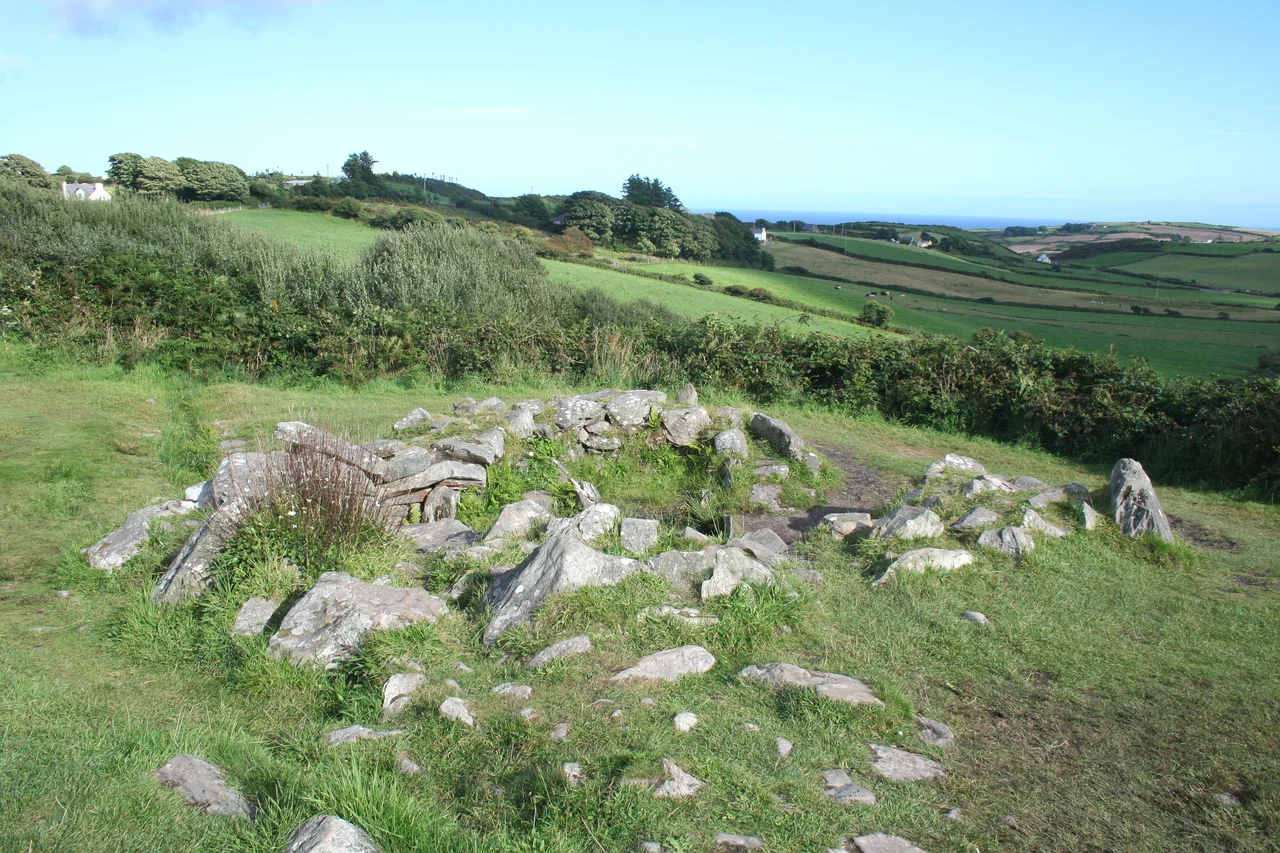

Drombeg Stone Circle
In 1957, when archaeologists excavated the central area of Drombeg stone circle, they found an inverted pot. Inside the pot were the cremated remains of a young adolescent, wrapped in thick cloth, mixed with sweepings from the funeral pyre. Smashed pottery sherds lay nearby. The radiocarbon dates put the circle's active use between 1100 and 800 BC - roughly three thousand years ago, when these stones were already being shaped and set into the ground above a small Cork valley. The circle is small, only 9.3 metres across. Locals call it The Druid's Altar. The druids came later. The grief is older.
Seventeen Stones
The circle originally consisted of seventeen closely spaced stones of local sandstone. Thirteen survive. Two of them, on the northeast side, stand 1.8 metres high - the entrance portals, taller than the rest. Directly opposite them, on the southwest, lies the longest stone in the circle: a recumbent, 1.9 metres long, set flat rather than upright. The two portal stones and the recumbent define an axis. That axis points southwest, toward the setting sun at midwinter solstice. This pattern - tall paired portals opposite a recumbent stone - is so common in West Cork and Kerry that archaeologists named it the 'Cork-Kerry type' axial stone circle. Drombeg is one of the most visited examples in Ireland, protected under the National Monuments Act, but it is not architecturally unusual. What is unusual is what survives intact around it.
The Carvings
The long recumbent stone has two egg-shaped cup-marks carved into its surface, one of them ringed. Cup-and-ring marks appear across Atlantic Europe in the Bronze Age, from Galicia to Scotland, their meaning still debated. The archaeologist Terence Meaden has suggested that a petroglyph on the northern side of one stone, about 200 millimetres long, depicts an erect phallus with two testicles. Another carving, 280 millimetres by 160 millimetres, on the upper surface of one of the recumbent stones - long identified as an 'axe-like outline' - he reads as vulvar. The two carvings, on this reading, may form a fertility pair. Both are prehistoric. Both have weathered three thousand winters of Atlantic rain. The interpretation will probably never be definitive. The marks themselves are not in doubt.
The Pot at the Centre
What sets Drombeg apart is not the architecture but what was buried in it. The excavation of 1957 - led by Edward Fahy from University College Cork - found, near the centre of the circle, the inverted urn containing the cremated remains. The bones were those of a young adolescent. The body had been wrapped in cloth before cremation. The urn had been deliberately inverted before burial, in the careful and intentional gesture that prehistoric mourners across Europe used to seal their dead. Around the urn lay sherds of broken pottery and the cleaned-out residue of the funeral pyre - a small ritual deposit at the heart of a monument that may have been built, in part, to mark this kind of grief. We do not know the child's name. We know they were loved enough that a community placed their ashes in a sacred place and aligned the stones to the setting sun above them.
Beside the Circle
About 40 metres to the west of the circle lie the remains of a small Bronze Age settlement: two round stone-walled huts and a fulacht fiadh - one of the curious horseshoe-shaped cooking mounds that dot the Irish landscape, characterised by a hearth, a well, and a stone-lined water trough that was filled and brought to boil with heated stones. The larger hut had a timber roof on posts. The smaller hut contains a cooking hearth on its eastern side. A causeway leads from the huts to the fulacht fiadh. Evidence suggests the fulacht was in use into approximately the 5th century AD - meaning people were still cooking here, fifteen hundred years after the circle was built, possibly long after its original meaning had been forgotten. The site is not just the circle. It is the circle plus the settlement plus the cooking place plus the burial, all within a few minutes' walk - a complete prehistoric landscape.
Why They Aligned It
Stand inside the circle at midwinter, around the 21st of December, and watch the sun setting. It drops directly along the axis of the monument, framed by the two portal stones, sinking toward the long recumbent altar. This is not a unique alignment among Bronze Age monuments - many across Atlantic Europe align to the solstices - but at Drombeg the geometry is precise enough that the alignment cannot be accidental. Why? The shortest day of the year mattered to people whose food supply depended on the sun's return. The monument may have served as a calendar, marking the moment after which days would lengthen again. It may have served as a place where the dead were brought into the cycle of the year - the adolescent's ashes lying close to the axis along which the year turned. The truth is that we do not fully know. The stones are still here. They still mark the day. That is enough to make the place feel inhabited, even now, by something patient and ancient.
From the Air
Drombeg stone circle sits at 51.5646 degrees north, 9.0870 degrees west, in a small hilltop field about 2.4 km east of Glandore village in West Cork. From the air, the circle is small - 9.3 metres across - and best seen at low altitude. Look for the level field above the road with the dark recumbent stone on its southwest side. The Atlantic coast is visible 1 km to the south. Cork Airport (EICK) is approximately 60 km east-northeast. Recommended viewing altitude 1,500-3,000 feet for the surrounding archaeological landscape, or as low as conditions allow for the stones themselves. Approach in clear weather - the site loses definition in low light, and the southwest alignment becomes invisible under cloud.
Nearby Stories
- Douglas 2.4 km away
- Macroom 5.5 km away
- Schull 8.2 km away
- Walter Siepmann 14 km away
- Killarney National Park 18 km away
- HMHS Llandovery Castle 29 km away
- Wolfpack Prien 72 km away
- SM U-27 101 km away