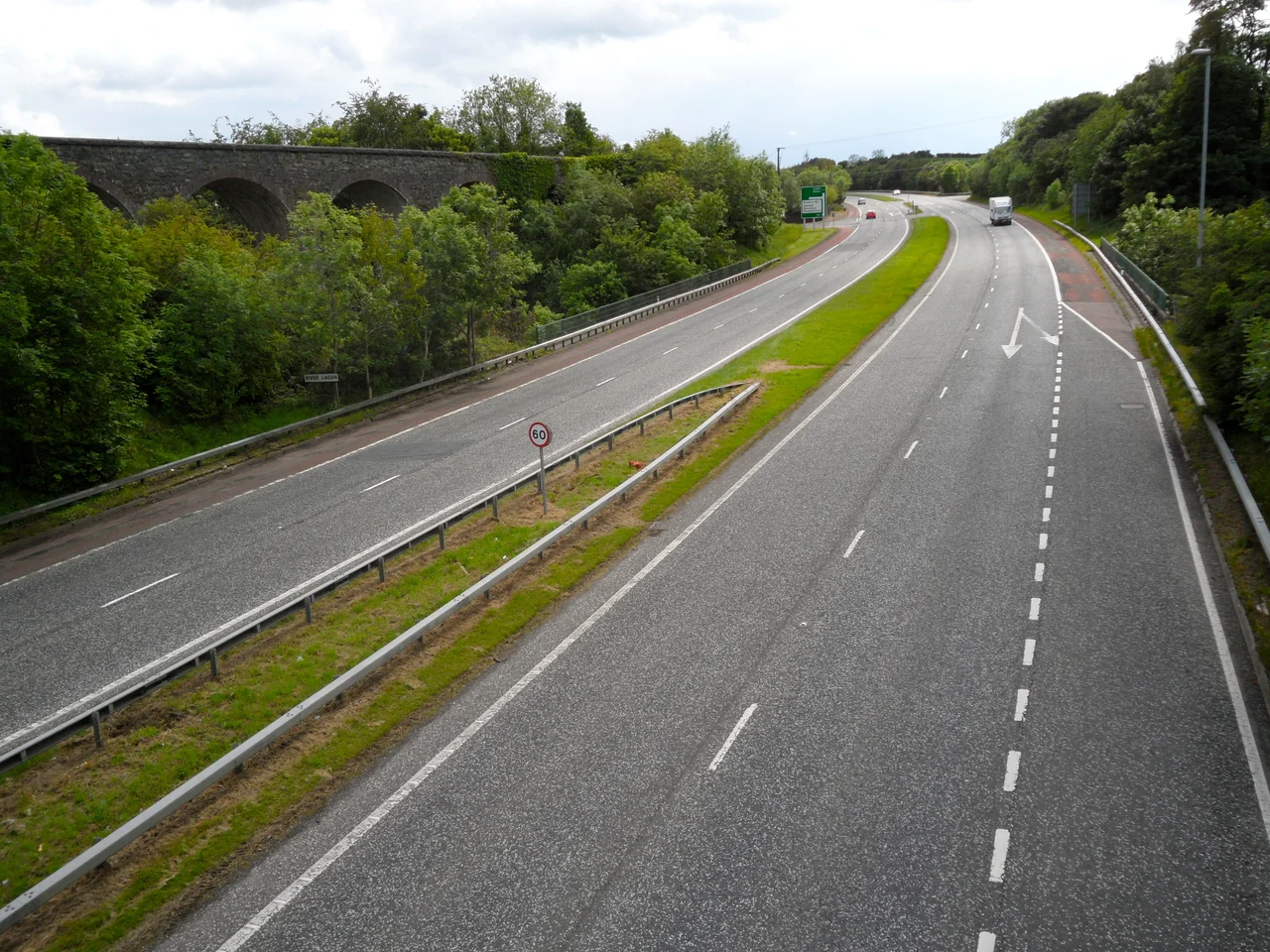

Dromore, County Down
There is a set of stocks in the Market Square at Dromore - the wooden frame in which, until well into the nineteenth century, public offenders were locked up by their ankles for the amusement and judgment of passers-by. Few towns in Ireland still have theirs. Dromore does. The square also has an eighteenth-century layout that is now legally protected, a town hall, and what one development plan described in 2003 as a quarter of its commercial units sitting vacant. The town has been on the main road between Belfast and Dublin for centuries, and was bypassed in 1972. It is the kind of small market town that has watched a lot of history go past without much help from anyone, and quietly absorbed what was left over.
Druim Mór
The Irish Druim Mór means "large ridge," and the town sits on one, above a curve of the River Lagan. St Colman established his monastery here in 510, and the diocese of Dromore grew up around it. After the Norman invasion of Ireland in the late twelfth century, the conquistador John de Courcy threw up a motte and bailey on the rise just east of the town centre - a great earthen mound topped with a wooden tower, now known locally as "the Mound," still standing and still impressive after eight hundred years. The Norman fort dominated the valley of the Lagan and gave Dromore its strategic identity for centuries. The Anglo-Normans held it until 1315, when Edward Bruce - brother of Robert the Bruce of Scotland - swept through County Down and burned the town as part of his short-lived attempt to make himself High King of Ireland.
Break of Dromore
On 14 March 1689, a Jacobite force commanded by Richard Hamilton met Williamite troops about a mile out of town on the Milebush Road. The battle that followed was short and one-sided. The Williamites, undertrained and outmaneuvered, broke and fled, leaving 400 dead on the field. The episode became known as the Break of Dromore. With the Williamites scattered, the Jacobite army marched north virtually unopposed, occupying Belfast within days. It would take Williamite reinforcements from England, and ultimately the Battle of the Boyne the following July, to reverse what happened on that muddy March morning outside Dromore. The town and the rebuilt cathedral had already been destroyed once before, in 1641; this was simply the next chapter in the same long argument.
The Bishop and the Ballads
Two famous bishops are buried in Dromore Cathedral. Jeremy Taylor (1613-1667), Bishop of Down and Connor and one of seventeenth-century England's most distinguished theologians, built the present cathedral in 1661 after the 1641 destruction. He had been chaplain to Charles I and was a friend of John Donne. His books Holy Living and Holy Dying are still in print. Thomas Percy (1729-1811), Bishop of Dromore from 1782, is buried in the aisle he added to the cathedral in the last year of his life. Percy is remembered today less for his episcopal work than for his Reliques of Ancient English Poetry (1765), which collected old English and Scottish ballads and helped trigger the Romantic-era revival of folk poetry. Walter Scott credited the Reliques as the inspiration for his own narrative verse.
The Man Who Made the Tractor Work
Harry Ferguson was born on a farm at Growell, just outside Dromore, on 4 November 1884. He left school at fourteen and went to work as an apprentice mechanic. By his early twenties he had built and flown the first aircraft to take off in Ireland. By his thirties he was redesigning the tractor. What Ferguson invented in the 1920s and 1930s - the three-point hitch and the hydraulic depth control system - solved the fundamental problem of farm mechanisation: how to stop tractors from flipping backwards when a plough hit a buried obstacle. The Ferguson System turned the tractor into the genuine workhorse of twentieth-century agriculture. The Ferguson TE20, manufactured from 1946, became one of the best-selling tractors in history. A Dromore boy effectively rewrote the engineering of farm work for the whole world.
The Years of the Bombs
Dromore was not spared during the Troubles. On 7 April 1976, the Provisional IRA carried out an incendiary bomb attack on a drapery shop on Market Square. William Herron, 64, his wife Elizabeth, 58, and their daughter Noleen, 26, all Protestant civilians, died in the fire that consumed the shop and the flat above where they lived. On 6 July 1988, Terence Delaney, 31, a Catholic civilian, was shot dead by the Ulster Freedom Fighters (a cover name for the Ulster Defence Association) while waiting for a lift to work. Two attacks, two communities, four civilians dead in a small town that had nothing to do with the political fight other than being a place where ordinary people happened to live.
The Doughnut Town
Dromore today has about 6,500 people, growing slowly as commuters move out from Belfast along the A1. The 2003 town centre development plan identified what planners call the doughnut effect: new housing on the edges, an emptied-out commercial core, residents driving to Banbridge or Sprucefield to do their shopping. The cathedral still stands. The Mound still stands. The eighteenth-century Market Square layout is protected. The rare set of stocks is still there. The cycling clubs that produced the Downey family - Seamus rode in the 1984 Olympics, his son Sean won a Commonwealth Games medal, his grandson Mark won UCI World Cup gold in 2016 - still meet for training rides. Dromore is exactly what most small Northern Irish market towns are: a place that has been many things, kept what it could, and watched the bypass take the through traffic away.
From the Air
Located at 54.41°N, 6.15°W in County Down, 19 miles southwest of Belfast on the A1 Belfast-Dublin road. Recommended viewing altitude 1,500-3,000 ft AGL to take in the town, the Norman motte (the Mound) to the east, the disused Dromore Viaduct on the old railway line, and the surrounding rolling country of mid-Down. Belfast International (EGAA) is about 18 nm north-northwest; Belfast City (EGAC) about 15 nm northeast. The Lagan Valley spreads to the north toward Lisburn. Best visibility on cool dry days when the river valley shows clearly against the surrounding farmland.
Nearby Stories
- Groomsport Lifeboat Station 1.1 km away
- Audleystown Court Tomb 3.5 km away
- Castleblayney 4.5 km away
- Lissan House 5.2 km away
- Castle Upton 5.6 km away
- Warrenpoint Ambush 8.9 km away
- Dungannon 12 km away
- Chicken Rock Lighthouse 53 km away