
Dwarfie Stane
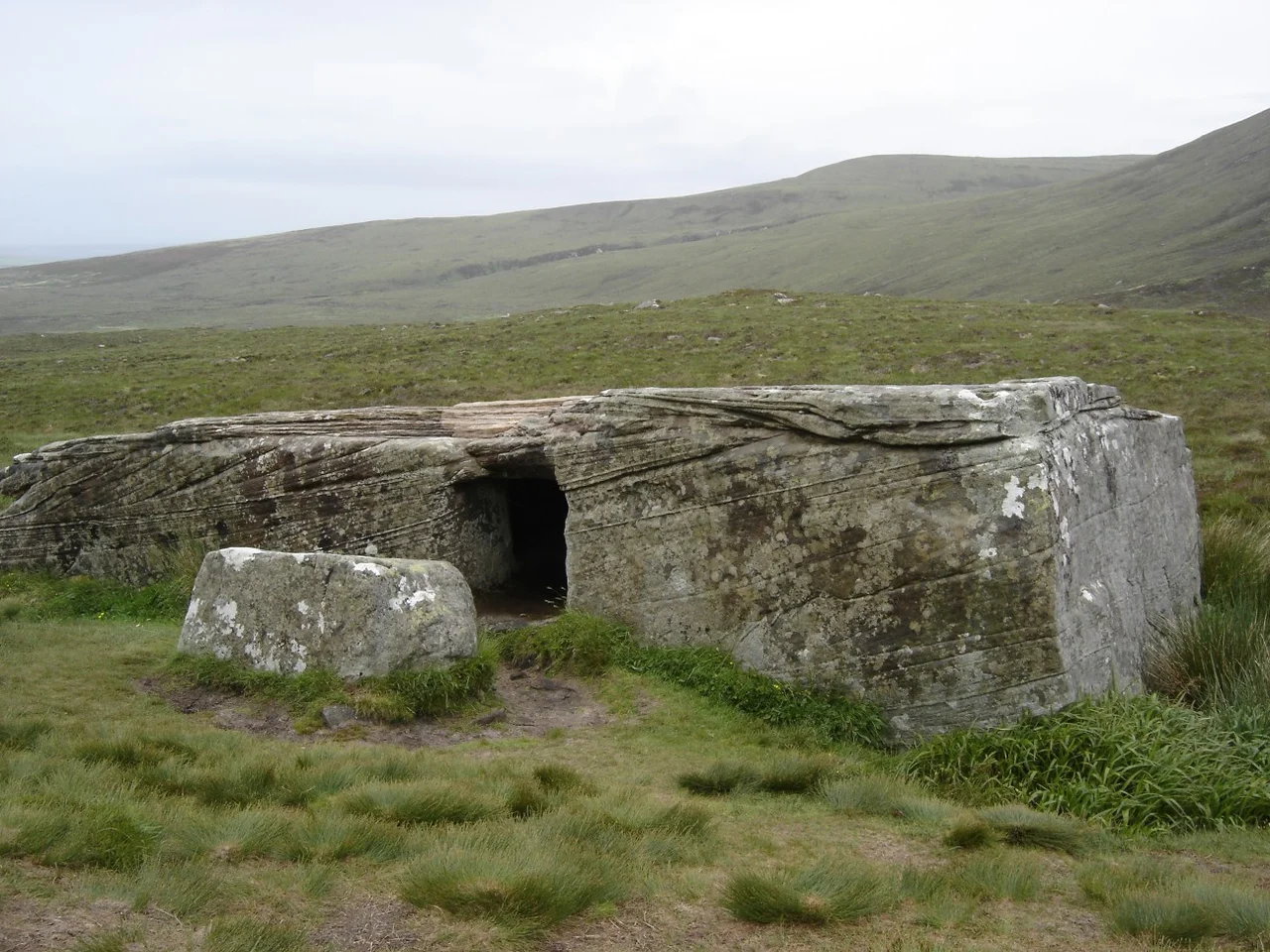
Someone, around 5,000 years ago, looked at an enormous block of sandstone lying on a peat moor on the island of Hoy and decided to hollow it out from the inside. Not pile stones around it. Not build a cairn over it. Carve into it. The work took weeks at least, more likely months, using antler picks and stone hammers on Old Red Sandstone that geologists have classified as extremely compact - meaning, in plain English, exceptionally hard. The result is the Dwarfie Stane: a passage 2.2 metres long opening onto two small side cells, the entire chamber cut from a single boulder. It is the only Neolithic rock-cut tomb known in Britain. There is nothing else like it in northern Europe.
A Boulder on the Moor
The stone itself is a glacial erratic - a block of Devonian Old Red Sandstone left here by the retreating ice tens of thousands of years before any human laid eyes on it. It measures 8.6 metres long by 4 metres wide by up to 2.5 metres high. It sits alone in a steep-sided U-shaped valley between Quoys and Rackwick on northwest Hoy, the slopes of Ward Hill rising to the east, the peatland brown and wet around it. A boardwalk now leads to it from the lane, and you can crouch and crawl inside. The entrance is a one-metre square cut from the west face. The passage runs straight in. Two side cells open off it, each about 1.7 metres by 1 metre. In the southern cell, the inner end is shaped into a kind of pillow - a slight rise of uncut rock left in place by whoever carved the chamber.
The Question of Why
Why anyone would choose this method - so much harder than the usual approach of stacking slabs into a cairn - is a question archaeologists have argued over for two centuries. The Dwarfie Stane bears a striking resemblance to Neolithic and Bronze Age rock-cut tombs around the Mediterranean. One theory is that the idea of rock-cut tombs spread north along the Atlantic coast, and Hoy's builders tried it once. The folklorist Hugh Miller, who was a working stonemason himself, was the first to point out that the Old Red Sandstone here is exceptionally compact - meaning the work would have been brutal even with metal tools, never mind the antler picks of the time. The archaeologist R. Castleden later suggested the experiment was "tried once and found to be unsatisfactory." Nobody built another.
The Hole in the Roof
Someone broke in through the top. The original entrance was sealed by a stone slab that now lies on the ground in front of the tomb, but at some unknown date, plunderers smashed through the roof to reach whatever was inside. By the sixteenth century the hole was already there - the antiquarian Jo Ben mentioned it in 1529. Historic Environment Scotland repaired the breach with concrete in the 1950s or 1960s, and the visible patch is still there. Whatever was originally placed inside the tomb - bones, grave goods, whatever the Neolithic farmers of Hoy chose to leave with their dead - was taken so long ago that no record survives.
Major Mounsey's Inscription
In 1850 a British army officer named Major William Mounsey carved an inscription into the rock above the entrance. It is in Persian calligraphy - Mounsey was a former spy and intelligence officer who had served in Afghanistan and Persia and was clearly proud of the languages he had learned. Translated, it reads: "I have sat two nights and so learned patience." He meant the midges. Above the Persian line, he carved his own name backwards in Latin - a little trick he liked. The graffiti is now itself protected as part of the monument's history. The midges, predictably, are still there. Anyone who has spent a still summer evening on Hoy can confirm that two nights would teach you patience, or possibly something else entirely.
From the Air
Located at 58.8847 N, 3.31278 W on the northwestern part of the island of Hoy. The Dwarfie Stane itself is small and easily missed from cruise altitude - a single dark block in the peatland of a glaciated U-shaped valley between Quoys to the north and Rackwick to the south. The boardwalk leading to it from the lane (visible as a thin line in the moorland) is the best aerial marker. Ward Hill (481 metres, the highest point in Orkney) rises immediately to the east, an unmistakeable bulk. Kirkwall Airport (ICAO: EGPA) lies 14 nautical miles northeast. The Old Man of Hoy sea stack is 4 nautical miles west on the cliffs - the great landmark of this corner of Orkney. Recommended cruise altitude 1,500-3,000 feet to take in the whole northern Hoy landscape including the valley, Ward Hill, and the western cliffs. Weather here is fickle - Hoy's hills draw cloud and drizzle even when Orkney Mainland is clear.
Nearby Stories
- HMS Sword Dance (1918) 9 km away
- Battle of Harpsdale 12 km away
- Copinsay 14 km away
- Broch of Gurness 16 km away
- Strathnaver Museum 20 km away
- HMS King Edward VII 21 km away
- Fair Isle 85 km away
- The Laki Eruption: The Volcano That Changed World History 939 km away