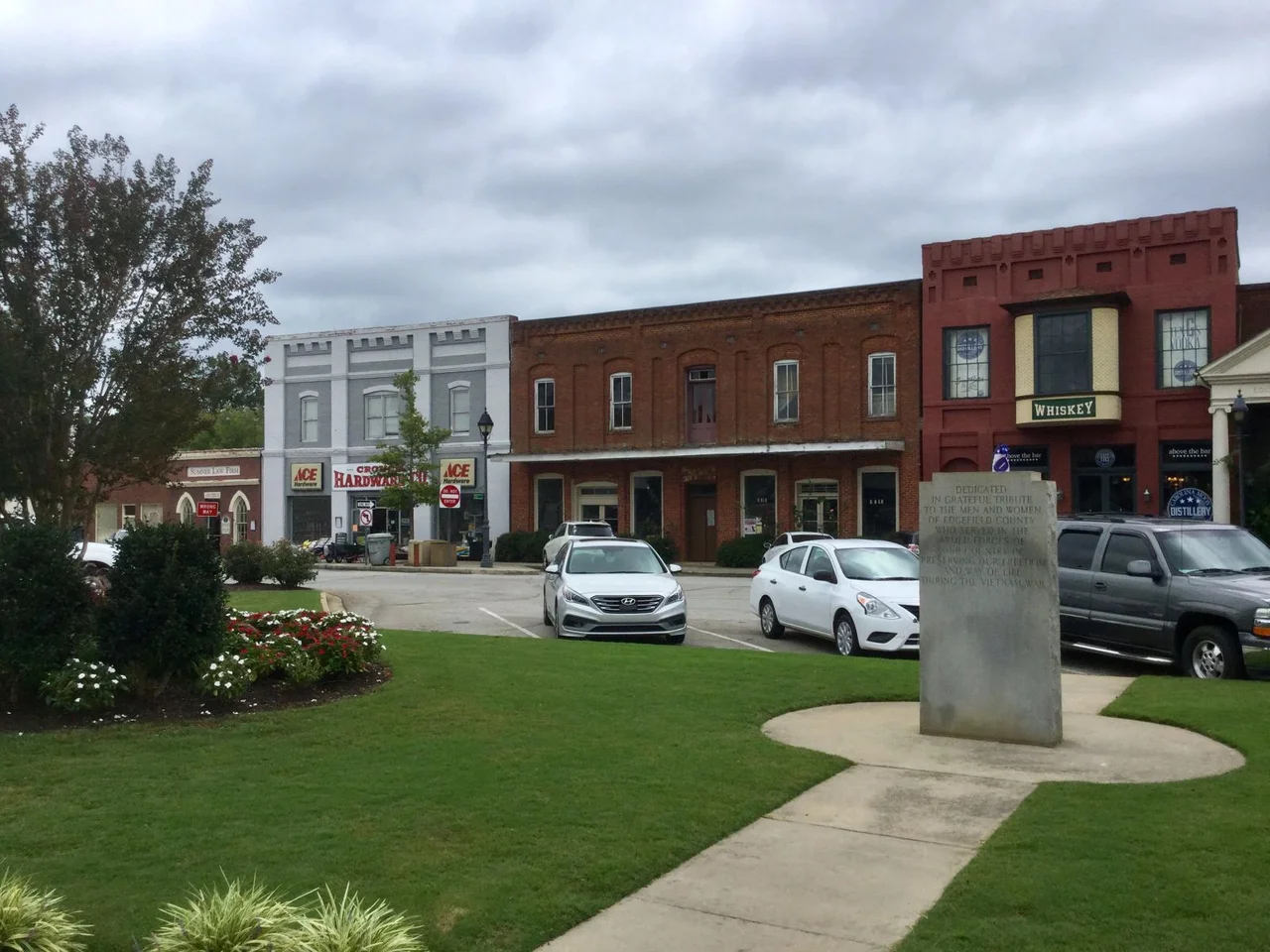

Edgefield, South Carolina
Dave Drake threw forty-gallon stoneware jars from local Edgefield clay and signed them. He was enslaved. He had taught himself to read and write in a state that made teaching enslaved people to read a crime, and he incised rhyming couplets into the wet clay before firing - "Dave belongs to Mr. Miles / wher the oven bakes & the pot biles," one reads. He made them between roughly 1830 and 1870. Today his work hangs in the Metropolitan Museum, and curators speak of him as one of the most important American artists of the nineteenth century. He did it in a town the historical signs warn was always known "for violence and scandal."
Dave the Potter
The pottery that made Edgefield internationally important was alkaline-glazed stoneware, a tradition developed in the early 1800s by Dr. Abner Landrum, who exploited the rich clay deposits in the area. Enslaved potters did much of the work, almost all anonymously. David Drake (c. 1800-1879) is the towering exception. He produced large storage jars - some among the largest ever turned in the South - between 1830 and 1870, and he signed and dated many. His couplets are by turns devotional, practical, and quietly mischievous. Most of his contemporaries left no name behind; their work is known by their owners' names. Dave Drake left his own. The Edgefield pots in major museum collections today carry his marks, and African American studies programs across the country teach his work as foundational. The town now actively centers Dave in its history.
Ten Governors and a Cane
Edgefield's political reputation is darker. Ten South Carolina governors came from this small town and county, an extraordinary concentration for a place of a few thousand people. Edgefield Congressman Preston Brooks made national headlines in 1856 when he walked onto the Senate floor and beat Massachusetts Senator Charles Sumner nearly to death with a gold-headed cane - a response to Sumner's antislavery speech. The attack helped push the country toward civil war. George McDuffie, also of Edgefield, helped develop the doctrine of nullification with John C. Calhoun, the idea that a state could nullify federal law. When Lincoln won in 1860, Edgefield's convention delegates joined the unanimous secession vote. The town's twentieth century continued the pattern with Strom Thurmond, born and died in Edgefield, who served in the Senate for nearly 49 years.
Fire, Brick, Boll Weevil
Like many Southern towns built largely of wood, Edgefield burned. In 1881 and 1884 fires destroyed the eastern and northern portions of the commercial district. In 1892 the southern and western sides of the Public Square burned too. An 1884 ordinance required new buildings within 500 feet of the town square to be brick, and from those fires rose most of the buildings standing today. The cotton economy that funded all of it collapsed in the early 1920s when the boll weevil reached Edgefield County and crashed production by as much as 90 percent. Lands that had grown cotton for over a century went idle. Sharecroppers left. The Great Depression deepened the decline. Population fell every census from 1920 to 1970.
What Remains
Edgefield's town square, with its courthouse and brick storefronts, still functions as the center of a county seat. The town is the headquarters of the National Wild Turkey Federation, a quirky national reach for a community of about 2,300 people. The Federal Correctional Institution sits partly within the city limits. Several antebellum mansions survive - Blocker House, Cedar Grove, Darby Plantation - alongside Horn Creek Baptist Church and the Pottersville historic district where the pottery tradition lived. Dave Drake's jars are scattered across major museums, but the clay he used is still here, in the ground, under the same piedmont sky.
From the Air
Edgefield sits at 33.787 N, 81.928 W in western South Carolina, 26 miles north of Augusta, Georgia. Cruise at 2,500 to 4,000 feet for clean views of the town square and surrounding peach orchards. Edgefield County Airport (6J6) is about 4 nm east; KDNL (Daniel Field, Augusta GA) is 22 nm south, KAGS (Augusta Regional) 27 nm south, KGRD (Greenwood County) 33 nm north-northwest. Visual landmarks: the brick town square at the convergence of US 25 and SC 23, the wide ribbon of the Savannah River 15 miles west, and the dense peach orchards spreading east along the SC 23 corridor.
Nearby Stories
- Stallings Island 4.3 km away
- Greenwood County, South Carolina 7.5 km away
- Georgia Guidestones 29 km away
- Kettle Creek Battlefield 30 km away
- Lake Murray (South Carolina) 33 km away
- Battle of Mobley's Meeting House 47 km away
- Orangeburg Massacre 66 km away
- Andalusia 78 km away