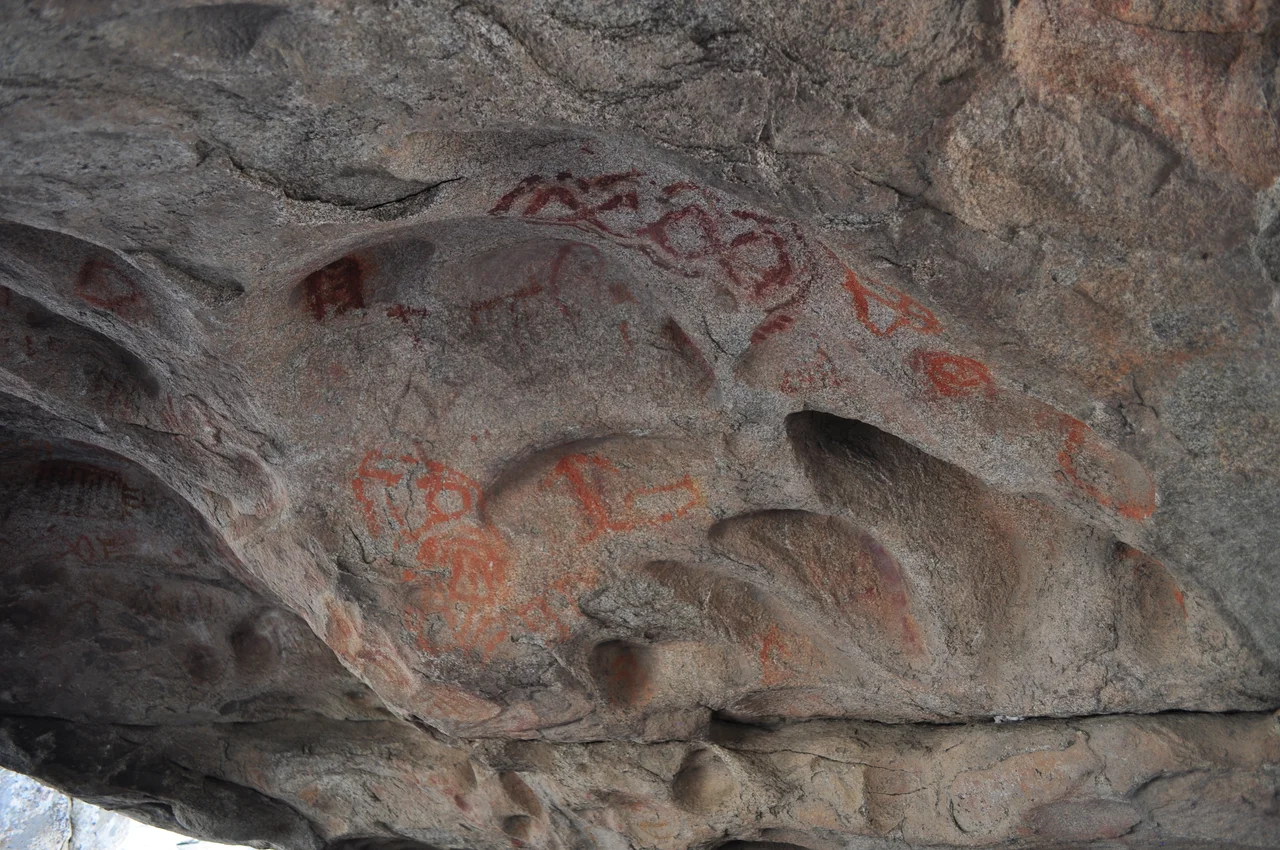

El Vallecito
On the morning of December 21, when the sun reaches its southernmost point in the sky and the northern hemisphere tilts furthest from it, something happens at El Vallecito that has been happening for a very long time. A ray of sunlight penetrates a rock shelter and falls directly on the eyes of a painted figure — illuminating the interior for a few minutes, then moving on. The Kumeyaay knew what this moment meant. They built their calendar around it.
A Site in Kumeyaay Territory
El Vallecito sits near La Rumorosa in Baja California's Tecate Municipality, in the Sierra de Juárez mountains. The Kumeyaay — known also as the Tipai-Ipai, Kamia, or formerly Diegueño — occupied a territory that stretched from Santo Tomas on the Baja California coast to the San Diego coast in California, and extended east into the mountains and deserts of northern Baja California. El Vallecito was within the eastern portion of their homeland.
Evidence of human presence in the Kumeyaay territory goes back at least 12,000 years, and occupation at this specific site dates to approximately 8000 BCE. The paintings and engravings at El Vallecito represent the accumulated record of people who used the site as a seasonal camp, a lithic workshop, and a place of ceremony — returning year after year, as gatherers do, tracking the seasons and marking the important ones in pigment and stone.
What the Site Contains
El Vallecito encompasses several distinct feature areas, each preserving different aspects of Kumeyaay artistic and ceremonial practice.
El Hombre Enraizado — the Rooted Man — is a small set of rocks with two painted panels. The first shows a geometric pattern of five lines ending in circular points. The second holds a hollow with an anthropomorphic figure that appears to have roots or limbs hanging downward, accompanied by smaller figures. La Cueva del Indio, the Indian Cave, shows evidence of heavy use: mortars, metates, ceramic material, and lithic waste from toolmaking fill the space. Its granite dome is painted on all sides — north, south, ceiling. Red, white, and black colors carry anthropomorphic figures, concentric circles, and lines extending across the roof.
Los Solecitos, or Wittinñur — which means 'painted rock' in the Kumeyaay language — has drawings on walls and ceiling whose meaning is not known. El Caracol, the Snail, harmonizes with the surrounding landscape and holds red paintings with small suns made in hollow-like figures, plus mortars and depressions with possible ritual functions.
The Solstice Alignment
The most remarkable thing about El Vallecito — and what sets it apart from a simple survey of rock art — is the precision built into its most important shelter. During the winter solstice, on December 21 and 22, a ray of sunlight enters the shelter and falls directly on the eyes of a painted figure. The illumination lasts for a few minutes before the light shifts.
This is not accident. Designing a space so that the solstice sun enters at precisely the right angle to illuminate a specific feature requires sustained astronomical observation — watching the sun's position shift over many days, in many years, and understanding the pattern well enough to build around it. The Kumeyaay were doing this at El Vallecito long before any European arrived in California to document it. The solstice marker served as a calendar indicator, signaling the start of winter and whatever ceremonial or agricultural significance that turning point carried in Kumeyaay life.
The Border That Divides the Homeland
The Kumeyaay territory that El Vallecito represents does not correspond to any modern political boundary. The people who created this site ranged freely between what is now California and what is now Baja California — the mountains and deserts here were not two different countries but one landscape. The international border that now divides the Kumeyaay homeland was not drawn until 1848, more than nine thousand years after people began using this site.
El Vallecito remains in Mexico, near La Rumorosa, accessible from Federal Highway 2. The site is managed by Mexico's Instituto Nacional de Antropología e Historia. Every year, on December 21, the solstice phenomenon that the site was built to observe still occurs — the light still falls on the painted eyes, just as the Kumeyaay designed it to do.
From the Air
El Vallecito is located at approximately 32.517°N, 116.248°W near La Rumorosa in the Tecate Municipality of Baja California, Mexico. The Sierra de Juárez mountains are visible from altitude; the site sits within them above the desert escarpment. Nearest airports: KSAN (San Diego International, ~45 nm NW), TIJ (Tijuana International, ~35 nm W).
Nearby Stories
- Laguna Salada 7.9 km away
- Heber, California 13 km away
- Jamul Indian Village 14 km away
- Manzanita Band of Diegueno Mission Indians 16 km away
- Richard J. Donovan Correctional Facility 26 km away
- Off-roading in Baja 129 km away
- San Felipe 250 181 km away
- Guadalupe Island Biosphere Reserve 377 km away