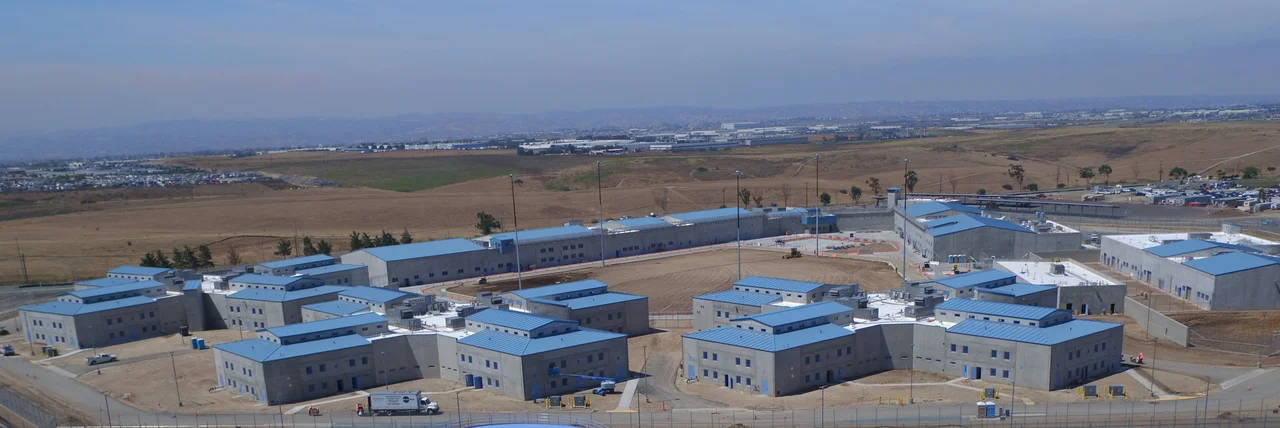

Richard J. Donovan Correctional Facility
Sitting on 780 acres of mesa just 1.5 miles from Mexico, Richard J. Donovan Correctional Facility is California's southernmost state prison — and the only one in San Diego County, home to some of the most high-profile inmates in American criminal history.
The Prison at the Edge of the Map
Most people driving south on Interstate 905 toward the Otay Mesa border crossing don't think about what lies in the hills to the west. But there, spread across a dry mesa overlooking the international boundary, is one of California's major state prisons.
Richard J. Donovan Correctional Facility opened on the Otay Mesa in eastern San Diego, named after a former director of the California Department of Corrections. The facility sprawls across 780 acres — roughly a square mile of secure perimeter, housing units, vocational programs, and administrative buildings. At its design capacity it houses several thousand inmates across multiple security levels. The proximity to the border is not incidental: the site was developed in an area of the county where land was available and the geography created natural buffer from surrounding communities.
San Diego's Only State Prison
California runs 35 adult correctional facilities across the state, but only one sits within San Diego County. That distinction has practical consequences for inmates and their families: San Diego has a large metropolitan population, and having only a single state facility means that many county residents serving state time are housed hundreds of miles from their families, making visitation difficult.
Donovan's location on Otay Mesa means it draws staff from the broader San Diego area, and it has become a significant employer in a part of the county that otherwise has a mixed economic profile. The prison's presence shapes the local geography — the roads, the retail patterns, the character of the surrounding neighborhoods.
The Names People Know
Donovan has housed a long list of inmates whose names became nationally known before they arrived here. Sirhan Sirhan, convicted of assassinating Senator Robert F. Kennedy in 1968, spent time at Donovan before being denied parole repeatedly. Erik and Lyle Menendez — convicted of murdering their parents in Beverly Hills — were both incarcerated at Donovan; in May 2025, they were resentenced, opening the possibility of release.
Suge Knight, the music executive who founded Death Row Records, served time at Donovan after his 2018 conviction. Charles 'Tex' Watson, one of the Manson family members convicted of murder in the 1969 Tate-LaBianca killings, has been housed at Donovan for decades.
These names represent exceptional cases — high-profile convictions that attracted sustained media attention. The vast majority of Donovan's population consists of people whose stories never made national news but whose circumstances are no less complicated.
What a Prison Is For
California's prison system has been the subject of sustained litigation, federal oversight, and political debate for decades. Overcrowding, healthcare access, recidivism rates, and the cost of incarceration per prisoner have all been contentious issues. Donovan, like all California state prisons, has operated within that contested context.
The facility offers vocational programs, educational opportunities, and rehabilitation services — the kinds of programs that research consistently shows reduce recidivism when adequately funded and accessible. Whether those programs reach enough of the population, and whether release conditions support successful reintegration, are questions that advocates, researchers, and corrections officials continue to debate.
For the people inside, Donovan is simply where they are. The mesa, the border visible in the distance, the dry hills — these form the horizon of daily life for thousands of Californians whose years are measured not by seasons but by sentences.
From the Air
Richard J. Donovan Correctional Facility sits on the Otay Mesa, approximately 1.5 miles north of the US-Mexico border. From the air approaching Tijuana or the Otay Mesa crossing, the prison's sprawling compound is visible as an organized grid of institutional buildings on the mesa east of San Diego. The Otay Mesa Port of Entry is visible nearby. KSAN (San Diego International Airport) is roughly 15 miles to the northwest.
Nearby Stories
- John William Finn 4.8 km away
- San Vicente Dam 5.3 km away
- Vallecito 12 km away
- Spanish Missions in Baja California 15 km away
- Mission Basilica San Juan Capistrano 74 km away
- San Clemente Island 106 km away
- Off-roading in Baja 187 km away
- Guadalupe Island Biosphere Reserve 375 km away