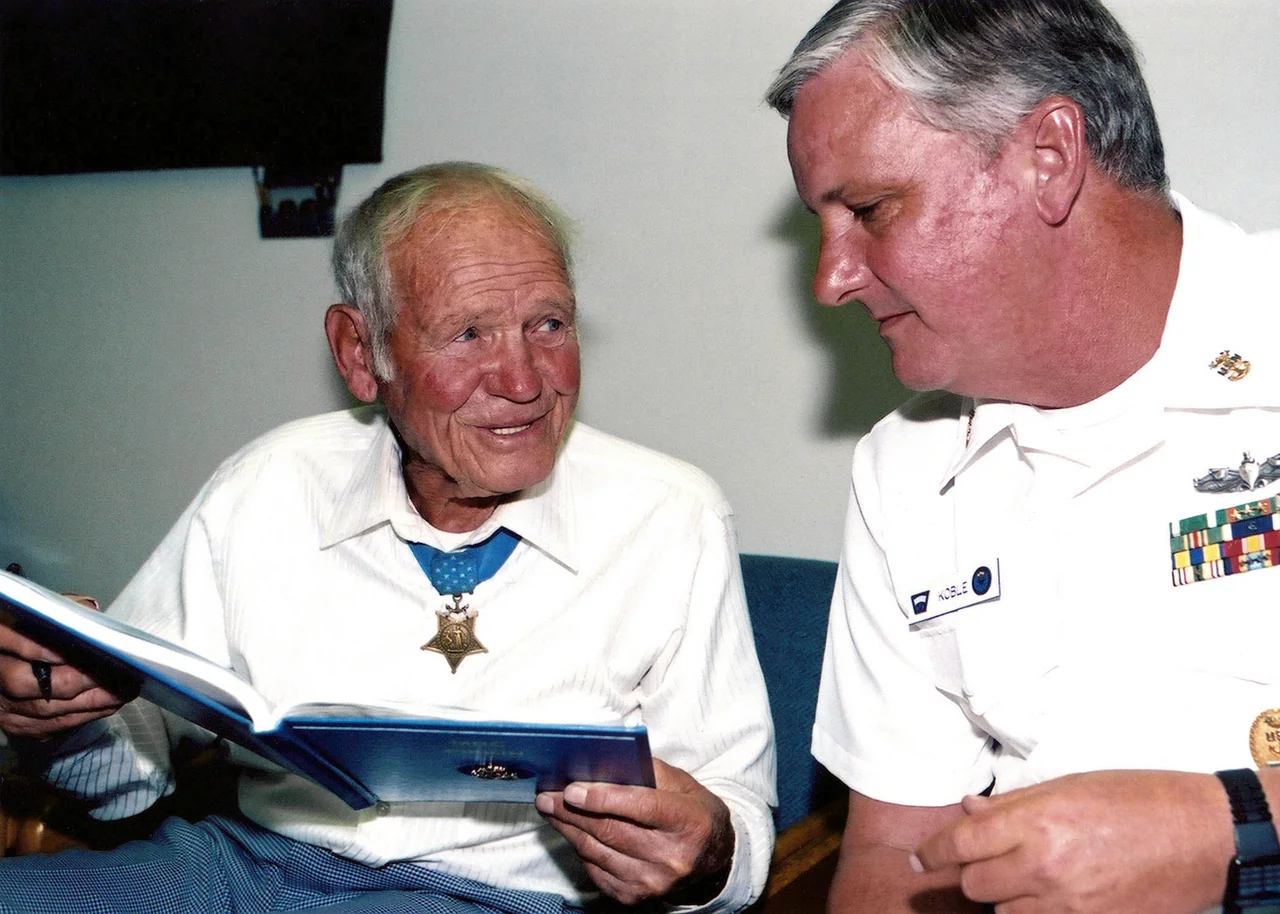

John William Finn
On the morning of December 7, 1941, a neighbor knocked on John Finn's door near Naval Air Station Kaneohe Bay and told him he was needed at the squadron. He drove toward the hangars catching sight of Japanese planes on the way, found his PBY Catalinas already burning on the ramp, and got behind a machine gun in an exposed position. He stayed there throughout the attack, firing despite being wounded again and again. He was 32 years old.
A Navy Man from the Beginning
John William Finn was born in Compton, California on July 24, 1909, and dropped out of school after the seventh grade. He enlisted in the Navy in July 1926, just before his seventeenth birthday, completed recruit training in San Diego, and attended General Aviation Utilities Training at Naval Station Great Lakes. By April 1927 he was back in San Diego, assigned to Naval Air Station North Island, where he moved from aircraft repair into work as an aviation ordnanceman — responsible for maintaining weapons and handling ammunition.
Finn was promoted to chief petty officer in 1935 after only eight years of active duty. He later described his advancement simply: 'Everybody thought I was a boy wonder. I was just in the right place at the right time.' As a chief, he served with patrol squadrons in San Diego, Washington, and Panama before being stationed at Kaneohe Bay on Oahu, where he was in charge of twenty men maintaining the weapons of VP-11, a PBY Catalina flying boat squadron.
Kaneohe Bay, December 7
The Japanese attack on Pearl Harbor on December 7, 1941, struck multiple targets across Oahu, including Naval Air Station Kaneohe Bay, where Finn's squadron was based. When he arrived at the hangars after his neighbor's warning, most of the PBYs were already on fire. The base was under attack.
Finn set up a machine gun at an improvised position — exposed, without cover — and began firing. He continued firing through the remainder of the attack despite taking multiple wounds. Ordnancemen are trained to maintain weapons, not to operate them in combat; Finn did both that morning, from a position that offered no protection, for as long as the attack lasted. When it was over, he had been wounded repeatedly but had stayed at his post.
Admiral Chester Nimitz formally presented Finn with the Medal of Honor on September 14, 1942, aboard a ship in Pearl Harbor, recognizing 'courage and valor beyond the call of duty.' Finn was the only aviation ordnanceman ever to receive the Medal of Honor.
After the War
Finn continued serving in the Navy after Pearl Harbor. He was commissioned as an ensign in 1942, reverted to chief petty officer in 1947, and eventually rose to lieutenant before retiring in 1956. His later years were spent in San Diego County, where he had been trained as a young sailor, and he made many appearances at events honoring veterans.
He was depicted in the 1970 film Tora! Tora! Tora! — shown in a sandbagged emplacement firing a water-cooled .50 caliber machine gun, trading fire with strafing Japanese Zeros. Finn regarded the film highly for its accuracy. He was less impressed by the 2001 Pearl Harbor.
In the years before his death, a section of Historic US Route 80 near his home was named the John Finn Route. Three buildings at the former Naval Training Center San Diego were named the John and Alice Finn Office Plaza. In 2012, Secretary of the Navy Ray Mabus announced a destroyer would be named in his honor — USS John Finn.
The Last One
John William Finn died on May 27, 2010, at the age of 100, at his home in Chula Vista, California. At the time of his death he was the oldest living Medal of Honor recipient, the last living recipient from the attack on Pearl Harbor, and the last living United States Navy recipient of World War II.
He had spent his final years in San Diego County, the same region where he had enlisted as a teenager and where he had completed recruit training more than eight decades before. The mountain backcountry east of the city — the canyons and ridges of the In-Ko-Pah Mountains, the borderland near Campo — is part of the same county. His coordinates are recorded there because that is where he made his home, and where the last of a generation came to rest.
From the Air
John William Finn's location is recorded at approximately 32.651°N, 116.365°W in the San Diego County backcountry. He lived in Chula Vista and his service is commemorated throughout San Diego County. Nearest airports: KSAN (San Diego International, ~40 nm W), KSEE (Gillespie Field, ~30 nm NW).
Nearby Stories
- Mud Caves of Anza-Borrego 6 km away
- Capitan Grande Reservation 6.2 km away
- Mount Signal Solar 7.7 km away
- Brawley, California 17 km away
- Jamul Indian Village 18 km away
- Spanish Missions in Baja California 23 km away
- Off-roading in Baja 145 km away
- San Felipe 250 195 km away