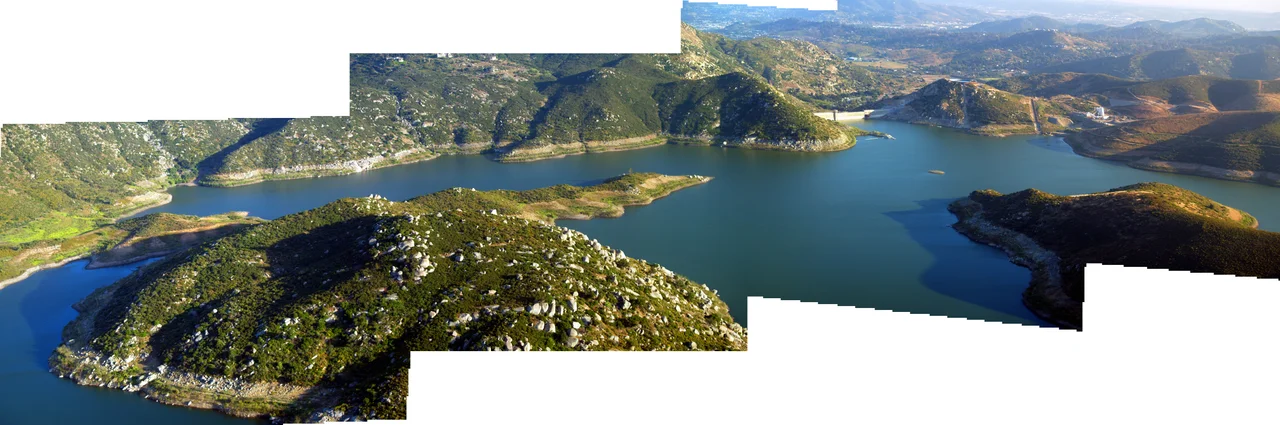

San Vicente Dam
Between 2009 and 2014, crews added 117 feet to the top of a dam that had stood for seven decades. The San Vicente Dam, a concrete gravity structure on San Vicente Creek northeast of Lakeside, was built between 1941 and 1943. When it was completed, it stood 220 feet high and held 90,000 acre-feet of water behind its curved face. When the raise was finished, it stood 337 feet high and held 242,000 acre-feet. No dam in the United States had ever been raised by more. It was also the largest raise ever accomplished using roller-compacted concrete — a technique that had not existed when the original dam was poured. The engineers of the 1940s built for their generation. The engineers of the 2000s built on top of them.
The Original Dam
Construction on San Vicente Dam began in 1941, two years before the United States entered World War II. The City of San Diego needed water storage beyond what its existing facilities could hold, and San Vicente Creek offered a site where the canyon geometry would produce a tall, efficient reservoir. The dam was completed in 1943 as a concrete gravity dam — a type that relies on its own mass to resist the pressure of the water behind it. At 220 feet, it was substantial for its era. The reservoir it created covered 1,069 surface acres at capacity and could hold 90,000 acre-feet. For nearly seventy years, that was enough. Then Southern California's water future started to look less certain, and the arithmetic changed.
The Raise
The project to raise San Vicente Dam was authorized in the early 2000s as part of San Diego's strategy to increase local water storage and reduce dependence on the imported Colorado River supply. The raise used roller-compacted concrete, a method in which dry concrete is spread in thin layers and compacted with vibratory rollers rather than poured in the conventional way. It is faster and less expensive than traditional concrete construction, but it requires precision: each layer must bond properly to the one beneath it. The engineers were, in effect, building a new dam on top of an old one, using a method that the original builders never anticipated. The raise added 117 feet of height, nearly doubling the dam's capacity. At completion in 2014, San Vicente became the largest reservoir in the San Diego County water system, surpassing El Capitan.
Storage as Insurance
San Diego imports most of its water — from the Colorado River via the Metropolitan Water District, and from the State Water Project via the same system. Local reservoirs exist not primarily to supply the city's daily needs but to provide a buffer when those imported supplies are interrupted: by drought, by infrastructure failure, by earthquake damage to the aqueducts that carry water three hundred miles from its source. The raise at San Vicente doubled the buffer. A two-year supply interruption, which would have depleted the old reservoir, can now be absorbed with capacity to spare. This is the logic of all of San Diego's water infrastructure: build for the disruption that has not happened yet, because when it does, there will be no time to build. The 117-foot raise was not growth. It was insurance.
The Reservoir from Above
From altitude, San Vicente Reservoir reads as a long blue arc pressed into the chaparral hills northeast of Lakeside. At full pool, its surface area reaches 1,069 acres — more than a mile and a half at its longest extent. The concrete dam face is visible at lower altitudes, a curved grey wall holding the water back against the canyon's downstream side. San Vicente Creek feeds in from the east; the reservoir drains south and west through a pipeline toward the city's distribution system. The terrain around it is steep, sparsely vegetated, and largely undeveloped — a consequence of the watershed protections that keep a municipal water supply clean. What looks from the air like empty backcountry is, in water terms, the most valuable land in the county.
From the Air
San Vicente Reservoir is located at approximately 32.912°N, 116.924°W northeast of Lakeside in San Diego County. The reservoir is easily identified from altitude as a large blue arc in chaparral terrain. Recommended viewing altitude 5,000–9,000 ft MSL. Nearby airports: KSEE (Gillespie Field, ~10 nm west), KRNM (Ramona Airport, ~12 nm northeast). The curved dam face is visible at lower altitudes in clear conditions.
Nearby Stories
- Borrego Valley Maneuver Area 1.5 km away
- Vallecito 2.5 km away
- John William Finn 5 km away
- Sweetwater Dam 11 km away
- Rancho Valle de San José (Portilla) 19 km away
- Mission Basilica San Juan Capistrano 39 km away
- Aliso Canyon 68 km away
- USS Higbee 240 km away