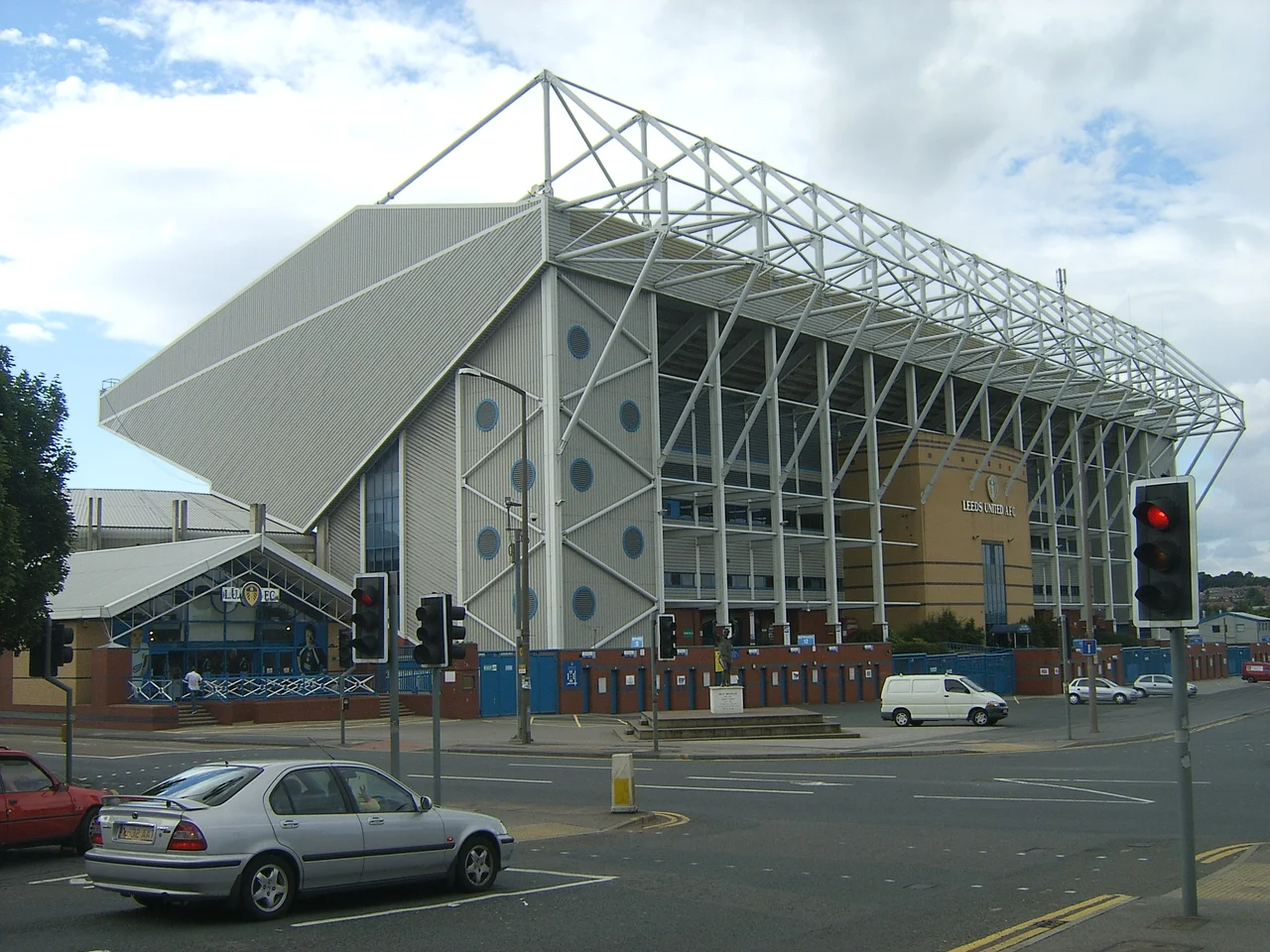

Elland Road
When Don Revie's Leeds United began losing in 1971, the manager hired a fortune teller from Blackpool named Gypsy Rose Lee. Local legend held that the ground was cursed by gypsies forced off the land when the stadium was built, and Revie wanted the curse lifted. That this story is told and retold at all says something about Elland Road. The place trades in superstition, grievance, and a fierce loyalty that has outlasted relegations, receiverships, and a stand burning to the ground.
The Old Peacock Ground
Before the football, there was a pub. Bentley's Brewery owned the land at the foot of Beeston Hill, beside the A643 road to Elland, and the field next to their Old Peacock pub became the Old Peacock Ground. That is where the nickname Peacocks came from, attached first to Leeds City and then to Leeds United. The first occupants were not footballers but rugby league players. Holbeck RLFC bought the ground from Bentley's for £1,100 in 1897 and put up the first stand. Holbeck collapsed in 1904 after losing a relegation play-off, and after a meeting at the Griffin Hotel in Boar Lane that summer, a new association football club named Leeds City took over the lease for £75 a year. Within months they had bought the ground outright. The lease was signed on 13 October 1904, on a field that had been changing hands and changing sports for less than a decade.
Revie's Cathedral
Don Revie was a player at Leeds before he was the manager who made the club feared across Europe, and the kop at the north end of Elland Road carries his name. Before it did, it was the Gelderd End, a vast standing terrace where the noise gathered and rolled forward. The record attendance came on 15 March 1967, when 57,892 people packed in for an FA Cup fifth round replay against Sunderland. The Taylor Report ended all of that. After Hillsborough, all-seater stadiums became mandatory, and in 1994 the Kop was converted to 7,000 seats and renamed for Revie. Elsie Revie, Don's widow, helped open it that October. Alex Ferguson, who knew about intimidating grounds, once called Elland Road the most intimidating venue in Europe.
Stands Named for Heroes
The four stands carry the names of the men who built the club's identity. The Don Revie Stand at the north. The Jack Charlton Stand on the east, once known as the Lowfields Road stand, rebuilt in 1993 at a cost of £5.5 million and at the time the largest cantilever stand in the world. The Norman Hunter Stand on the south, renamed in April 2020 after Hunter died, three days before his name went up. The John Charles Stand on the west, renamed after the Welsh giant died in February 2004. There is also a Billy Bremner statue on Bremner Square outside the ground, with ten engraved stones around it naming the Leeds legends: Charles, Charlton, Allan Clarke, Johnny Giles, Eddie Gray, Hunter, Peter Lorimer, Lucas Radebe, Gary Speed, and Gordon Strachan. The stadium is a roll call of names that locals say with reverence.
Sold, Bought Back, Sold Again
Elland Road's most difficult chapters have nothing to do with football. In 2001, when chairman Peter Ridsdale was pushing his catastrophic plan to relocate Leeds to a 50,000-seat stadium at Skelton, a ballot of season ticket holders showed 87.6% in favour of moving. The plan collapsed when Ridsdale resigned in March 2003. Later that year, with the club drowning in debt, the stadium was sold with a 25-year lease and buy-back clause to raise funds. It emerged in late 2006 that the ground had been quietly sold on to a British Virgin Islands-based corporation. Andrea Radrizzani bought it back for £20 million in 2017. In July 2024 the club announced it again held full ownership, having reacquired the stadium in March 2024 after exactly twenty years away. In September 2025, BDP Architects were appointed to expand capacity to around 53,000, and Leeds City Council granted planning permission in January 2026.
More Than Football
Queen played here on 29 May 1982. U2, Happy Mondays, and hometown band the Kaiser Chiefs have all filled the stadium for nights of noise that had nothing to do with football. England drew 3-3 with Sweden on 8 June 1995, the first England home international away from Wembley in 22 years. Three Euro 96 group games involving Spain were played here. The 1938 Rugby League Championship Final between Leeds and Hunslet drew 54,112 spectators, still the record for any rugby league match at the ground. Two of the 2015 Rugby Union World Cup matches were played here. The Damned United filmed Brian Clough's disastrous 44-day reign in 2009. The King's Speech borrowed Elland Road as a stand-in for the old Wembley. Through all of it, the Peacocks have kept their nest at the foot of Beeston Hill.
From the Air
Elland Road sits at 53.78N, 1.57W at the foot of Beeston Hill in south Leeds, beside the A643 and near M621 junction 1. The Wakefield Line railway runs immediately south of the ground. Leeds Bradford Airport (EGNM) is 8 nautical miles north-northwest. Cottingley railway station is closest; Leeds station is 1.5 miles north. From altitude, look for the distinctive square cantilevered roof of the East Stand alongside the M621 corridor.
Nearby Stories
- Stockport Air Disaster 4.5 km away
- Hillsborough Disaster 6.1 km away
- Murder of Sophie Lancaster 6.3 km away
- Battle of Stamford Bridge 9.8 km away
- Wressle Castle 12 km away
- Gordale Scar 12 km away
- Gainsborough Old Hall 19 km away