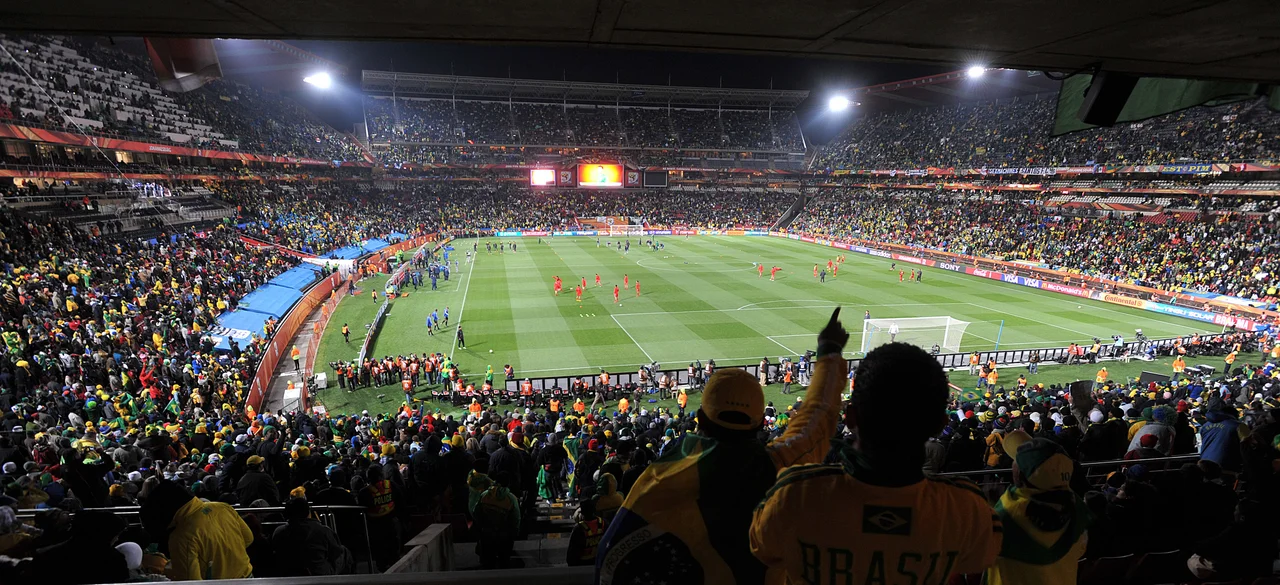

Ellis Park Stadium
On 24 June 1995, a man in a green Springbok jersey walked onto the turf at Ellis Park and changed what a country could imagine about itself. Nelson Mandela, four years out of prison and one year into the presidency, wore the number six shirt of François Pienaar, captain of a team that Black South Africans had long supported only when it lost. South Africa had just beaten New Zealand 15 to 12 in extra time. When Mandela handed Pienaar the Webb Ellis Cup, sixty-odd thousand mostly white fans began to chant his name. The stadium where that happened started its life as a garbage dump.
From Quarry to Cathedral
In 1927 the Transvaal Rugby Football Union went looking for a home and settled on an unlovely patch of Doornfontein, a worked-out quarry strewn with refuse. They named it for J. D. Ellis, the city official who freed up the land. Built in eight months for a few thousand pounds, the stadium hosted its first test against the touring All Blacks in June 1928. Over the decades the crowds swelled, peaking at a remarkable 95,000 for a match against the British and Irish Lions in 1955. The original ground was demolished in 1979 and rebuilt; by 1982 it was the most modern stadium in the country, seating close to 60,000. Rugby has been played here in all but two years of its existence, the gap only for construction. In 2005 it became the first Black-owned stadium in South Africa.
The Day the Country Held Its Breath
The 1995 Rugby World Cup final was never only about rugby. Joel Stransky kicked all fifteen of South Africa's points that afternoon, three penalties and two drop goals, the last of them a long dropped kick in extra time that broke the deadlock and the nerves of a nation watching. But it is the image afterward that endures: a Black president in the colors of a sport built by the apartheid establishment, embracing a white Afrikaner captain. For one afternoon, a fractured country saw a glimpse of what it might become. The moment has been ranked among the greatest in the history of sport, and it happened on a field reclaimed from a rubbish tip in Doornfontein.
Eleven April
Six years later, the same stadium held a far darker day. On 11 April 2001, Kaizer Chiefs met Orlando Pirates in a Soweto derby, the fiercest rivalry in South African football. The ground held about 60,000, but an estimated 80,000 or more fans pressed toward the gates, many with forged tickets, others waved through by corrupt sellers. When a roar went up for a goal late in the match, those still outside surged forward to get in. People were crushed against fences and one another in the bottleneck. Forty-three died that day, twenty-nine inside the ground and fourteen beyond it, several of them children, and more than 250 were injured. It remains the worst sporting disaster in South African history. A commission of inquiry laid blame on overcrowding, fraud, and a failure to plan for the crowd that came.
Sport, Song, and Survival
Ellis Park has held more than rugby. In 1995 it staged the rest of the World Cup; in 2009 it hosted the FIFA Confederations Cup, and in 2010 it took on five group games and a quarter-final of the FIFA World Cup, its capacity nudged up to 62,000. It has hosted Brazil, Manchester United, and Arsenal, and in 1985 it gave its turf to Concert in the Park, a benefit for hunger relief that drew twenty-two acts, and in November 1994 Whitney Houston performed here on her Concert for a New South Africa tour, with the Johannesburg show broadcast live on HBO. The ground sits at the heart of a sporting precinct alongside an athletics stadium, an arena, and an Olympic-class pool. Through triumph and tragedy alike, the old quarry has kept its place in the life of Johannesburg.
From the Air
Ellis Park, sponsored as Emirates Airline Park, sits in Doornfontein just east of central Johannesburg at about 26.198°S, 28.061°E, on the Highveld plateau roughly 1,750 meters above sea level. From the air it is easy to pick out as a large bowl set within a cluster of sports venues, with the downtown towers immediately to the west and the mine-dump ridges of the gold reef threading the city. O. R. Tambo International Airport (ICAO: FAOR) lies about 20 km to the east, the most likely arrival gateway; Rand Airport (ICAO: FAGM) in Germiston is roughly 11 km to the southeast for light aircraft. Best viewing comes on dry, clear winter days; summer afternoons can bring sudden Highveld thunderstorms.
Nearby Stories
- Kyalami Grand Prix Circuit 12 km away
- TauTona Mine 16 km away
- Boipatong Massacre 17 km away
- Battle of Bronkhorstspruit 33 km away
- Nan Hua Temple 57 km away
- Royal Bafokeng Nation 59 km away
- Secunda CTL 69 km away
- Vaal Reefs Mining Disaster 79 km away