
Ennedi Plateau
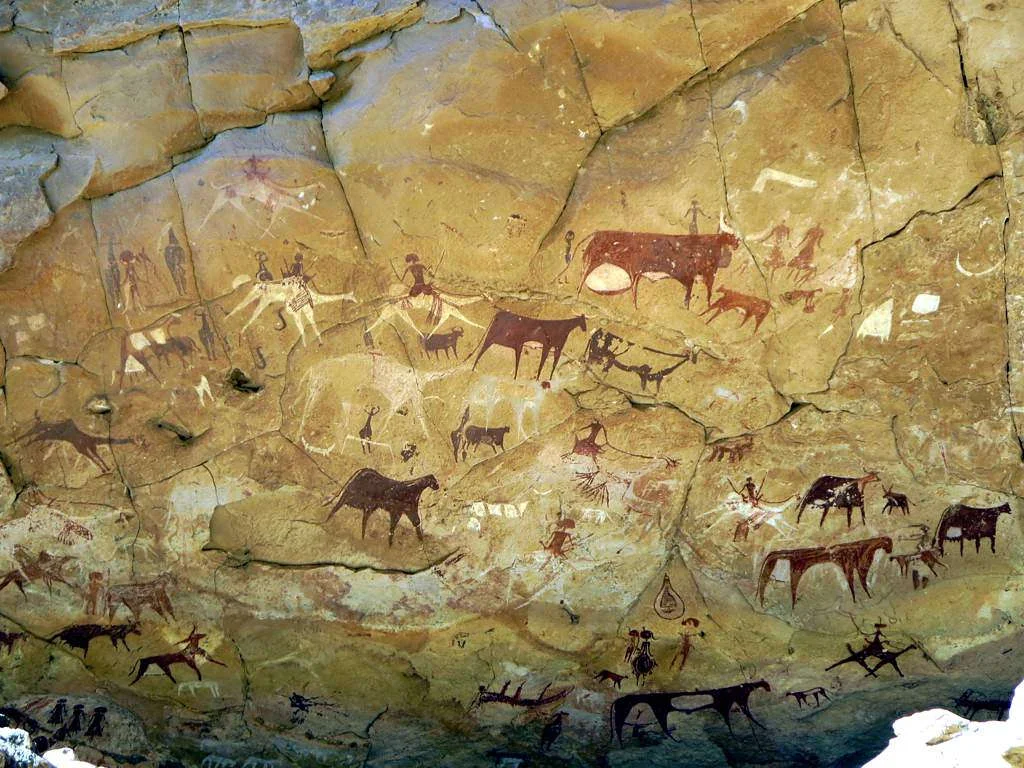
Deep in a canyon of the Ennedi Plateau, in a pool called the Guelta d'Archei, a few dozen crocodiles survive. They are West African crocodiles - the desert crocodile, as they are often called - and they are dwarfed compared to their cousins elsewhere, stunted by millennia of isolation in a shrinking pool. They are living echoes of a wetter Sahara, holding on where the green once was. Above them, on the sandstone walls of the Ennedi, other echoes keep company: painted cattle, galloping horses, archers, women in long dresses, and the faded ghosts of hunter-gatherers who became pastoralists when the rain began to leave.
A Sandstone Island
The Ennedi Plateau covers about 60,000 square kilometers - roughly the area of Switzerland - and rises to 1,450 meters above sea level. Its high ground is sandstone laid over a Precambrian granite base, sculpted by wind and temperature into towers, pillars, arches, and bridges. Scattered across this maze are at least twenty gueltas - perennial or semi-perennial desert pools, rarely larger than a few dozen meters in the dry season - that make life possible. Around 6000 years before present, the Ennedi received roughly 250 mm of rainfall a year; savanna covered the plateau. By 4300 BP it was down to 150 mm. By 2700 BP it had fallen to 50 mm, roughly today's level. The monsoons still reach up from the Intertropical Convergence Zone between May and September, but barely. Much of the Sahara's blowing sand is born here, in the slow grinding down of the Tibesti-Ennedi triangle.
Galleries on Stone
The rock art of the Ennedi begins around 5000 BC and extends into the Iron Age. More than 86 percent of it is painted - red and white and ochre on sandstone ceilings, walls, and floors - and the rest is engraved. Cattle dominate. Over half the images at one surveyed site are cattle, some drawn with lyre-shaped horns, some carefully individualized with different coats. Caprids (goats and sheep) make up another 10 percent, dogs about 5 percent. Later, as climates dried and societies stratified, the artists began showing warriors behind round shields and women in long dresses. Horses appear, often galloping, sometimes drawing chariots - a very different way of moving than the static cattle that came before. At Niola Doa, "the place of the girls," monumental human figures stand wrapped in wavy lines and geometric patterns, some perhaps depicting a genetic trait called steatopygia. These artists knew their world. They recorded it with a precision that archaeologists are still decoding.
What Was Lost, What Returns
The fauna the rock artists painted has mostly vanished. The last West African lions survived in the Ennedi until they were hunted out in the 1940s. Scimitar-horned oryx were declared extinct in the wild in 2000; addax nearly went the same way. Any surviving Sudan cheetah may still hide in the Ennedi's remote canyons. In December 2023, African Parks and Sahara Conservation moved the first ten addax from the Ouadi Rimé-Ouadi Achim Faunal Reserve in central Chad back to the Ennedi, and released them into the reserve - the first of what will be many returning. Oryx reintroduction is planned. Camera traps identified an isolated population of North African ostrich; chicks were raised in captivity and released, and 25 were counted in 2022. The Ennedi has become a rewilding laboratory, its sandstone walls witnesses to both the original abundance and the slow attempt to bring some of it back.
Fragile Protection
The plateau was added to the UNESCO World Heritage list in February 2016. In early 2018, African Parks assumed management in partnership with the Chadian government, backed by €4.7 million from the European Union and roughly €3 million from the Dutch Postcode Lottery. In January 2019, Chad designated about 50,000 square kilometers as the Ennedi Natural and Cultural Reserve. The protections are real but imperfect. The protected area was reduced to accommodate oil exploration - concessions that have already produced accidental spills contaminating groundwater. Vandals have defaced rock art: in January 2017, inscriptions in French and Arabic were scrawled over paintings older than the pyramids. The Trust for African Rock Art and the Factum Foundation are documenting the art in 3D, racing erosion and graffiti to preserve a record. From the air, the Ennedi is breathtaking - pink sandstone cities rising from a sea of dunes, canyons threading between them, the occasional flash of green at a hidden guelta. It is one of the last places on Earth where a Sahara that used to be green still leaves visible traces on stone.
From the Air
Coordinates 17.00°N, 23.00°E, in northeastern Chad. The plateau spans Ennedi-Ouest and Ennedi-Est provinces. Amdjarass International (FTTE) is the nearest major airport with a 3,050m runway. Recommended viewing altitude 10,000-20,000 feet to appreciate the sandstone towers, natural arches, and the vast scale of the plateau against the surrounding Sahara.
Nearby Stories
- Ennedi Est (province) 49 km away
- North Darfur 214 km away
- Al Zorg 225 km away
- Ain Farah 304 km away
- Kutum 328 km away
- Zakouma National Park 720 km away
- Great Man-Made River 920 km away
- Manovo-Gounda St. Floris National Park 947 km away