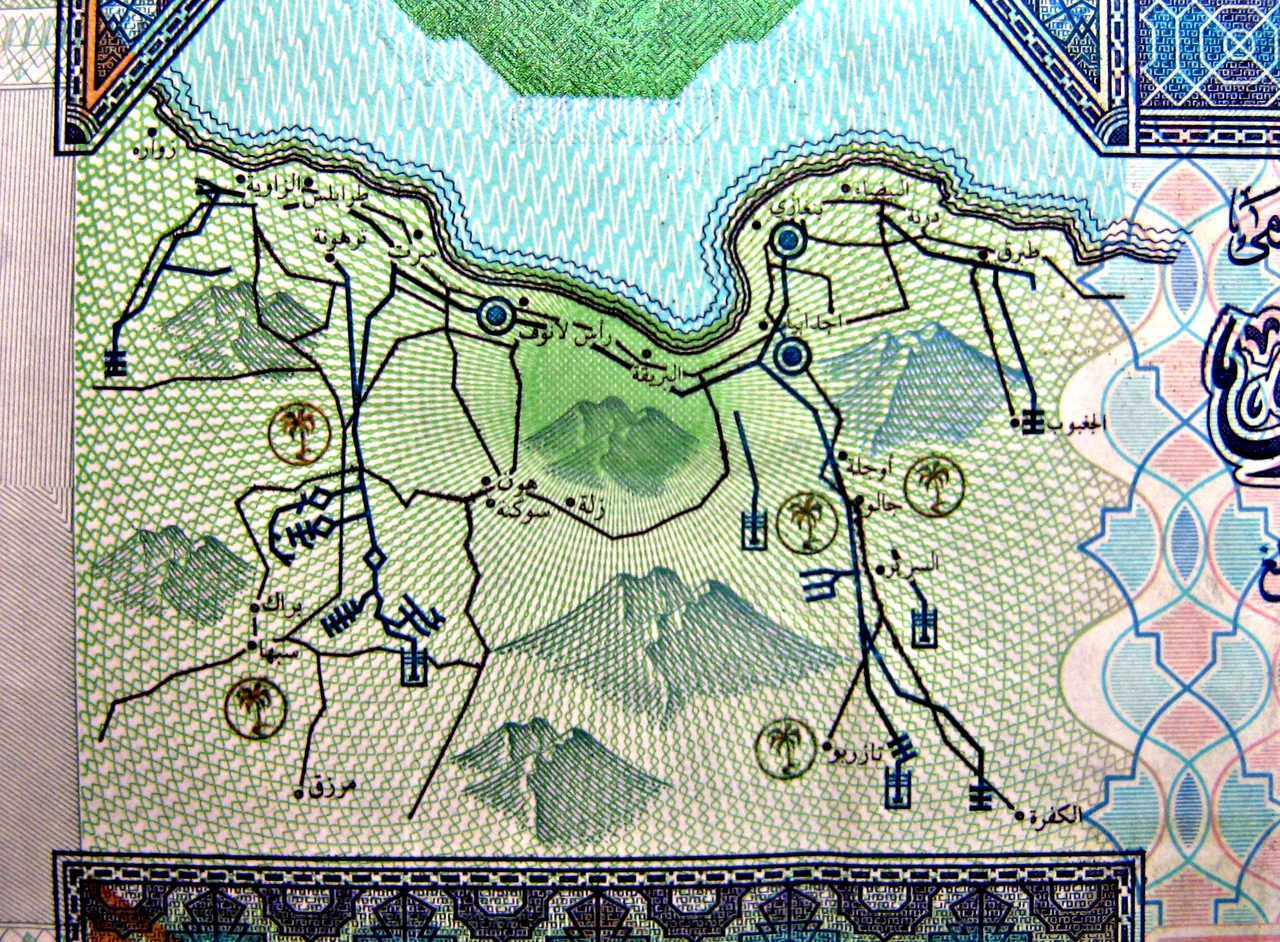

Great Man-Made River
They went looking for oil and found water instead. In 1953, prospectors drilling beneath the empty southern desert of Libya struck not petroleum but vast reservoirs of fresh water, sealed underground since the last ice age. It took thirty years and around twenty-five billion dollars to do anything with that discovery, but the result is one of the largest engineering works ever built: a continent-spanning grid of buried pipe that hauls ancient water nearly a thousand miles north, from beneath the Sahara to the thirsty cities on the Mediterranean coast. Muammar Gaddafi called it the Eighth Wonder of the World. The scale almost justifies the boast.
A River With No Banks
There is no river to see. The Great Man-Made River is entirely underground, a network of pipe so large it is hard to picture: about 2,820 kilometers of concrete conduit fed by more than 1,300 wells, most of them sunk deeper than 500 meters into the desert. Together they deliver some 6.5 million cubic meters of fresh water every single day to Tripoli, Benghazi, Sirte, and the towns between, water that travels distances of up to 1,600 kilometers from wellhead to tap. The pipes themselves are giants, pre-stressed concrete cylinders broad enough to drive through, manufactured at purpose-built plants in the Libyan desert. By the project's own accounting it is the largest underground network of pipes and aqueducts on the planet, and it supplies roughly 70 percent of all the fresh water Libya uses.
Drinking the Ice Age
The source of all this water is the Nubian Sandstone Aquifer System, an enormous body of fossil water lying beneath Libya, Egypt, Sudan, and Chad. The crucial word is fossil. This water accumulated during wetter periods of the last ice age, tens of thousands of years ago, and it is not being replenished. Every cubic meter pumped to the coast is drawn from a finite, non-renewable store. How long it can last is genuinely disputed. Optimistic figures suggest the supply could endure a thousand years at older extraction rates; other analyses warn the accessible water could be largely exhausted within 60 to 100 years. The honest summary is that nobody knows precisely, and the answer depends entirely on how fast the taps are opened. It is a one-time inheritance being spent in real time.
Building It
Construction began in 1984, when Gaddafi laid a foundation stone in the Sarir region, and proceeded in phases. The first major phase was inaugurated in 1991; the second, billed as First water to Tripoli, reached the capital in 1996. The work drew on engineering from around the world even as Libya funded it without loans from international banks. A South Korean consortium led the early construction, much of the steel wire came from Italy, and Australian firms handled corrosion protection. Analysts have pointed out a stark economic logic behind the gamble: at the time, extracting this groundwater was estimated to cost roughly a tenth of what desalinating seawater would have. For a desert nation, pumping ancient water was simply cheaper than making new water from the sea.
Water as a Weapon
A system that carries life to millions can also be held hostage. During the 2011 conflict, a NATO airstrike hit one of the two plants that manufactured the project's pipes at Brega, an event that drew international scrutiny over the targeting of civilian water infrastructure. In the years of fighting that followed, the network suffered neglect and breakdowns; by 2019 more than a hundred of the wells on the western system had been dismantled. In April 2020 an armed group seized a control station and cut the flow to Tripoli, leaving over two million people without water and drawing condemnation from the United Nations. The fragility is the point. A nation that pipes most of its drinking water through a single vast machine has built both a marvel and a vulnerability into the same structure.
The Reckoning Underground
The Great Man-Made River is an extraordinary answer to an ancient problem, and it carries an ancient warning with it. Two thousand years ago, in the same desert, the Garamantes built cities by tapping fossil water through hand-dug tunnels, and their civilization faded as that water ran low. The modern project does the same thing on an industrial scale, with pumps instead of foggaras. The engineering is heroic; the arithmetic is unforgiving. A buried sea that took an ice age to fill cannot be refilled on any human timescale. For now the water flows north, greening the coast and filling the reservoirs. What happens when the aquifer finally falls is a question Libya has chosen, for the moment, to leave for later.
From the Air
This part of the southern well-field network sits near 25.46 degrees North, 21.60 degrees East, in the deep Libyan Sahara of the Kufra and Sarir basins. From altitude the signature feature is agriculture, not water: huge dark circles of center-pivot irrigation bloom across the otherwise bare desert wherever the wells reach the surface, visible far better from the air than the buried pipeline itself. The reservoirs near the coast appear as bright artificial lakes. Nearest airfields include Kufra (HLKF) to the southeast and Sabha (HLLS) to the west, with the coastal terminus cities of Benghazi (HLLB) and Tripoli (HLLT) far to the north. Expect vast emptiness, no terrain lighting, and dust haze; clear daylight reveals the startling green circles against the sand.
Nearby Stories
- Lady Be Good (aircraft) 221 km away
- Senussi Campaign 315 km away
- Cave of Swimmers 371 km away
- Gilf Kebir National Park 453 km away
- Arch of the Philaeni 567 km away
- Battle of Beda Fomm 583 km away
- Gaberoun 771 km away
- Uan Muhuggiag 1081 km away