.jpg)
Gaberoun
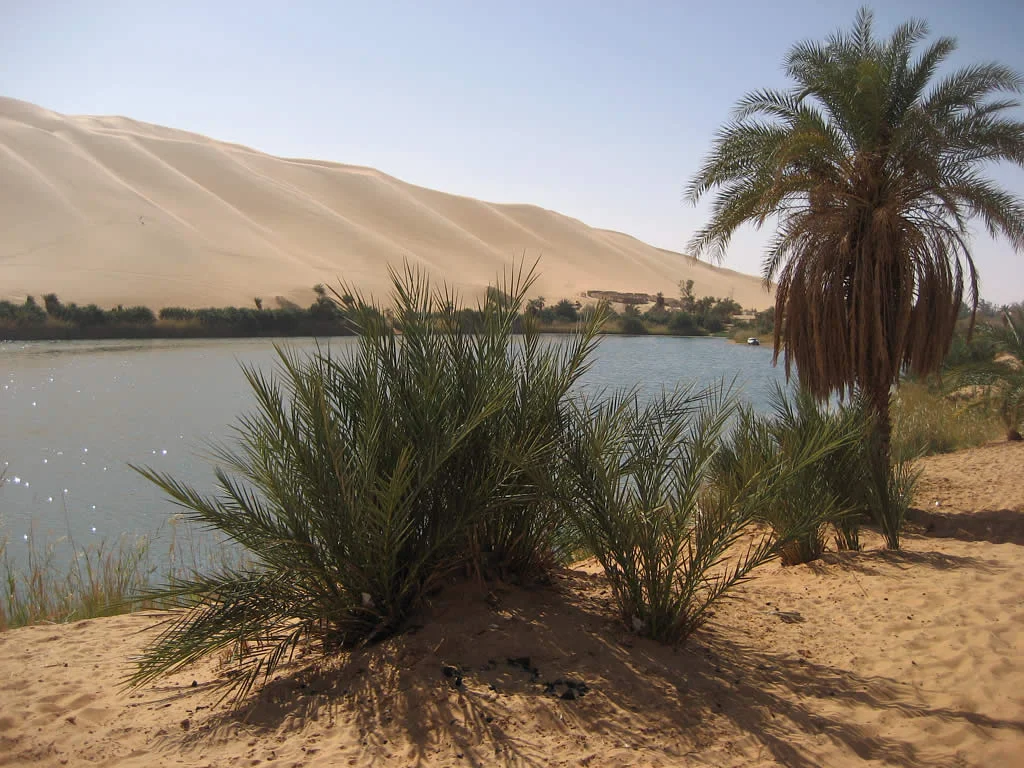
In the middle of one of the most lifeless landscapes on Earth, there is a lake. The Ubari Sand Sea rolls on for tens of thousands of square kilometers, a hyper-arid ocean of dunes in southwestern Libya, and then, abruptly, a sheet of blue-green water appears in a hollow between the crests, fringed by date palms and the broken walls of an abandoned village. This is Gaberoun, the largest of the Ubari lakes. The water is a mirage that turns out to be real, and stranger still, it is alive. The lake is salt, nearly five times saltier than the sea, and tiny red shrimp swarm its shallows.
A Lake That Shouldn't Be Here
Gaberoun is a relic. The lakes of the Ubari are the last shining remnants of a far wetter Sahara, pockets where ancient groundwater still reaches the surface in the low ground between the dunes. There is no rain to speak of and a brutal sun overhead, so evaporation concentrates whatever water seeps in, leaving Gaberoun intensely saline. The salinity is what makes swimming here so peculiar: the dense water buoys you up the way the Dead Sea does, and the experience is genuinely pleasant despite the brine and the company of small crustaceans. The dunes that cradle the lake tower above it, so that from the water's edge you look up at slopes of pale sand rising against the sky in every direction.
The Worm Eaters
People once lived at Gaberoun, and they lived in part off the lake itself. A small community settled here, and among their foods were the tiny worm-like crustaceans, a kind of brine shrimp, that they harvested from the salty water. The trait earned the lake people of this sand sea a blunt nickname: Dawada, the worm eaters, after the red shrimp dried and ground into paste and cakes. It was an improbable livelihood, fishing protein out of a salt lake in the heart of the Sahara, but it sustained generations. In the 1980s the community was relocated out of the dunes to Wadi Bashir, a settlement of concrete apartments built south of the sand sea, ending centuries of life on the lakeshore.
What the Palms Hide
On the northwestern shore, scattered among the date palms, the old village still stands in ruins. Mud-brick walls, roofless and softening back into the ground, mark where families once lived beside the water. The abandonment gives Gaberoun a doubled character: a place of startling natural beauty haunted by the recent past, the homes empty but not ancient, left within living memory. A modest tourist camp was later set up on the northeastern shore, with open patios, sleeping huts, and a souvenir shop, drawing the small number of travelers willing to cross the dunes. The palms shade both the living and the lost.
Reaching the Water
Gaberoun does not give itself up easily. The lake lies off the road that runs between Sabha and Ubari, but the road only gets you close. From a point roughly 150 kilometers west of Sabha, reaching the water means a 36-kilometer crossing by four-wheel drive straight through the dunes of the Ubari Sand Sea, also called the Ramlat Dawada. It is slow, hot, disorienting work, with the best months falling between October and May, when the climate softens and the summer mosquitoes thin out. Other lakes lie scattered across the same erg, Mandara, Um al-Maa, Mafo, each its own bright eye in the sand. Of them all, Gaberoun is the broadest and the most storied.
Shrinking Mirages
The Ubari lakes are not permanent fixtures so much as a slow-motion farewell. They survive on the same underground water that civilizations have tapped across the Fezzan for millennia, and several of the smaller lakes in the sand sea have shrunk dramatically or dried out entirely within recent decades as the water table beneath the dunes has fallen. A few, like Um al-Maa, hold on; others are now little more than salt-crusted hollows where blue water used to be. Gaberoun, the largest, endures for now, but its very existence is a reminder of how thin the margin is out here. A lake in the desert is a balance between what seeps in and what the sun takes away, and that balance is shifting. To stand on its shore is to look at something beautiful and quietly impermanent.
From the Air
Gaberoun lies at 26.80 degrees North, 13.54 degrees East, within the Ubari Sand Sea (Idehan Ubari) of southwestern Libya. From the air it is unmistakable: a small, brilliant patch of water and green palms set in an immense field of linear and star dunes, a natural navigation landmark in an otherwise featureless erg. The nearest airfields are Sabha (HLLS) roughly 150 km to the east and Ubari (HLUB) to the west, with the Wadi al-Ajal and the ruins of Germa lying just north of the sand sea. Expect extreme isolation, no terrain lighting, and frequent blowing dust. Clear, calm daylight gives the best view; low morning or evening sun throws long shadows across the dune crests and makes the lake glow.
Nearby Stories
- Garamantes 4.8 km away
- Germa 47 km away
- Wadi Mathendous 143 km away
- In Amenas Hostage Crisis 396 km away
- Killing of Muammar Gaddafi 517 km away
- Africa (Roman Province) 532 km away
- Libyan Civil War (2011) 543 km away
- Great Man-Made River 763 km away