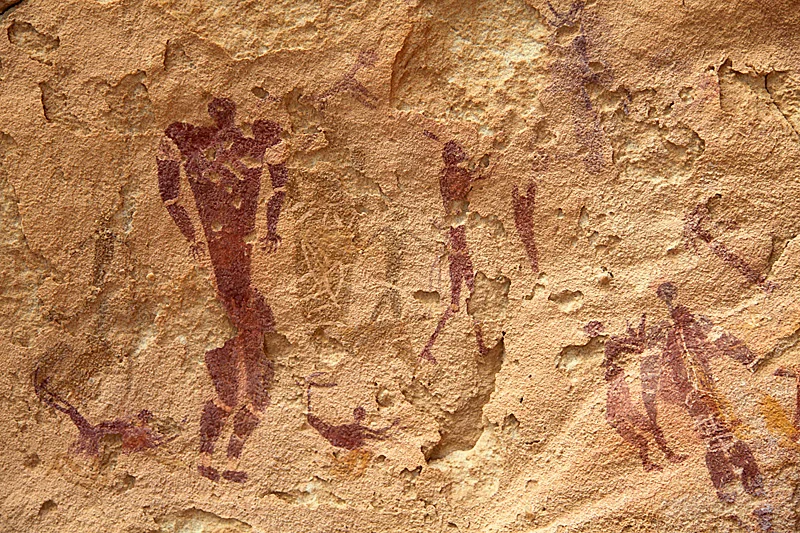

Cave of Swimmers
There is no water here. There has not been water here for thousands of years. And yet on the wall of this shallow rock shelter, painted in red and ochre, small human figures drift with their arms swept back and their legs trailing behind them, as if caught mid-stroke in a lake that no longer exists. They were painted onto the Gilf Kebir, a sandstone plateau in the far southwest corner of Egypt, near the Libyan border, in a quarter of the Sahara so empty that reaching it still takes a week of driving across open dune. The figures are the reason this place has a name. People call it the Cave of Swimmers.
The Man Who Found Them
In October 1933, a Hungarian aristocrat and desert explorer named László Almásy came over the rim of a wadi in the Gilf Kebir and saw the paintings for the first time. Almásy had spent years chasing the legend of Zerzura, a lost oasis said to lie somewhere in the Libyan Desert. He never found it. He found something stranger instead: evidence that this absolute wasteland had once been green. Almásy gave the rock art a chapter in his 1934 book, and argued that the swimmers were exactly what they appeared to be, people who had really swum, in a Sahara that had since dried from temperate land into bone-dry desert. The idea was so radical that his own editor inserted footnotes to distance himself from it. Decades later, Almásy would be reshaped into the doomed romantic hero of Michael Ondaatje's novel The English Patient and the 1996 film, his real life almost entirely rewritten.
When the Sahara Was Green
Almásy was right about the climate, even if the cause lay beyond what he could have known. Beginning around the end of the last ice age, a long wet phase known as the African Humid Period turned the Sahara into a landscape of grassland, shallow lakes, and slow rivers. Rain followed shifts in summer sunlight and was amplified by the vegetation and dust that the rain itself created. Giraffe and hippopotamus appear among the paintings here, animals that need standing water and grazing, animals impossible in today's desert. Roughly five thousand years ago the rains failed, the lakes evaporated, and the green Sahara died. The people who had lived and hunted and, perhaps, swum across it scattered. Some archaeologists believe they drifted east toward a reliable river, carrying ideas that would take shape, generations later, along the banks of the Nile.
Swimmers, or Souls
Not everyone agrees the figures are swimming at all. The rock-art researcher Andras Zboray calls them "clearly symbolic," their true meaning lost. The German ethnologist Hans Rhotert read them as the dead. The anthropologist Jean-Loïc Le Quellec agrees, pointing to parallels with the Coffin Texts, the ancient Egyptian funerary writings in which souls float through Nun, the primordial waters. The Egyptian scholar Yasser Al-Laithy found echoes of the same idea in the tomb of Ramesses VI, where painted figures swim through the waters of the underworld. By this reading the small drifting bodies are not bathers but spirits, suspended forever in an eternal sea. Eight thousand years on, no one can say for certain. The figures keep their secret, arms back, legs trailing, neither clearly alive nor clearly dead.
A Fragile Inheritance
The fame that The English Patient brought has come at a cost. The cave shown in the film was a built set, not the real shelter, but visitors arrived anyway, and the genuine paintings have suffered for it. Fragments have been chipped away as souvenirs. Surfaces have cracked after people splashed water on them to brighten the colors for a photograph. Graffiti has been scratched into the rock, and litter collects nearby. Guides are now trained to protect the site and rubbish is cleared, but these pigments have endured for eight thousand years only to grow vulnerable in a single careless generation. The swimmers crossed an ocean of time to reach us. Whether they survive the next century is, for once, entirely up to the people who come to look at them.
From the Air
The Cave of Swimmers lies in Wadi Sura on the western flank of the Gilf Kebir plateau at 23.59°N, 25.23°E, deep in Egypt's New Valley Governorate near the Libyan border. This is some of the most remote airspace in North Africa, with no settlements, roads, or lights for hundreds of kilometers in any direction. The plateau itself is the only major landmark, a dark sandstone mass rising roughly 300 meters above a sea of pale dunes and visible from far off in clear desert air. Best appreciated from medium altitude (8,000 to 12,000 feet AGL) where the wadis cutting into the plateau's edge stand out in raking morning or late-afternoon light. There are no nearby airports of consequence; the closest meaningful fields are far to the northeast in the Nile Valley, including Asyut (HEAX) and, much farther, Cairo International (HECA). Across the border to the west, Kufra in Libya (HLKF) is the nearest airfield. Carry full reserves: visibility is usually excellent, but blowing sand from the khamsin winds can erase the horizon within minutes.
Nearby Stories
- Senussi Campaign 17 km away
- Gilf Kebir National Park 21 km away
- Lady Be Good (aircraft) 318 km away
- Great Man-Made River 365 km away
- Nubian Sandstone Aquifer System 376 km away
- Dakhla Oasis 397 km away
- Lake Ptolemy 433 km away
- Ennedi Est (province) 655 km away