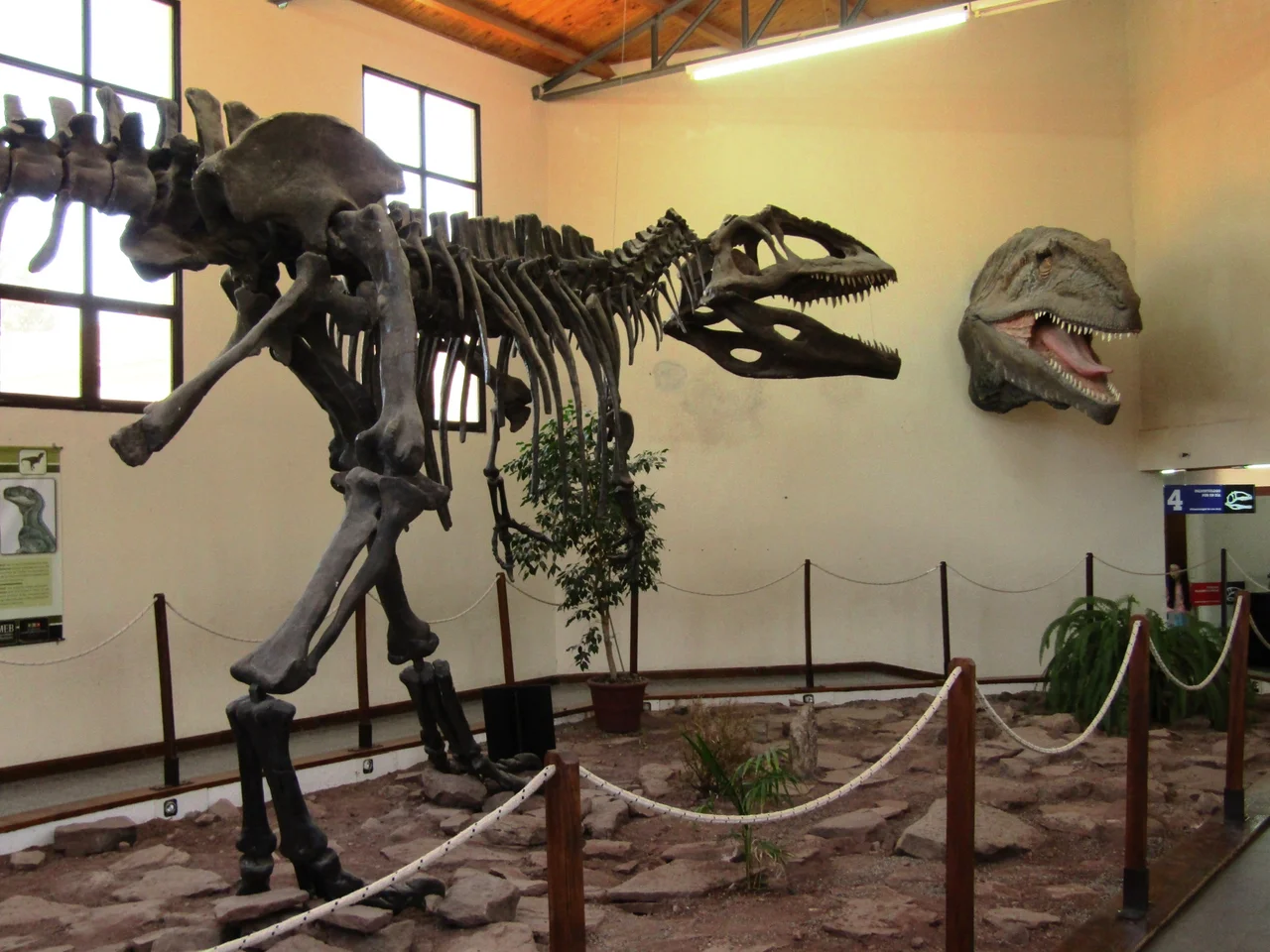

Ernesto Bachmann Paleontological Museum
An auto mechanic out hunting fossils in his dune buggy is not how most museums begin. But in July 1993, Ruben Dario Carolini was doing exactly that in the badlands southwest of Villa El Chocon when he uncovered a leg bone longer than he was tall. The bones belonged to Giganotosaurus carolinii, one of the largest meat-eating dinosaurs ever found, and the discovery was so important that the town built a museum around it. The Ernesto Bachmann Paleontological Museum opened in 1997, and the giant carnivore is still the reason anyone makes the trip.
The Giant Southern Lizard
Giganotosaurus means giant southern lizard, and the name is no exaggeration. The animal stretched an estimated 12 to 13 meters from snout to tail and weighed somewhere between 6 and 8 tons, rivaling and by some measures exceeding Tyrannosaurus rex in length. Its skull alone reached about 1.56 meters. The skeleton Carolini found was unusually complete, around 70 percent, which let scientists describe the species in 1995 and reconstruct its proportions with rare confidence. Built lighter and more agile than the heavy-jawed T. rex of North America, it hunted in South America roughly 30 million years before its famous northern cousin ever appeared. To stand beneath the mounted reconstruction is to grasp, viscerally, how small a human being is.
A Province of Monsters
Giganotosaurus is the headliner, but the museum's galleries read like a roster of Patagonian giants. Here is Amargasaurus cazaui, a sauropod with two rows of tall spines rising like a sail from its neck, and a cast of the head of Bajadasaurus pronuspinax, whose forward-curving neck spines may have been defensive armor. A replica vertebra of Argentinosaurus huinculensis hints at one of the most massive land animals that ever lived. The abelisaur Skorpiovenator bustingorryi is displayed exactly as it was found in the rock, mid-excavation, bones still in their death pose. The Neuquen region of Argentina has yielded more dinosaur species than almost anywhere on Earth, and many of them are gathered under this one modest roof.
Where the Holotypes Sleep
Behind the public galleries, the museum is a working scientific institution. Its laboratory cleans, conserves, and studies fossils still emerging from the surrounding badlands, and it keeps an official repository under the code MMCh-P. What it holds there is precious: holotype specimens, the single defining examples against which an entire species is measured. The original bones of Skorpiovenator, Bajadasaurus, Choconsaurus baileywillisi, the small whip-tailed sauropod Leinkupal laticauda, and Giganotosaurus itself are stored here. A holotype cannot be replaced. When a researcher anywhere in the world wants to know precisely what one of these animals was, the answer lives in a drawer in Villa El Chocon.
Read in the Rock
The dinosaurs are only part of what the museum keeps. Its collections reach beyond paleontology into archaeology and local history, with material from ancient human sites scattered around Villa El Chocon, such as the place known as Moro 1. The badlands that preserved Cretaceous bones also held the traces of the people who came to this valley far more recently, and the museum treats both as worth saving. Alongside the giant theropods sit the small original remains of turtles and an ancient frog, Avitabatrachus uliana, and a replica of a crocodile relative, Araripesuchus patagonicus. Together they sketch a fuller picture of a vanished Patagonian world, not just its monsters but the modest creatures that shared its rivers and shorelines.
The Mechanic's Museum
The museum carries the name of Ernesto Bachmann, a local enthusiast of paleontology, but its soul belongs to the amateurs who walk the badlands looking. Carolini was a self-taught fossil hunter, not a credentialed scientist, and the largest predator of his hemisphere now bears his name in its species epithet, carolinii. The car he built and used to comb the desert is itself on display, a reminder that some of the most important discoveries in the history of paleontology were made by ordinary people who simply paid attention to the ground. Villa El Chocon has come to call itself the Valley of the Dinosaurs, and this small museum is the reason why.
From the Air
The Ernesto Bachmann Paleontological Museum sits in Villa El Chocon at approximately 39.26 S, 68.78 W in Neuquen Province, Argentina, on the rust-red shores of the Ezequiel Ramos Mexia reservoir along the Limay River. From the air the setting is striking: deep red and ochre sandstone cliffs, the broad blue-green sheet of the dammed lake, and a compact village of white houses with red-tiled roofs clustered on low hills. A viewing altitude of 3,000 to 6,000 feet shows the village, dam, and surrounding badlands together. The nearest major airport is Presidente Peron International at Neuquen (ICAO: SAZN), about 70 km to the northeast; Zapala Airport (ICAO: SAHZ) lies to the west. Conditions are usually clear and dry, with strong Patagonian winds and excellent long-range visibility over the open steppe.
Nearby Stories
- Neuquén 14 km away
- Museo Carmen Funes 41 km away
- FaSinPat 44 km away
- Zapala 71 km away
- Vaca Muerta 109 km away
- Sol Líneas Aéreas Flight 5428 174 km away
- Lanin National Park 176 km away
- Patagonian Desert 203 km away