
Museo Carmen Funes
A single fossilized leg bone in this museum once stood taller than the rancher who found it - he mistook it for a petrified tree trunk lying in his field. It belonged to Argentinosaurus huinculensis, and the bones cataloged here as MCF-PVPH-1 represent the largest land animal ever scientifically identified. In an unassuming municipal museum in the oil town of Plaza Huincul, the Carmen Funes Museum guards a creature so vast that paleontologists reconstruct a single one of its back vertebrae at over a meter and a half tall.
The Largest Animal That Ever Lived
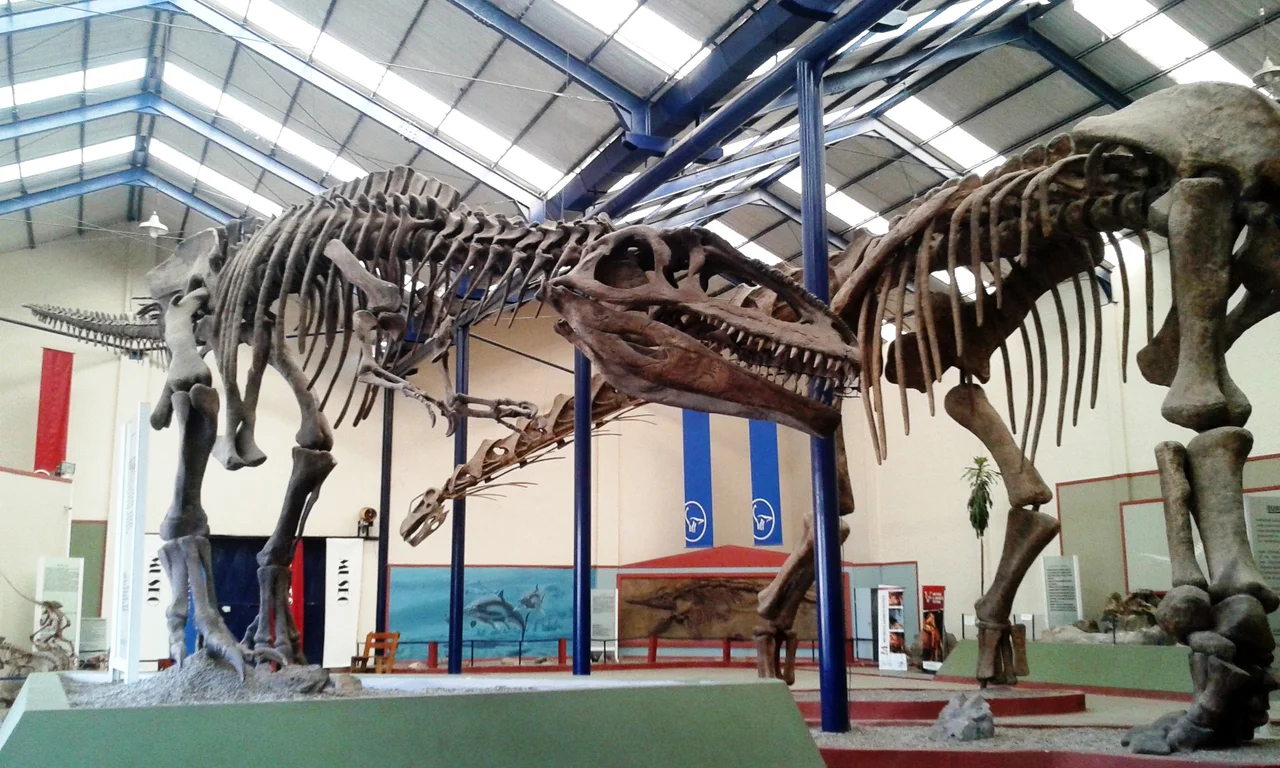
Argentinosaurus is the museum's colossus, and its claim is staggering: among all dinosaurs known from substantial remains, none was bigger. The fossils were unearthed in 1987 by a local farmer, Guillermo Heredia, on his land east of Plaza Huincul, then excavated and formally described in 1993 by the Argentine paleontologists Jose Bonaparte and Rodolfo Coria. From those incomplete bones, scientists estimate the living animal stretched perhaps 35 meters from nose to tail and weighed somewhere between 75 and 100 tonnes - heavier than a dozen elephants, a plant-eater so enormous it pushed against the physical limits of how large a land animal can grow. A single one of its back vertebrae has been reconstructed standing more than a meter and a half tall. The original fossils, the reference specimen for the entire species, are cataloged here as MCF-PVPH-1, and the full reconstructed skeleton towers over visitors. To stand beneath it is to confront a body plan that seems to belong to a different planet.
The Tiniest Giants
But the museum's most tender treasure is not its largest. Its collection includes the only known sauropod embryos ever discovered - unborn dinosaurs preserved inside their eggs, recovered from an immense nesting ground at Auca Mahuida in the Patagonian desert. These fragile finds revealed, for the first time, what the giants looked like before they hatched: their fossilized skin, the shape of their tiny skulls, the start of a life that would have ended in something the size of a Boeing. The museum shared them with the world in an exhibit aptly named Tiniest Giants, mounted in cooperation with the Natural History Museum of Los Angeles County. Eleven holotype specimens - the original reference fossils for entire species - reside in this single collection.
Where Titans and Predators Meet
The museum was established in 1984 with municipal funding. Rodolfo Coria, one of the most important dinosaur hunters Patagonia has produced, became its director in 1997 and oversaw a transformative period of excavation and international collaboration. Fieldwork continues across the fossil-rich badlands, often in partnership with American institutions. Past exhibitions have staged the Mesozoic's ultimate confrontation - a mock battle pairing Argentinosaurus, the largest land animal known, against Giganotosaurus, among the largest meat-eating dinosaurs ever found, assembled in cooperation with the Fernbank Museum of Natural History in Atlanta. In 2024 the museum and its giants drew the cameras of French and Japanese filmmakers for a documentary on the dinosaurs of Patagonia, carrying these Neuquen fossils to audiences a world away.
The Woman Behind the Name
The museum carries the name of Carmen Funes, the pioneer who first settled this corner of the desert. Known across the region as La Pasto Verde - the Green Grass - she had arrived in 1878 as a teenager attached to the army during the Conquest of the Desert, then stayed to run a wayside inn that welcomed travelers, soldiers, and the Pehuenche and Mapuche people of the steppe. She wore men's clothing, raised her own livestock, and held the frontier together through sheer competence until her death in 1916. That a museum of ancient giants bears the name of a frontierswoman is fitting: both speak to a Patagonia where survival was never small.
From the Air
The Carmen Funes Museum stands at roughly 38.93 degrees south, 69.19 degrees west, in Plaza Huincul, central Neuquen province, at 55 Cordoba Avenue just east of where National Route 22 meets Provincial Route 17. From the air, Plaza Huincul appears as a desert city twinned with neighboring Cutral Co, surrounded by the arid badlands of the fossil-bearing Huincul Formation. The nearest major airport is Neuquen's Presidente Peron International Airport (ICAO SAZN) to the east; Zapala Airport (ICAO SAHZ, elevation 3,330 feet) lies to the west. Cruise at 6,000 to 9,000 feet over a flat, low-lying desert landscape with sparse vegetation, low rainfall, and typically excellent visibility - the same stark terrain that, 90 million years ago, was home to the giants now displayed inside.
Nearby Stories
- Ernesto Bachmann Paleontological Museum 27 km away
- Zapala 40 km away
- FaSinPat 40 km away
- Vaca Muerta 50 km away
- Espacio Lejano Station 107 km away
- Lanin National Park 156 km away
- Sol Líneas Aéreas Flight 5428 218 km away
- Lihué Calel National Park 266 km away