.jpg)
Eski Yurt
For decades, shoppers haggled over vegetables and household goods on a square in Bakhchysarai without knowing - or perhaps without being allowed to remember - that they stood on one of the holiest sites in all Crimea. Beneath the market stalls lay the sanctuary of a warrior-saint the Crimean Tatars called a slayer of dragons. Around it stretched a cemetery where khans had been laid to rest. This is Eski Yurt, whose name means "old settlement" or "old headquarters," a whole medieval town that time and empire pressed down into the ground until only fragments broke the surface.
A Town on the Trade Road
In the days of the Golden Horde, Eski Yurt was large - possibly a proper city - strung along an ancient trade route that linked the Black Sea ports of Chersonesus and Kalamita with the Crimean interior. You can measure its old importance by its dead. Its principal cemetery, Qirq Azizler, dating to the fourteenth and fifteenth centuries and now entirely destroyed, was the oldest and largest Muslim burial ground known in the western half of the peninsula. When the Crimean Khanate won independence from the Golden Horde in 1441, the first khans may have made their main residence here, a short mile west of the fortified mountain stronghold of Qirq Yer. Only after Bakhchysarai was founded in 1532 did Eski Yurt slip from power - and, apparently, lose even its original name.
The Saint Who Fought Giants
At the heart of the town stood the Aziz, the sanctuary of Malik Ashtar - a symbolic tomb, or maqam, honoring a seventh-century companion of the Caliph Ali who was actually buried far away in Cairo. Crimean Tatar tales, however, gave him a local death. In their telling, Malik Ashtar was the first to bring Islam to Crimea, a dragon-fighter and a brave warrior mortally wounded in a battle with giants, dying here in Eski Yurt. Generations later, the legends say, wandering dervishes miraculously discovered his grave and raised a shrine over it. People believed that those bitten by snakes could find healing by praying at the Aziz. Within the shrine's mosque, dervishes practiced their mystical rituals and turning, whirling prayer-dances - a place of pilgrimage that drew visitors until the 1920s.
Tombs of the Girays
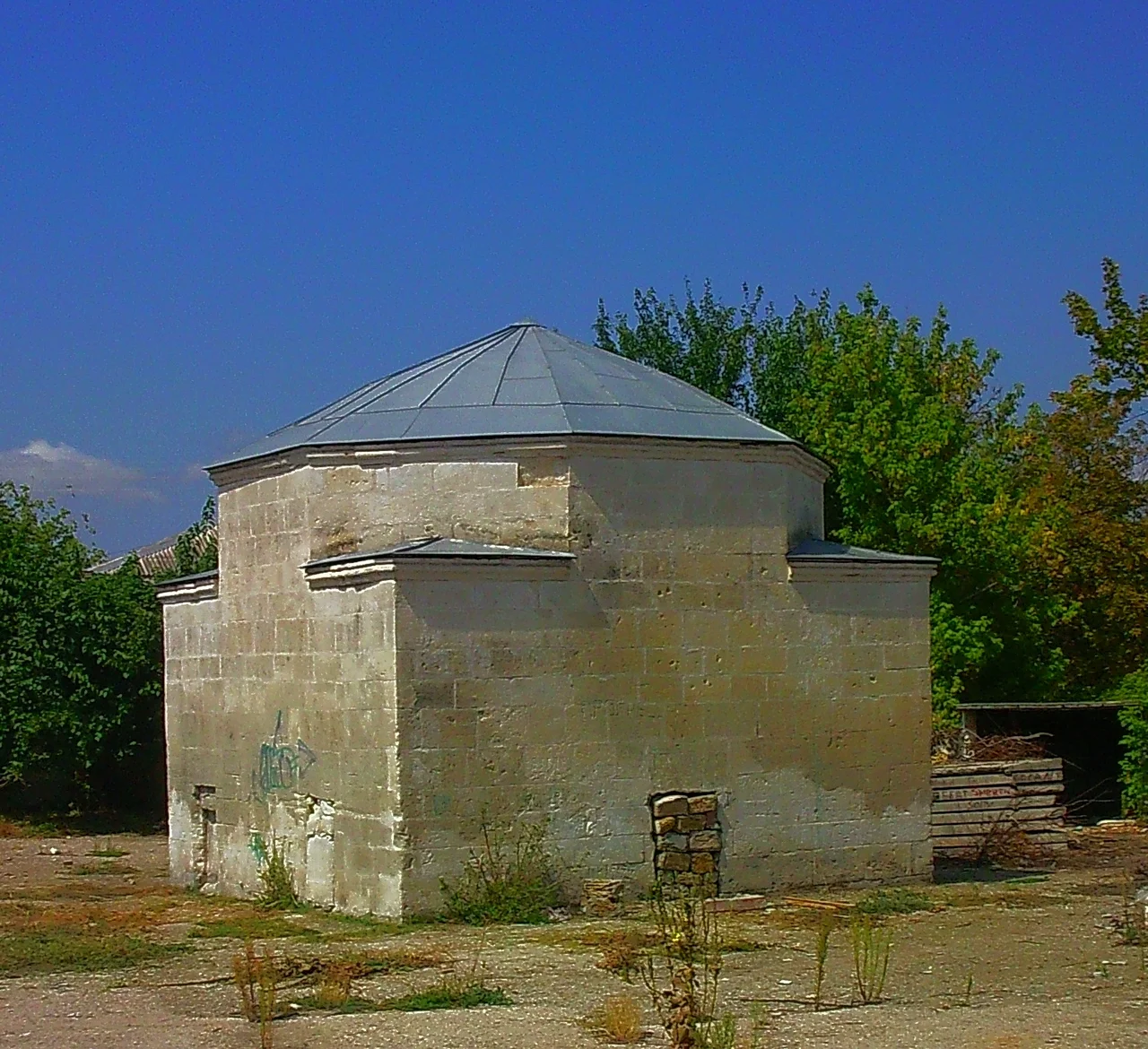
Though the great cemetery is gone, a handful of stone mausolea still stand, small domed türbe scattered among the modern houses. There is the tomb of Bey Yude Sultan, mother of a fifteenth-century bey, and the tomb of Ahmed Bey, named for a gravestone found leaning against its walls. There is a sixteenth-century tomb of Mehmed Bey, and a slender minaret so often mistaken for something else that its true nature has to be insisted upon. Most striking is the family shrine of the ruling dynasty itself: narrative sources record that three khans of the Giray line rest inside it - Mehmed II Giray, who died in 1584, Saadet II Giray in 1588, and Mehmed III Giray in 1629. Kings sleep here, in a place most passersby would never guess held royalty.
Erased and Remembered
The twentieth century tried to erase Eski Yurt twice over. The Soviet regime closed the sanctuary in the 1920s. Then, in 1948, following the mass deportation of the Crimean Tatars from their homeland, the village - like nearly every Crimean place bearing a non-Russian name - was rechristened "Podgorodnyeye" and eventually swallowed into Bakhchysarai. The medieval town lay hidden beneath cottages; the sacred square became a marketplace. But memory outlasted the erasure. When Crimean Tatars began returning in the late 1980s, activists demanded the market leave the holy ground. In 2006 it finally did, clearing the way for a project by the Bakhchysarai Historical and Cultural Reserve to raise a museum - and to let a buried town, at last, be seen.
From the Air
Eski Yurt occupies the western quarter of Bakhchysarai near 44.752 N, 33.846 E, in the Crimean foothills. From roughly 3,500-5,000 feet, follow the valley of the Churuk-Su between limestone ridges; the surviving domed türbe sit amid the town's western housing, with the Khan's Palace to the east and the Chufut-Kale escarpment beyond it. Simferopol International (UKFF) lies about 20 nm northeast; Sevastopol's Belbek (UKFB) to the southwest.
Nearby Stories
- Battle of the Chernaya 6.1 km away
- Kalamita Bay 9.3 km away
- Taigan Safari Park 9.6 km away
- Saky Air Base 29 km away
- Soviet Destroyer Dzerzhinsky 32 km away
- Soviet Destroyer Otvazhny 33 km away
- Bilohirsk 37 km away
- Abkhazia 549 km away