
European Marine Energy Centre
The highest wave ever measured at the test site was over eighteen metres tall. That number alone explains why the European Marine Energy Centre exists where it does. If you want to know whether your wave-energy converter can survive the ocean, you do not test it in a tank. You bolt it to the seabed off Billia Croo on the west coast of Orkney and let the North Atlantic decide. Since 2003, dozens of companies from a dozen countries have done exactly that. Some of their machines went on to commercial deployment. Some sank. All of them learned something the calm waters of a research basin could never have taught them.
Why Orkney
Orkney has more renewable energy capacity than the islands can use, and that surplus is not an accident. The same exposed Atlantic geography that crushed Spanish Armada ships and wrecked countless sailing vessels turns out to be ideal for harvesting energy from waves and tides. The Fall of Warness, on the western edge of the small island of Eday, runs nearly four metres per second at spring tides. That is roughly eight knots of free-flowing seawater, several times denser than air and infinitely more reliable than wind. When the UK government's Science and Technology Committee recommended in 2001 that Britain needed a dedicated marine-energy test centre, Orkney was the obvious choice. The centre opened in 2003 and has been running ever since.
Six Sites, One Mission
EMEC's operations spread across the archipelago. Billia Croo handles full-scale wave testing in fifty to seventy metres of water off Stromness. The Fall of Warness handles full-scale tidal testing off Eday, with eight grid-connected berths. Two scale test sites at Shapinsay Sound and Scapa Flow let developers try smaller prototypes in calmer water before committing to the open Atlantic. A hydrogen plant at Caldale on Eday turns surplus tidal electricity into green hydrogen. The main office sits in Stromness, in the Charles Clouston Building of the Orkney Research and Innovation Campus. Together these sites form a complete laboratory for ocean energy: shelter to severity, prototype to product.
The Machines That Have Tried
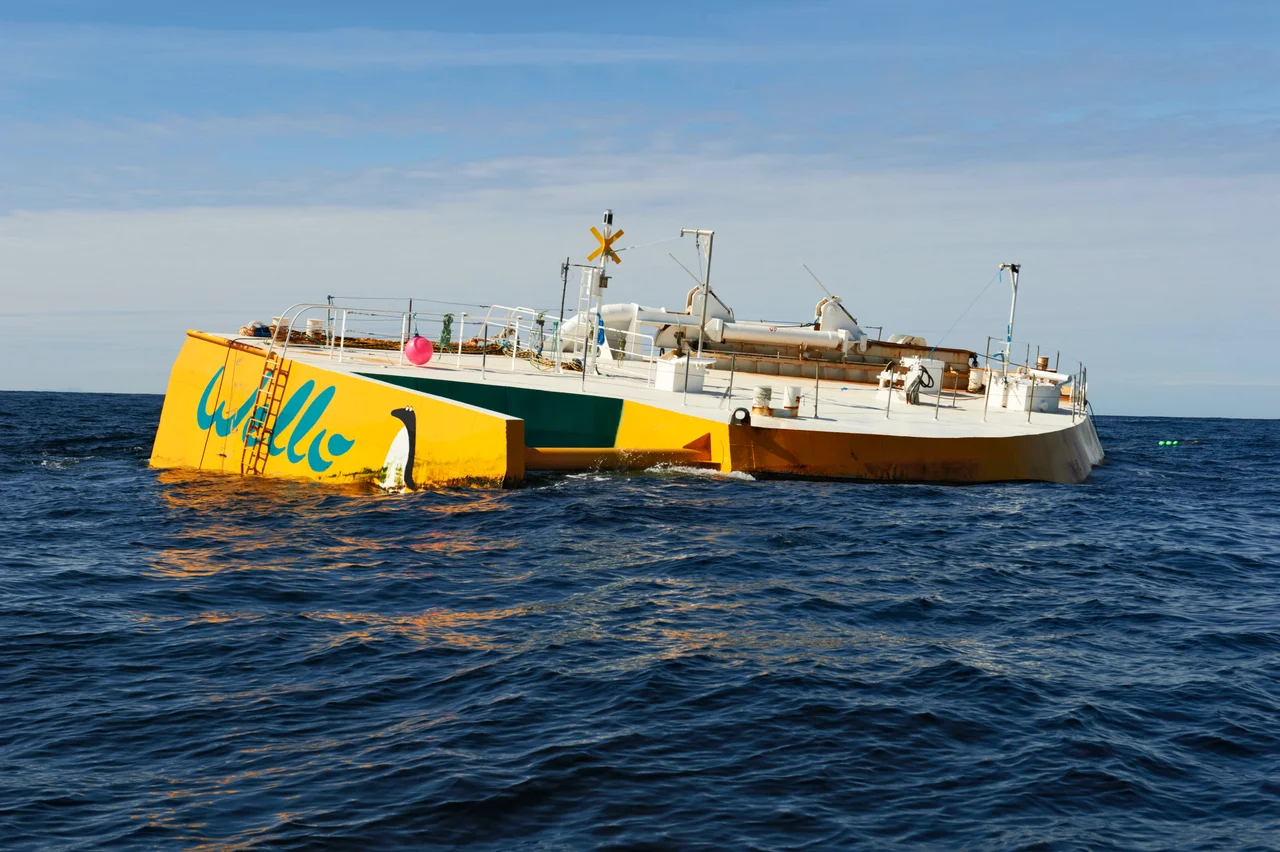
Pelamis Wave Power deployed a 750-kilowatt snake-like converter at Billia Croo in 2004, the first machine in the world to feed wave energy into a national grid. Finland's AW-Energy followed in 2005, then Aquamarine Power's seabed-hinged Oyster in 2009, then a string of others: Wello's Penguin, Seatricity's pump-ashore design, CorPower Ocean's resonant buoy. Some succeeded. The Penguin sank in March 2019. On the tidal side, Dublin-based OpenHydro put the first grid-connected tidal turbine in UK waters in 2006. Orbital Marine Power's floating SR2000 exported more than three gigawatt-hours into the Orkney grid in twelve months of continuous operation. Each deployment was an experiment. Each result, success or failure, fed into the next generation.
Microsoft's Underwater Datacenter
In 2018, EMEC hosted one of the strangest experiments in its history. Microsoft sealed a small datacenter inside a cylindrical pressure vessel and lowered it onto the seabed at the Billia Croo wave test site. The 450-kilowatt server farm sat on the bottom for two years, cooled by the cold North Atlantic and powered by the local grid. When Microsoft pulled the capsule back up in 2020, the servers inside had failed at one-eighth the rate of an equivalent land-based installation. Project Natick proved that the ocean floor was a viable place to run cloud infrastructure. The fact that it happened off Orkney, in water already crowded with prototype turbines, says something about what EMEC has become: a place where ideas about the future of energy and computing collide with the indifference of the North Atlantic.
Hydrogen Island
Orkney generates more renewable electricity than its grid connection to the Scottish mainland can carry. The surplus has to go somewhere, and EMEC's answer is hydrogen. A proton-exchange-membrane electrolyser installed at Caldale in 2016 splits water using excess tidal energy and the output of a community wind turbine, producing green hydrogen for storage and transport. In 2017 the system achieved the world's first tidal-powered hydrogen production. A 1.8-megawatt-hour vanadium-redox-flow battery joined the system in 2022 to smooth the fluctuating supply. The whole arrangement is a working preview of what a fully renewable energy system might look like, running quietly on a small island off the north coast of Scotland.
From the Air
EMEC's headquarters sit in Stromness at 58.96°N, 3.30°W, with test berths scattered across the Orkney archipelago. Kirkwall Airport (EGPA) is the closest field, 15 km east-northeast, with a paved 1,460 m runway. The Billia Croo wave site is 2 km offshore from Stromness on the west coast. The Fall of Warness tidal site sits in the channel between Eday and Rousay, roughly 25 km north of Kirkwall. From altitude in clear weather, look for the distinctive layout of Stromness harbour and the substation buildings at Billia Croo and Eday. Westerly gales routinely exceed 40 kt; visibility can drop from CAVOK to fog in under fifteen minutes. Check EGPA and Wick (EGPC) METARs and TAFs carefully.
Nearby Stories
- Castle of Mey 9.7 km away
- Copinsay 12 km away
- HMS Sword Dance (1918) 27 km away
- Strathnaver Museum 28 km away
- HMS King Edward VII 35 km away
- Fair Isle 74 km away
- Jarlshof 135 km away
- The Laki Eruption: The Volcano That Changed World History 926 km away