.jpg)
Fairy Pools
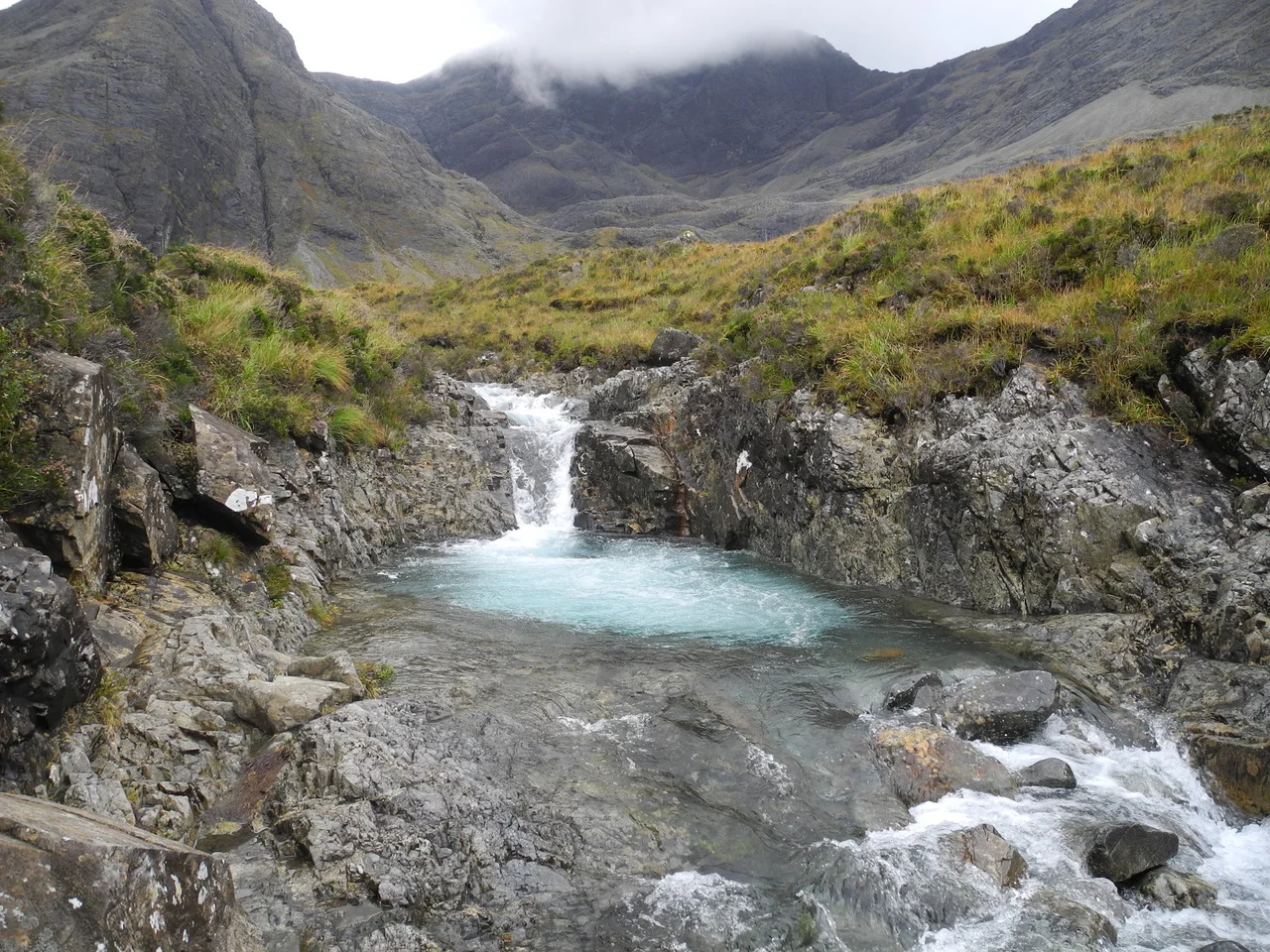
In 2006, thirteen thousand people walked into Coire na Creiche to see the waterfalls. By 2015 that number was eighty-two thousand. By 2019 it was more than a hundred and eighty thousand. The pools themselves have not changed - a chain of plunges in the Allt Coir' a' Mhadaidh, fed by snowmelt and rain off the Cuillin, the colour an unreal aquamarine even on grey days - but the corrie around them has been transformed by feet. A car park appeared. Then a bigger one. Then composting toilets. The Fairy Pools have become Skye's most famous photograph, and one of the clearest case studies in how the internet can break a landscape.
Glen Brittle and the Cauldron
The pools sit in Glen Brittle, on the Allt Coir' a' Mhadaidh - the burn of the corrie of the wolf or dog - draining from the northern flank of the Cuillin into the River Brittle. The corrie itself, Coire na Creiche, takes its name from the old Gaelic for spoils, recalling the cattle raiders who used the enclosed amphitheatre as a refuge for stolen herds. The 1601 Battle of Coire na Creiche - the last clan battle ever fought on Skye - was decided here, at the same flat green ground where tourists now wade and bathe. The Cuillin gabbro above is some of the roughest mountain rock in Britain, frictioned in dry weather, treacherous in wet. The pools below are the run-off, gathered into small basins ringed with stone.
Why the Blue
The blue is real, but it is geological rather than magical. The Allt Coir' a' Mhadaidh runs clear off the mountain - filtered through scree and minimal soil - and the basins are floored with pale gabbro and quartz, which reflect light upward and lend the water its luminous cast. When the sun catches the surface, the colour edges into a green-cyan that does not look like Scottish water. In flat overcast it dims to a steadier blue. Photographs taken from low angles on bright days are responsible for most of the publicity; in person, particularly in driving rain, the effect can be subtler than expected. The first known reference to 'the Fairy Pools' is in a 1931 guide book. There are no known associations with actual fairy folklore, despite the name.
Cold That Hurts
The water is mountain-temperature year-round - somewhere between 4 and 10 degrees Celsius depending on the season, occasionally lower. Wild swimmers come anyway, and have for decades. The Open Cold Water swimming community treats the pools as a pilgrimage. A successful immersion involves stepping into a pool that feels not so much cold as electrically painful; the gasp reflex is involuntary. Most people last under a minute. Some plunge from the rock lip at the upper pool, swim a width, and clamber out shaking. There is no lifeguard, no railing, no cell signal beyond the path. The rocks are slick. The current can pull at the legs. In winter the path freezes; in summer the midge can be unbearable.
Walking In
From the Glen Brittle car park the walk takes around twenty minutes - a stony path, sometimes muddy, with the Cuillin lifting north as you climb. The full sequence of pools extends about a kilometre up the burn. Lower pools are the busiest; higher pools, requiring small scrambles, are quieter. The view back down the glen, especially as the light goes, can be spectacular - the corrie opening to the sea at Loch Brittle, the Cuillin gathering darkness above. Rangers patrol now. There are signs about Leave No Trace, about the fragility of the path edges, about the volume of toilet paper that has had to be removed from behind boulders. The Fairy Pools have become a cautionary tale, but they remain very beautiful.
From the Air
The Fairy Pools sit at 57.25 N, 6.26 W in Glen Brittle, on the northern flank of the Cuillin. Recommended viewing altitude 2,500-4,000 ft AGL to see the pools and the Cuillin ridge above. The corrie opens northwest into Glen Brittle and onward to Loch Brittle. Nearest airports: Inverness (EGPE) ~95 nm east, Glasgow (EGPF) ~140 nm south, Oban (EGEO) ~55 nm south. The Cuillin generate severe orographic effects: rotor downwind, sudden cloud, and rapid visibility loss. The car park at the base of the walk is visible from the air as a roughly rectangular cleared area beside the road.
Nearby Stories
- Bernera Barracks 0.3 km away
- Storr Lochs Hydro-Electric Scheme 1.9 km away
- Eigg 6 km away
- Torridon 10 km away
- Glenfinnan Railway Station 14 km away
- German submarine U-722 16 km away
- Lochmaddy 32 km away
- SS Seniority 46 km away