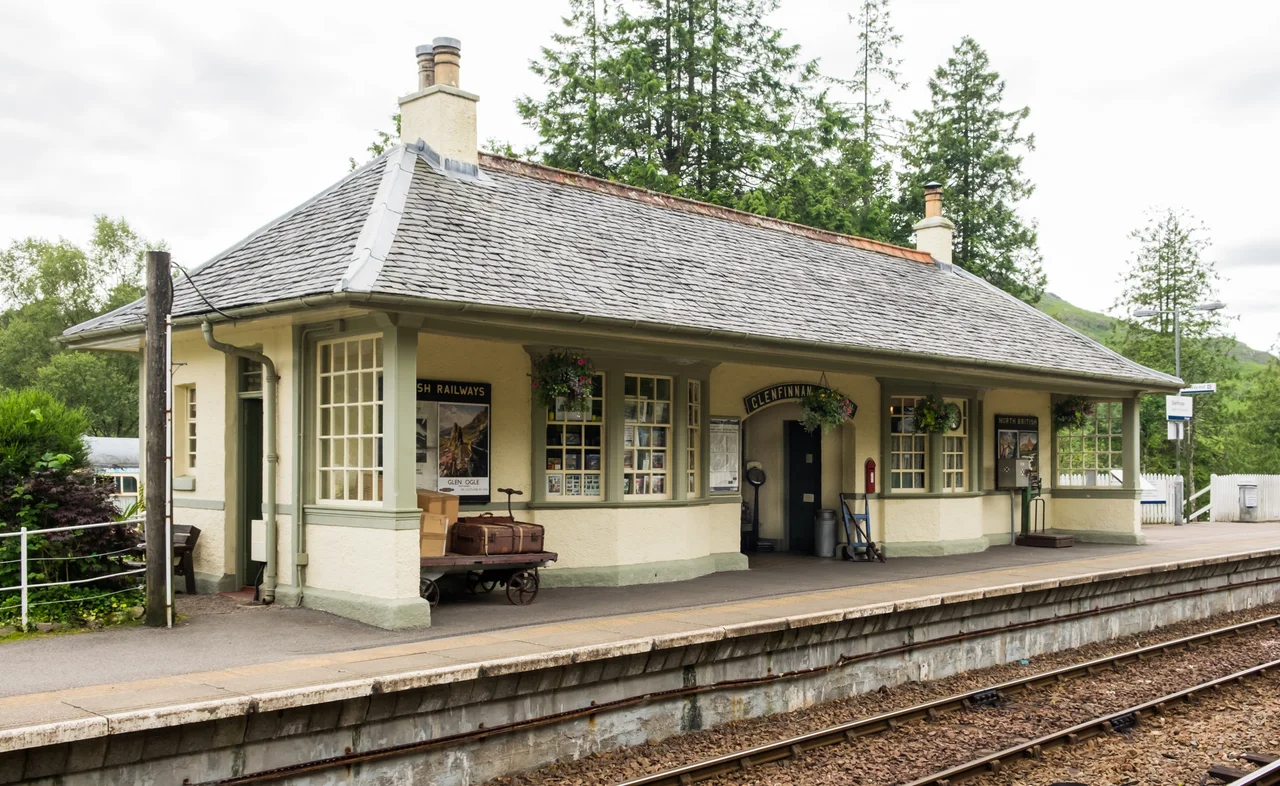

Glenfinnan Railway Station
The station opened on 1 April 1901. It was built of mass concrete, a then-novel material being pushed hard by the engineer Robert McAlpine, whose nickname Concrete Bob would stick to him for the rest of his career. The architect James Miller dressed the building in his familiar chalet style. The whole assembly, station, signal box, and the viaduct just visible to the east, was meant to civilise a stretch of the West Highland Line where the train ran out of more or less inhabited country and into the silent uplands. Then, almost a century later, a fictional locomotive carried a fictional schoolboy across the viaduct on a sheet of cinema, and Glenfinnan became famous for something nobody in 1901 could have imagined.
Concrete Bob's Bridge
The viaduct, about seven-tenths of a mile east of the station, is the reason most visitors come. It curves across the valley of the River Finnan at the head of Loch Shiel on twenty-one tall arches, the largest concrete railway viaduct of its era in Britain when it opened. Robert McAlpine built it. He had to. The Mallaig Extension Railway needed to cross a wide glen, the engineers wanted a graceful curve, and concrete was cheaper and more available than dressed stone in that country. McAlpine had been quietly making concrete his signature material, betting his career on it, and the Glenfinnan Viaduct was one of the bets that paid off. Stand on the platform at the station and you can see the bridge's arches stepping across the valley. Walk the link path the museum has been rebuilding for years and you can stand under them.
A Chalet on the Highland Line
James Miller designed the West Highland Line's distinctive small stations in a soft chalet style, with bracketed eaves and a domestic warmth that softened the harshness of the country they served. Glenfinnan got two platforms either side of a crossing loop, sidings on the south side, and a signal box with fifteen levers at the east end of the Down platform. From the start the line was worked by an electric token system, a way of guaranteeing that only one train at a time held the key to a stretch of single track. The semaphore signals stayed in place until 13 April 1986. The signal box closed soon after, replaced by Radio Electronic Token Block controlled from Banavie. Train Protection and Warning System equipment was added in 2003. The chalet-style booking office stayed where Miller put it.
Camping Coaches and the Station Museum
From 1936 to 1939 the LNER parked a camping coach at Glenfinnan, an old passenger carriage converted into accommodation that travellers could rent for a Highland holiday. The Scottish Region brought camping coaches back from 1952 to 1962. A Pullman replaced the older coach in 1963 and was joined by another in 1967, until the whole programme was wound up at the end of the 1969 season. The booking office is now the Glenfinnan Station Museum, focused on the construction and operation of the Mallaig Extension Railway. The original tablet instruments are preserved. The museum was extensively refurbished in 2011 and 2012, with work on the signal box, a new external staircase, and a reference theatre added. The museum is open seasonally.
The Hogwarts Express Effect
When the Harry Potter films began using the Glenfinnan Viaduct as the route of the fictional Hogwarts Express, the small Highland station found itself on the international map. The Jacobite steam train, a regular summer working between Fort William and Mallaig, became one of the most photographed scheduled passenger trains in Europe. Visitors now walk out from the station along the rebuilt link path to watch the locomotive cross the curve. The station itself, meanwhile, still does what it has always done. Four trains a day run to Mallaig and three to Glasgow Queen Street, plus a fourth that connects with the overnight Caledonian Sleeper to London Euston. Tickets must be bought in advance or from the guard, because the booking office is a museum now.
From the Air
Glenfinnan station sits at 56.872 N, 5.450 W in the Highland council area, beside Loch Shiel at the western end of the Great Glen system. Recommended viewing altitude 1,500-3,000 ft AGL to see the station, viaduct, and loch together. Visual references: the curving Glenfinnan Viaduct just east of the station, Loch Shiel running southwest from the viaduct, and Ben Nevis rising to the east-northeast. Nearest ICAO airport is Inverness (EGPE) well to the northeast; Oban (EGEO) is the regional alternate to the south. Expect Atlantic weather rolling in off Loch Shiel; valley fog is common.
Nearby Stories
- Castle Stalker 5.1 km away
- Battle of Mulroy 6.6 km away
- Glenmoriston 8.2 km away
- Battle of Glen Shiel 9 km away
- High Pasture Cave 9.4 km away
- Inner Hebrides 11 km away
- Port an Eilean Mhòir boat burial 12 km away
- Battle of Dalrigh 25 km away