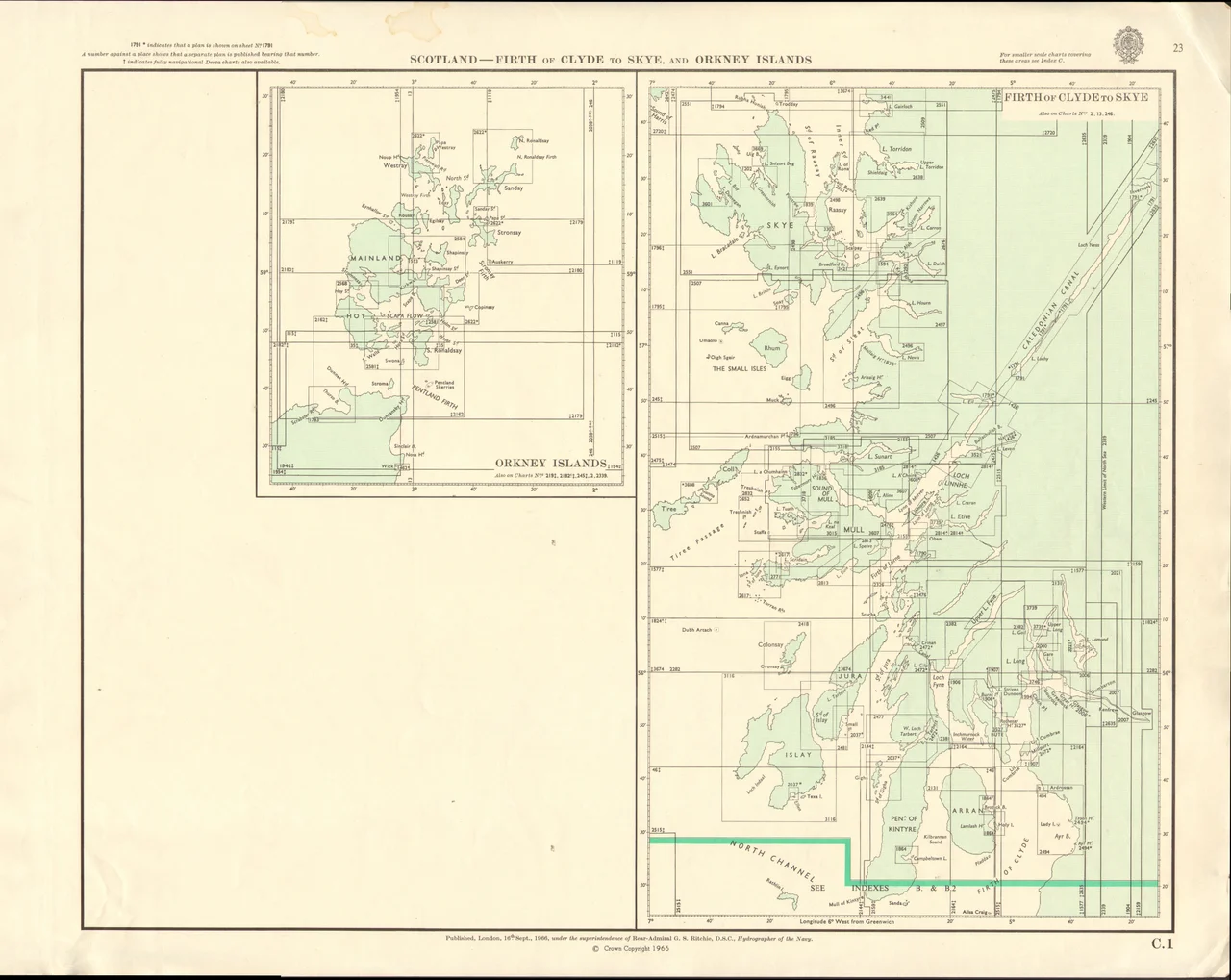
.jpg)
Inner Hebrides
Resist the urge to count them. The Inner Hebrides are fractal: focus on Mull and you notice Ulva offshore, then the channel separating Ulva from Gometra, then the skerries beyond that, and so on until the map dissolves into open Atlantic. Hundreds of islands lie scattered along Scotland's west coast here, and the temptation for a first-time visitor is to try and bag as many as possible. Don't. The ferries radiate out from the mainland with few links between the islands, so an ambitious itinerary means long hours waiting on draughty jetties. The whole point of these islands is the opposite of hurry.
Pick One and Stay
The islands reward depth over breadth. Skye comes first for most travelers, and for good reason: its serrated Cuillin ridge and the weird rock pinnacles of the Trotternish Peninsula make it the most spectacular of all, linked to the mainland by a toll-free bridge. But that accessibility brings crowds. Mull is quieter, its main town of Tobermory a curve of brightly painted houses around a sheltered harbor, reached by a 45-minute ferry from Oban. Islay is ringed by whisky distilleries. Tiree lies low and sandy, scoured by Atlantic winds that, mercifully, keep the midges away. The advice locals give is simple and sound: choose one island, settle in, and save the rest for another year. The weather will decide the rest. When it is good here it is glorious; when it turns, it is misery, and you learn to plan around the possibility that your ferry home simply will not sail.
Where Christianity Came Ashore
In 563, an Irish monk named Columba landed on a tiny island off the tip of Mull with twelve companions and founded a monastery. That island was Iona, and what began on its low green turf became the engine room of Christianity across Scotland. From Iona, monks carried their faith to the Picts and the Scots, then on to the Continent, founding houses in Belgium, France, and Switzerland. Around the year 800, the monks here are believed to have produced the Book of Kells, the most lavishly illuminated manuscript of the early medieval world. They could not keep it. In 806, Viking raiders killed dozens of monks in a bay still called Martyrs' Bay, and the survivors carried the great book to safety in Ireland. To reach Iona today you drive across Mull to Fionnphort, leave the car, and take a short ferry to walk the last stretch to the abbey on foot, much as pilgrims have for fourteen centuries.
The Cave That Made Music
Off the west coast of Mull rises Staffa, an uninhabited slab of rock where a Paleocene lava flow cooled into thousands of hexagonal basalt columns, the same geology that built the Giant's Causeway across the water in Ireland. The sea has carved a cathedral into the columns: Fingal's Cave, where waves boom and echo against the pillared walls. In 1829 the composer Felix Mendelssohn took a boat out to it, was overwhelmed by the sound, and wrote the opening bars of what became his Hebrides Overture. He was not the only pilgrim of the Romantic age. Wordsworth and Keats came, Tennyson came, and Turner came and painted it. You reach Staffa the same way they did, by boat from Mull, weather permitting, which here is always the operative phrase.
The Emptied Land
The quiet of these islands is partly beautiful and partly a wound. The thin soil never supported much beyond subsistence crofting eked out with fishing, and in the nineteenth century the landlords did the arithmetic and found that sheep paid better than tenants. So the people were cleared, sometimes violently, from the small farms their families had worked for generations. The Highland Clearances still surface in local memory and in the ruined stone shells of abandoned townships scattered across the hillsides. Gaelic culture survived the emptying, though thinly. You may still hear the language spoken in a Skye pub or at a village ceilidh, the fiddle and the dancing going late. The machair, the flower-strewn grassland on the sandy islands, blooms each summer over ground that once fed far more people than it does now.
Island Time
What the Inner Hebrides offer, in the end, is a particular relationship with weather, water, and patience. The beaches on Tiree and Islay face open Atlantic and run to white sand and turquoise shallows that look improbable at this latitude, the same parallel as Newfoundland. Seafood comes off local boats; Mull makes good cheese; the distilleries pour peated single malts that taste of the islands they come from. Buses run once or twice a day, timed for the school run, so you walk or you cycle or you drive the lonely single-track roads and pull into passing places to let the sheep go by. The pace is not a marketing slogan here. It is imposed by geography and weather, and once you stop fighting it, it becomes the whole reason to have come.
From the Air
The Inner Hebrides scatter across roughly 56.5°N, 6.0°W along Scotland's west coast. From a cruising altitude of 30,000 feet on a rare clear day, the islands read as a broken mosaic of green and brown set in dark Atlantic water, with Skye's Cuillin ridge the most prominent landmark to the north. For a closer look, descend to 3,000–5,000 feet to trace the indented coastlines and the white-sand bays of Tiree and Islay. Nearest airports: Glasgow (EGPF) is the main gateway, about 90 nautical miles southeast; Oban (EGEO) serves the ferry hub on the mainland; and Tiree (EGPU) offers the rare island landing. Weather is the governing factor year-round, with low cloud, rain, and strong Atlantic winds common; clear visibility is a gift, not an expectation.
Nearby Stories
- Lismore Seminary 6.1 km away
- Muck 8.6 km away
- Tiree 12 km away
- Glenfinnan Railway Station 15 km away
- Colonsay 21 km away
- Loch Fyne 29 km away
- German submarine U-722 44 km away
- HMS Audacious 91 km away