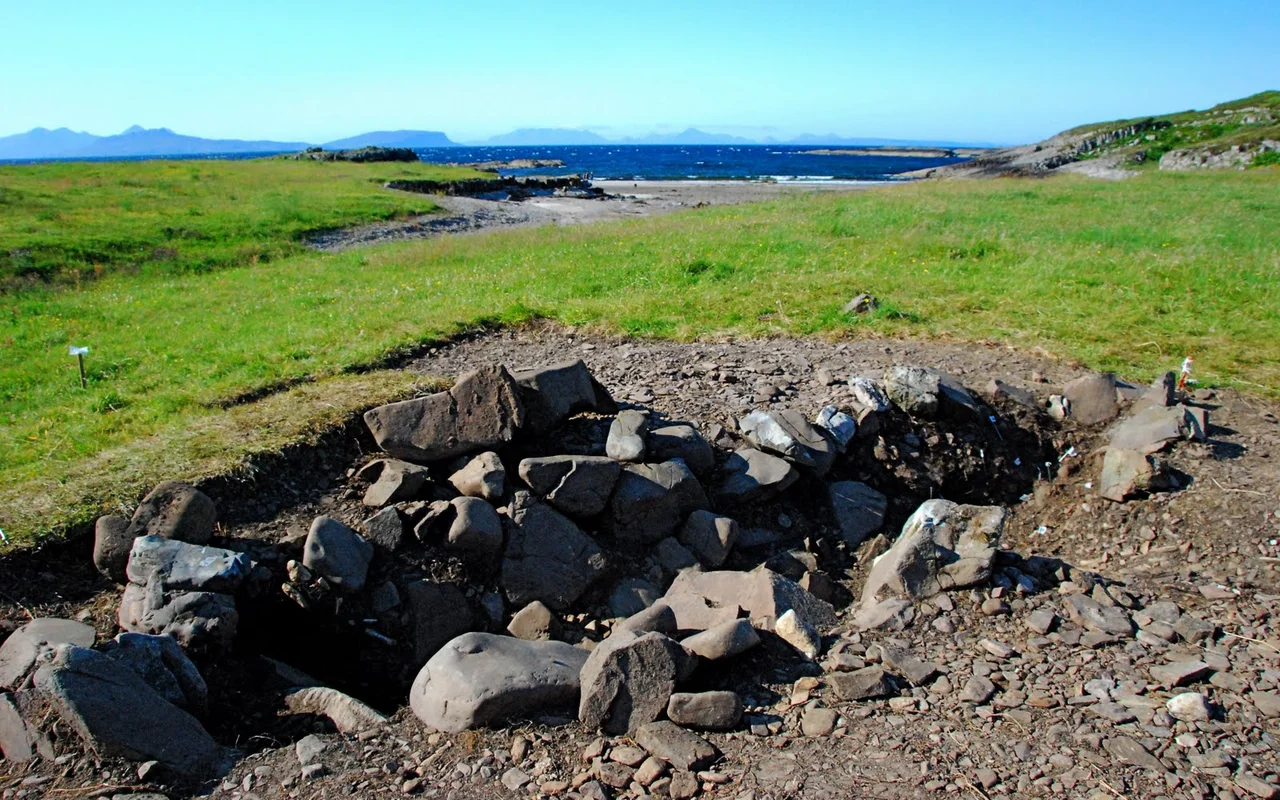

Port an Eilean Mhòir boat burial
On 18 October 2011, archaeologists in Ardnamurchan announced that they had found something nobody had ever uncovered on the British mainland before: an intact Viking boat burial. The vessel was small, only five metres long by one and a half wide. Inside it lay the remains of a man who had been buried with his sword, shield, and spear in the tenth century - placed there a thousand years before students from the universities of Manchester and Leicester scraped soil away from his shield boss in a bay on Scotland's westernmost peninsula. Boat burials had been found on the Scottish islands - in the Hebrides and the Northern Isles - but none, ever, on the mainland itself. This one had survived because no one had thought to look there.
A Sword Bent into an S
The grave goods, when archaeologists worked through them, told a story of a warrior of considerable rank. A shield had been placed over the man's chest in the traditional Viking style. His sword had been deliberately bent into an S-shape - a common Norse ritual that symbolised the death of a weapon along with its owner, ensuring no one else would ever swing it. His spear had been snapped in half and laid beside him. The dead man was also accompanied by an axe, a knife, a bronze ring-pin from Ireland, items of pottery, a whetstone imported from Norway, a drinking horn, a sickle, and a set of tongs and a ladle that still held traces of organic material. The breadth of the assemblage marked him out: this was someone who had moved through the Norse trading world, accumulating objects from across the North Atlantic before being buried with them on a Scottish headland.
Reading His Teeth
Modern science added a layer no medieval mourner could have anticipated. Researchers ran isotopic analyses on the man's tooth enamel and dentine, measuring strontium and lead from the enamel (which records location in early childhood) alongside nitrogen and carbon from the dentine (which records diet up to about age fifteen). The combination produced a biographical sketch. From ages two to six the boy had eaten an overwhelmingly terrestrial diet - bread, meat, dairy - with a brief but significant spike of marine food between ages three and five. From age six onward he ate increasingly from the sea. Cross-referenced with the origins of his grave goods, the data narrowed his probable homeland to one of four places: eastern Ireland, northeastern mainland Scotland, Norway, or Sweden. The man whose name no one remembers had eaten his way across an ocean before he was buried beside it.
A Place That Mattered for Six Thousand Years
The Ardnamurchan Transitions Project, the joint archaeological effort that found the burial, had been investigating the peninsula for several years as part of a much longer inquiry into social change here from the Neolithic to the Highland Clearances - six thousand years of human use of a single small piece of coast. The Viking grave was not isolated. It lay near existing Neolithic and Bronze Age burial cairns. Dr Hannah Cobb, the project's co-director from the University of Manchester, called it 'one of the most important Norse graves ever excavated in Britain' and added that the proximity to the older monuments could not be a coincidence: 'This was a place which was very important to people over an extraordinarily long period of time.' Some of the finds went on display at the British Museum in 2014, in an exhibition titled Vikings: Life and Legend. The rest are still being studied. The headland where he was buried looks out across the open Atlantic toward Skye and the Outer Hebrides - the sea route by which he, or his people, had come.
From the Air
Located at 56.76N, 6.02W at Port an Eilean Mhòir on the north coast of the Ardnamurchan peninsula, facing the Inner Hebridean Sea. The burial site lies about 45 km southeast of Loch na h-Airde on Skye, where Norse-era maritime infrastructure has also been found. Nearest airport: Oban (EGEO), about 35 nm south-southeast. Recommended viewing altitude 1,500-3,000 ft to see the small headland and surrounding bays, with the Small Isles (Eigg, Rum, Muck, and Canna) visible to the northwest in clear weather.
Nearby Stories
- Strontian 3.6 km away
- Gylen Castle 6.7 km away
- Kinloch Castle 10 km away
- Carsaig Arches 16 km away
- Tiree 24 km away
- German submarine U-722 26 km away
- Dun Telve 27 km away
- Skerryvore 29 km away