
One Stove, Three Stones
The philosophy fits on a kitchen shelf. In the language of the Mbaham Matta Wuh people, a cauldron balanced on three stones is how you cook a meal. The cauldron is life itself. The three stones are you, me, and they -- or, as the local saying puts it, "Ko, on, kno mi mbi du Qpona": you, me, and they are related. From this image of a cooking fire, the people of Fakfak built a framework for living together that has outlasted sultanates, colonial occupations, a world war, and the political tensions that still divide West Papua. In 2016, the Indonesian government recognized "Satu Tungku Tiga Batu" -- One Stove, Three Stones -- as intangible cultural heritage at the national level. It may be the only philosophy of religious tolerance in the world that began with someone figuring out the most stable way to balance a pot.
A Port Between Worlds
Fakfak sits on the Onin Peninsula of West Papua, wedged between limestone karst hills that force its streets into switchbacks and dead ends. Once known as Kapaur -- a name still used by biologists describing the region's specimens -- the town was historically one of the few Papuan settlements connected to the wider Malay trading world. The Sultanate of Ternate, hundreds of kilometers to the northwest, claimed sovereignty over Fakfak and its nutmeg-producing hinterland. Through that connection flowed traders and religious teachers from the Arab world and the Indian subcontinent, arriving in the 19th century and possibly earlier. Their descendants still live here, making Fakfak the only town in West Papua with a significant Muslim Indian and Arab Indonesian community. The sultanate eventually granted the Dutch colonial government permission to settle in Papua, and the Netherlands established a permanent post in Fakfak in 1898.
Three Days in April
On April 1, 1942, the Japanese 1st Detachment landed at Fakfak. The small Royal Netherlands East Indies Army garrison surrendered without a fight. A garrison of 67 men from the 24th Special Base Unit moved in and converted the port into a seaplane base, one node in Japan's chain of Pacific outposts. For the next two and a half years, Allied bombers attacked the town repeatedly -- between April 1943 and October 1944, multiple raids struck Fakfak's harbor and facilities. The Japanese held the town until September 1945, when the war ended. The occupation left scars but did not break the community's social fabric. The three stones of the cooking fire -- Islam, Protestantism, and Catholicism -- remained in place.
The Monument in the Center of Town
Walk through Fakfak today and you will find a monument at the town's center commemorating the Satu Tungku Tiga Batu philosophy. It is not decorative; it is declarative. The three stones represent Islam, Protestant Christianity, and Catholic Christianity -- the three faiths that coexist here. Whatever the religion, the people are still considered family. This is not an abstract aspiration carved into stone and forgotten. The Masjid Patimburak, a mosque near Fakfak, was built cooperatively by Muslim and Christian residents, a physical expression of the philosophy that no single stone holds up the cauldron alone. In a region where religious and ethnic tensions have sometimes erupted into violence, Fakfak's tolerance is neither accidental nor naive. It is practiced, maintained, and taught to each generation through stories, ceremonies, and the simple daily act of sharing meals.
Limestone and Rock Paintings
The karst landscape that makes Fakfak's streets so tortuous also makes it beautiful. Limestone hills rise abruptly from the coastal plain, riddled with caves and draped in tropical vegetation. Half an hour from town, white sand beaches stretch for a kilometer and a half along the coast. Nearby, ancient rock paintings mark the cliff faces -- evidence that people have been living in and navigating this limestone labyrinth for thousands of years. The paintings are enigmatic, their meanings debated, but their presence anchors Fakfak in a timeline far deeper than the sultanates and colonial administrations that documented its more recent past. Biologists still use the old name Kapaur when describing species collected from the Onin Peninsula, a reminder that the natural world here predates every human claim.
Between Flags
Fakfak occupies an uneasy political space. Historically bound to the Sultanate of Ternate yet geographically rooted in West Papua, the town and its people have long been caught between competing identities. Some residents align with the Indonesian state; others sympathize with the Free Papua Movement. The population has grown from 12,566 at the 2010 Census to roughly 17,700 today, but Fakfak remains isolated, its port diminished in importance, its role as a trading hub fading. The Muslim Indian and Arab Indonesian communities that once thrived on maritime commerce have shrunk as the port has quieted. Yet the philosophy endures. The three stones still hold the cauldron. In a town where the streets themselves refuse to run straight, the people have found a way to keep their balance.
From the Air
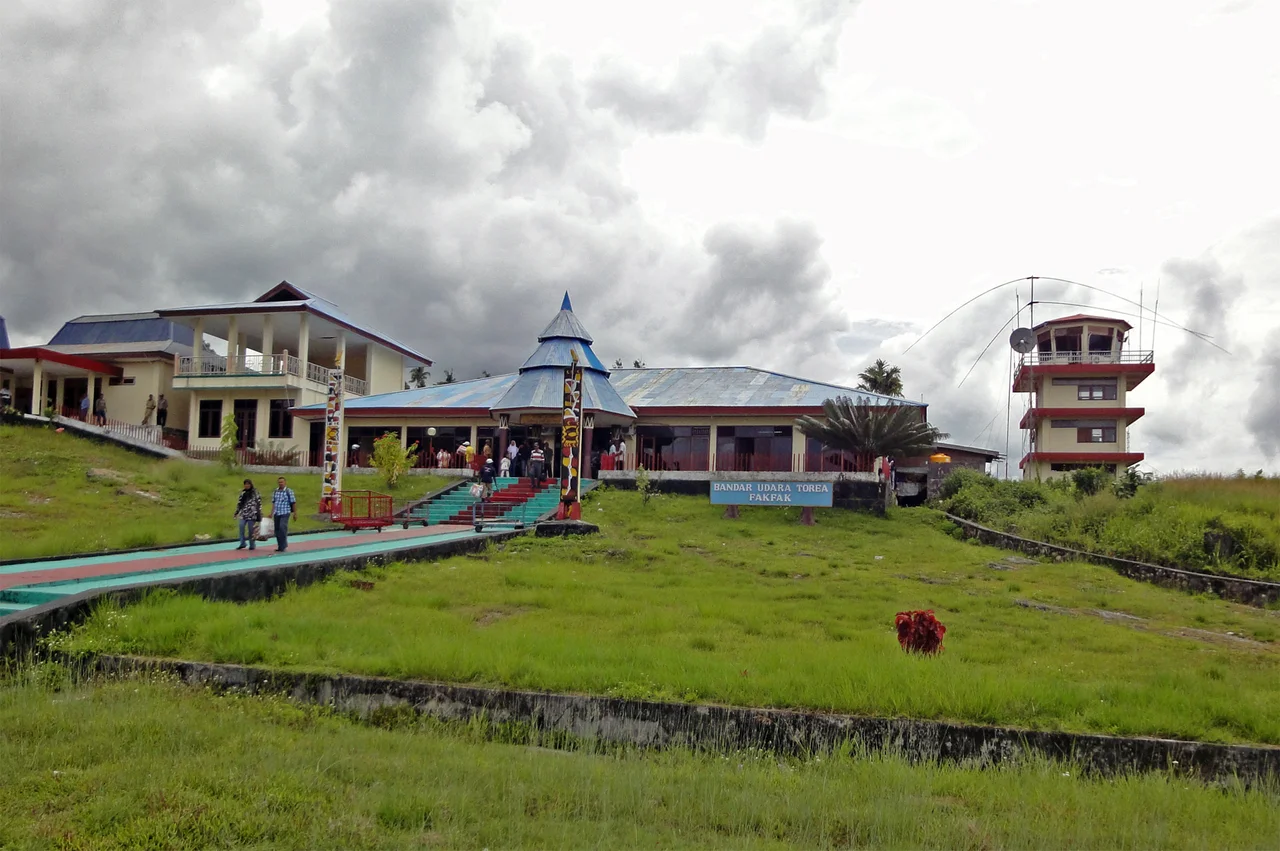
Located at 2.93S, 132.30E on the Onin Peninsula of West Papua, Indonesia. The town is nestled among dramatic limestone karst hills along the coast. Fakfak is served by Siboru Airport (ICAO: WASF, IATA: FKQ), which replaced the older Torea Airport in 2024. The coastline features white sand beaches visible from altitude. Approach from the sea for the best view of the limestone hills and the town threading between them. The Onin Peninsula extends south into the Banda Sea.
Nearby Stories
- The Gamble Beneath Bintuni Bay 35 km away
- Where the Bird's Body Begins 42 km away
- The Captain's Old Habits 104 km away
- Babo Airfield: The Last Stop Before the War 117 km away
- The Prayer That Became an Island 200 km away
- Seven Years of Fever and Flag 204 km away
- Misool: Port of Kings 221 km away
- Banda Neira: Fortress, Prison, Paradise 262 km away