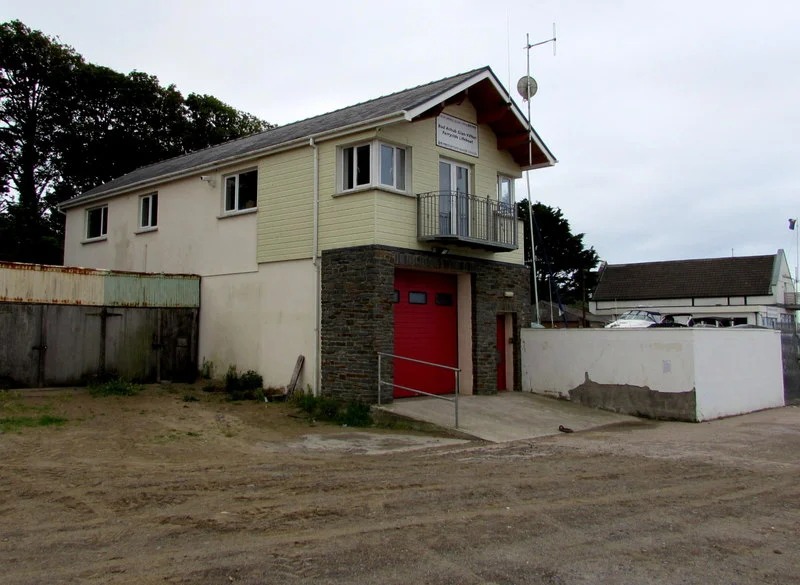

Ferryside Lifeboat
The boat is called The Freemason because the Freemasons bought it. In 2012, when the Ferryside crew needed a new lifeboat to replace the eighth in their independent service's history, the Province of West Wales Freemasons donated 50,000 pounds towards the 80,000 cost. The rest came from local fundraising, the kind of village-hall and chip-shop work that small lifeboat stations have always run on. On 1 September 2012, with music from the Carmarthen Symphonic Wind Band and the Deputy Grand Master Brian Hilling handing over the keys, the new Ribcraft RIB was dedicated, named, and rolled into service. She has been answering distress calls on the Tywi estuary ever since.
Two Hundred Years of Saving
The story of lifesaving on this coast begins in 1835 - eleven years after Sir William Hillary founded the institution that would become the RNLI. The first station, Carmarthen Lifeboat Station, was sited not at Ferryside but across the water at Laugharne; it closed in 1843 with no recorded service. A new station was established at Ferryside itself in 1860 and served for an exact century, closing on 30 June 1960 when the Tywi was no longer used commercially and the demand for full-time cover had thinned. In the 125 years between the first Laugharne lifeboat and the last Ferryside one, the boats had been launched 57 times and saved 94 lives. A modest tally on paper. Each of those numbers a person who got home.
St John Cymru and the Inflatable
By the early 1960s, leisure boating on the estuary had taken off in a way the old commercial-port lifeboat service had never been designed for. The Llanelli division of St John Ambulance Cymru saw the problem first - cadets watching swimmers and small craft get into trouble and no rescue service to call. In 1966 they started a beach patrol under the guidance of Wilf Holloway. The Llanelli inflatable boat manufacturer Avon Inflatables donated a small RIB. From those modest beginnings, a permanent independent service grew - one of more than seventy independent lifeboat stations around the coasts of Britain and Ireland, working alongside the RNLI under the same coastguard coordination but funded and run separately.
The Talus Tractor
A lifeboat on a tidal estuary lives or dies by its launch tractor. The Tywi at low water exposes a wide field of sand and mud that no road vehicle can cross; you need a machine purpose-built to drive through water, sand and mud, sometimes fully submerged. In 2016 the Ferryside crew started fundraising for a new one. A 10,000-pound grant from Trinity House and a 2,500-pound gift via the Pendine branch of J & J Wilson got them a second-hand Talus MB-H amphibious tractor, T112, refurbished by its original builders Clayton Engineering. T112 had previously served at Anstruther Lifeboat Station on the Firth of Forth between 1991 and 2003. It arrived at Ferryside on Friday 30 June 2017 and has been hauling The Freemason in and out of the estuary ever since.
Standalone
In 2024 a decision was taken - amicably, for reasons of mutual benefit, in the language of the formal announcement - to separate the operations of St John Cymru and the Ferryside Marine Division. The lifeboat became a standalone charity, registered with the Charity Commission on 13 February 2025 as registration number 1212126. It retains its declared facility status with HM Coastguard and its membership of the National Independent Lifeboats Association. Practically, almost nothing about the working life of the crew changed. The same volunteers turn out for the same calls. The pager still buzzes for the same 999s and the same VHF Channel 16 maydays. What changed is the legal structure and the bank account.
What the Tide Does Here
The Three Rivers estuary - Tywi, Taf and Gwendraeth converging into Carmarthen Bay - has one of the largest tidal ranges in the world, second only to the Bay of Fundy. At spring tides the water can rise or fall more than eight metres in six hours. Channels that look like fordable streams at low water are forty feet deep and racing at the turn. Sandbars appear and vanish overnight. The Ferryside crew average around 28 callouts a year, a number that has been rising as more pleasure craft find the bay. They are on call twenty-four hours a day every day, all year, all weather. They are volunteers. They are local. They pay for the fuel and the kit out of the box on the shop counter at the Ship Inn and the collection at the village fete. They get up at 3am in the rain because someone's father is in trouble on the sand.
From the Air
Ferryside Lifeboat operates from the beach at 51.77N, 4.37W on the east shore of the Tywi estuary, about 9 statute miles south-west of Carmarthen. The boathouse and Talus tractor are visible from the air on the foreshore. Best viewed from 1,500 to 3,000 feet. EGFP Pembrey is 6 nautical miles southeast; EGFH Swansea 21 nautical miles east-southeast. Check Pembrey AWR airspace status before low-level flying.
Nearby Stories
- Teifi Valley Railway 1.2 km away
- Haverfordwest 5.1 km away
- Mumbles Lifeboat Disaster 8.1 km away
- Neath and Tennant Canal 12 km away
- Strata Florida Abbey 27 km away
- HMS H47 31 km away
- Ilfracombe Lifeboat Station 38 km away
- HMHS Glenart Castle 44 km away