
Ferryside
On 30 March 2005, Ferryside became the first village in the United Kingdom to lose its analogue television signal. The residents had voted for it. After a three-month trial of digital receivers - one per set, with a helpline for the teething problems and one-to-one support for the elderly - more than 85% of households responded to the follow-up survey and 98% of those who answered voted to keep the digital. The analogue channels went dark from the local transmitter at the end of March, except for BBC Two Wales, which the villagers stubbornly kept because it ran certain programmes the digital alternative did not. An 800-year-old ferry village had become, briefly and improbably, the technological vanguard of British broadcasting.
The Ferry that Came Before
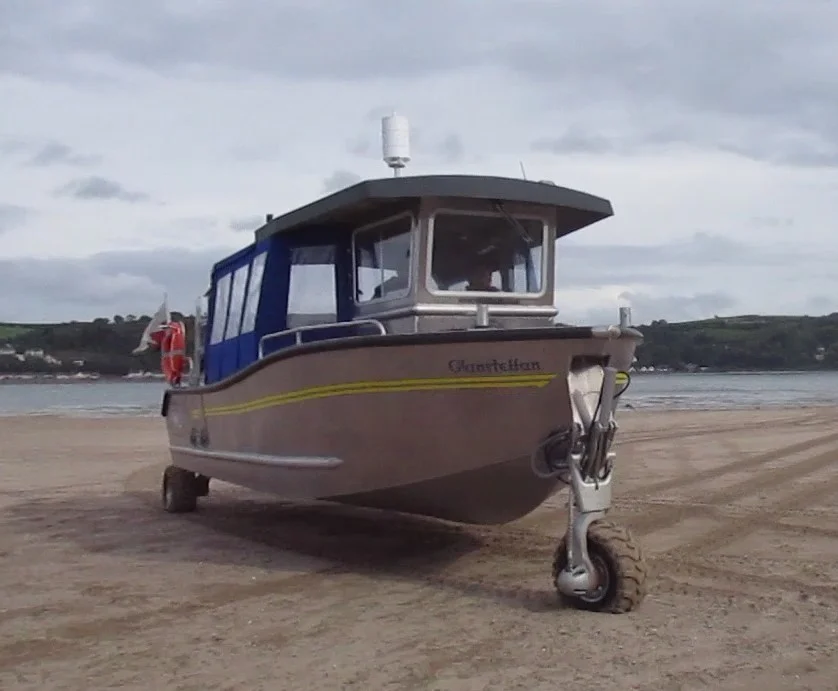
The village owes its existence and its name to the crossing of the River Tywi. Long before Brunel's railway arrived in 1852, before the holiday cottages and the retirees and the lifeboat shed, this was a landing place on the route to Llansteffan opposite. Giraldus Cambrensis - Gerald of Wales - is recorded as using the ferry in 1188. By 1844 the parish had 895 residents, mostly fishermen and cocklewomen and the families that served the boats. Carmarthen Bay opens just downstream, and the village faces west across the estuary to Llansteffan Castle on the other side, watching the sun go down behind it every evening. In 2018 an amphibious craft from a New Zealand company called Sealegs started running a tourist crossing - a 007-style vehicle that drives down the slipway, swims to Llansteffan and walks up the other side - reviving in modified form the route Gerald rode 830 years before.
Dylan Thomas at Alpha House
Dylan Thomas was related to Ferryside by marriage. His maternal great-aunt Amy had married the village's lifeboat coxswain, Captain David Jones, and they lived at Alpha House on Eva Terrace. Their son David ran the Dorothy Cafe next to the Ship Inn; David's son Raymond was Dylan's second cousin and the boy he played with on the beach. Thomas came down here as a child and again as an adult after he moved to Laugharne up the coast. He drank at the White Lion. He was friends with Dick Bright at 2 Neptune Villas. Bright's niece Beryl Hughes wrote down the stories. One reading of Under Milk Wood places the fictional Llareggub here at least as much as in Laugharne - the 1939 War Register for Ferryside shows an occupational profile of seafarers, fishermen, cockle gatherers and farmers that maps onto the play closely enough that some scholars argue Ferryside and New Quay are better fits than Laugharne itself.
Lifeboats and the Hostile Tide
The waters off Ferryside are no kinder than they look. The Three Rivers estuary - where the Tywi, Taf and Gwendraeth converge - has the second-largest tidal range in the world after the Bay of Fundy. At low water the channels twist between miles of exposed sand; at high water they refill with the speed of a chase scene. Lifeboats have been on this coast since 1835. The current Ferryside Lifeboat, an independent service founded in 1966 and now a standalone charity, runs a Ribcraft RIB called The Freemason and answers an average of 28 calls a year, a number rising as more pleasure craft find the bay. The boathouse, opened by the Duchess of Gloucester in 2010, sits on the beach near the railway. Volunteers run it. Donations fund it. The crews are local.
Cockle Wars
The estuary used to belong, in working terms, to the cocklewomen of Llansaint up the road. By 1900 they were lifting around 650 tons a year from the sand. The trade thinned. Then in 1993 the cocklebeds at Ferryside experienced one of their rare bumper years, and because the beds were unlicensed there was nothing to stop anyone with a rake from joining in. Crews drove down from the Gower, from Liverpool, from the Dee estuary, from Glasgow. They fought on the beach. The papers called it the cockle wars and Parliament eventually called for the beds to be licensed, which they were. Ferryside today still gets occasional commercial openings when the population is right - tractors on the sand, hundreds of pickers, a brief reanimation of an industry that has been pottering along here for a thousand years.
Carriage Trade
The 2011 census put the village population at 846. It has the railway station Brunel built in 1852 on the South Wales Railway, a school that has been on the same site for over 150 years, the parish church of St Ishmael's standing on its rock above the shore, the lifeboat shed, the yacht club, and three pubs that have outlasted most of the people who drank in them. Notable ex-residents include the painter Gordon Stuart - whose portraits of Kingsley Amis, Dylan Thomas and Huw Wheldon hang in the National Portrait Gallery - and the parasitologist J.W.W. Stephens FRS, who was born here in 1865. Less celebrated locally: General Sir Thomas Picton, born nearby at Iscoed Mansion, former governor of Trinidad whose reputation rests on both his courage at Waterloo - where he died - and his documented cruelty to slaves on the island he governed. History does not always render its men neatly.
From the Air
Ferryside is at 51.77N, 4.37W on the east shore of the Tywi estuary, about 8.5 statute miles south of Carmarthen. Best viewed from 1,500 to 3,000 feet to take in the full Three Rivers estuary. Llansteffan Castle is the prominent landmark on the west shore opposite. EGFP Pembrey is 6 nautical miles southeast; EGFE Haverfordwest about 30 nautical miles west. Pembrey AWR airspace is nearby - check NOTAMs.
Nearby Stories
- Teifi Valley Railway 1.2 km away
- Haverfordwest 5.1 km away
- Mumbles Lifeboat Disaster 8.1 km away
- Neath and Tennant Canal 12 km away
- Strata Florida Abbey 27 km away
- HMS H47 31 km away
- Ilfracombe Lifeboat Station 38 km away
- HMHS Glenart Castle 44 km away