
FNB Stadium
From the air it looks like a giant clay pot resting on the veld, its outer skin a mosaic of earth-toned tiles meant to glow like fire at dusk. South Africans call it the Calabash, after the gourd used as a cooking vessel across the continent. On 11 July 2010, inside that pot, Spain beat the Netherlands one to nil to win the FIFA World Cup, Andrés Iniesta striking in the 116th minute. But the night belonged to an older man wheeled out in a golf cart, wrapped against the winter cold, smiling at a roaring crowd. It was Nelson Mandela's final public appearance, and FNB Stadium had been the stage for the most important moments of his nation's rebirth.
A Pot Among Stadiums
First built in 1987 and known officially as FNB Stadium since 1989, the ground was reborn for the 2010 World Cup. Architects from Populous and Boogertman + Partners reshaped it into the calabash, a vast bowl wrapped in a skin of mottled fiber-cement panels with a ring of openings near the base lit from below, so that at night it seems to sit over glowing coals. It became the largest stadium in Africa, with a capacity of nearly 95,000. Ten dark vertical lines break the facade. Nine point toward the other 2010 host stadiums; because nine is an unlucky number in some local tradition, a tenth was added, aimed at Berlin's Olympic Stadium, which had hosted the previous final. The line marks the road to the final, and the Calabash sat at its end.
Where a Free South Africa Began
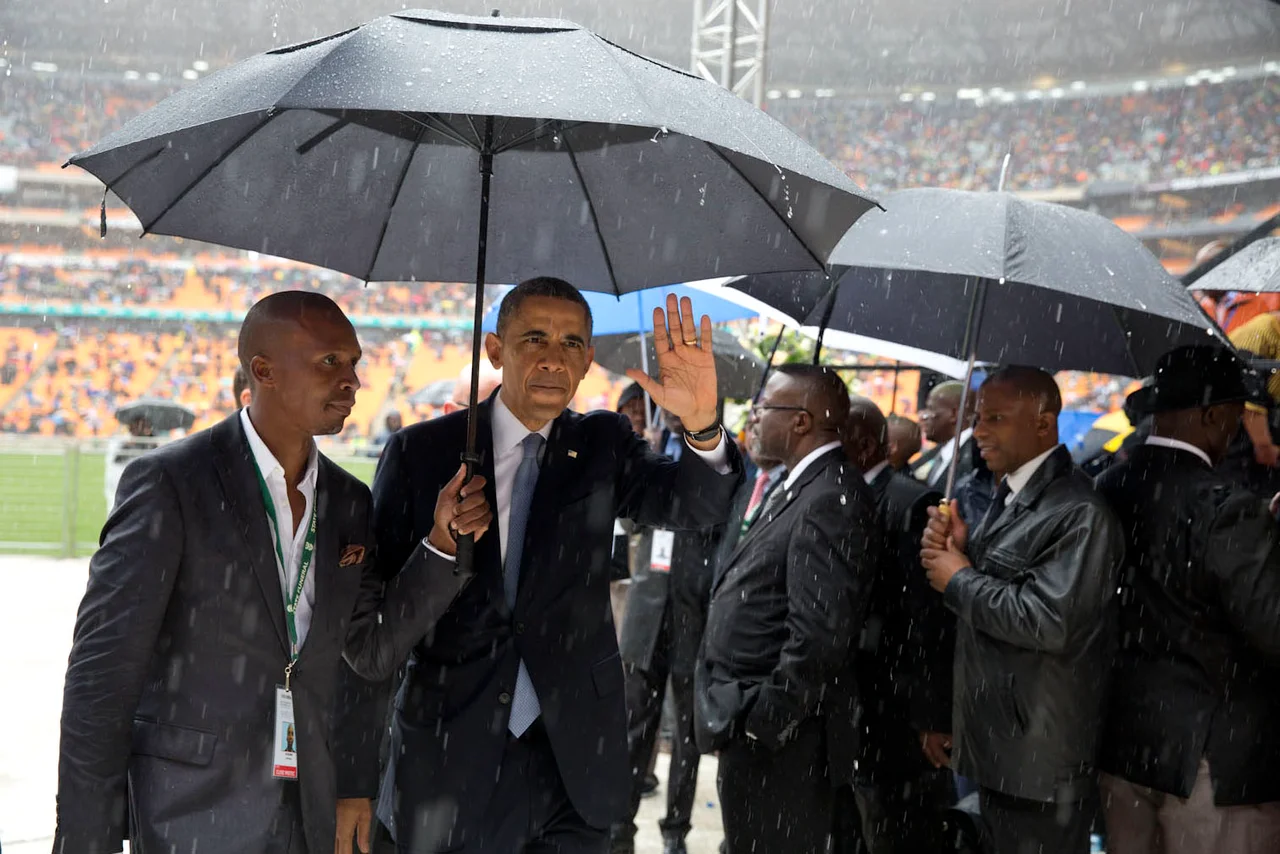
Long before the World Cup, this ground was woven into the story of liberation. It was here that Nelson Mandela gave his first Johannesburg speech after walking out of prison in 1990, addressing a city he had not seen as a free man in twenty-seven years. When the assassinated Communist leader Chris Hani was buried in April 1993, his funeral filled this stadium; weeks later, the funeral of the exiled ANC president Oliver Tambo was also held here. The venue stands on the edge of Soweto, the township whose name is shorthand for the long struggle against apartheid, and it has carried that history in its concrete ever since. When Mandela died in December 2013, the nation's official memorial service was held here, and world leaders, including a rain-soaked Barack Obama, came to say goodbye.
The Home of the Game
Football is the Calabash's first language. It is the home of Kaizer Chiefs and the favored ground for the Soweto derby against Orlando Pirates, the biggest fixture in South African sport. The national team, Bafana Bafana, treats it as a spiritual home; here they lifted the 1996 Africa Cup of Nations, beating Tunisia two to nil with Mandela watching from the stands. Here, too, the country secured its first World Cup qualification in 1997 through a Phil Masinga goal against Congo. In 2010 the stadium hosted the World Cup opening ceremony, the opener between South Africa and Mexico, and the quarter-final in which Uruguay edged Ghana on penalties after Luis Suárez's notorious goal-line handball denied Africa a first semi-final. The rebuilt stadium even set rugby attendance records, packing in more than 94,000 for matches against the All Blacks.
The Weight of a Crowd
A stadium this size carries risk as well as joy. On 29 July 2017, two people died and seventeen were hurt in a crush as fans pressed to enter for another Chiefs–Pirates derby, a grim echo of the Ellis Park disaster sixteen years earlier. The Calabash has also drawn the world's biggest acts, from Coldplay, who filmed part of a music video here, to global concerts and political rallies. It remains the beating heart of South African sport, a structure that wears its country's history on its tiled skin: the pot in which a nation cooked up its hopes, mourned its dead, and once, on a cold July night, gave its greatest son a final ovation.
From the Air
FNB Stadium, also called Soccer City or the Calabash, sits in Nasrec on the edge of Soweto, southwest of central Johannesburg, near 26.235°S, 27.982°E, on the Highveld plateau roughly 1,700 meters above sea level. From the air it is unmistakable: a single enormous earth-toned bowl shaped like a gourd, ringed by open parkland and exhibition grounds, with the mine dumps of the old gold reef to the north and the dense rooftops of Soweto to the west. O. R. Tambo International Airport (ICAO: FAOR) lies about 30 km to the east-northeast; Rand Airport (ICAO: FAGM) in Germiston is roughly 18 km to the east for light aircraft. Dry, clear winter skies give the best visibility; the stadium's tiles read most vividly in low-angle morning or evening light.
Nearby Stories
- Kyalami Grand Prix Circuit 12 km away
- TauTona Mine 16 km away
- Boipatong Massacre 17 km away
- Battle of Bronkhorstspruit 33 km away
- Nan Hua Temple 57 km away
- Royal Bafokeng Nation 59 km away
- Secunda CTL 69 km away
- Vaal Reefs Mining Disaster 79 km away