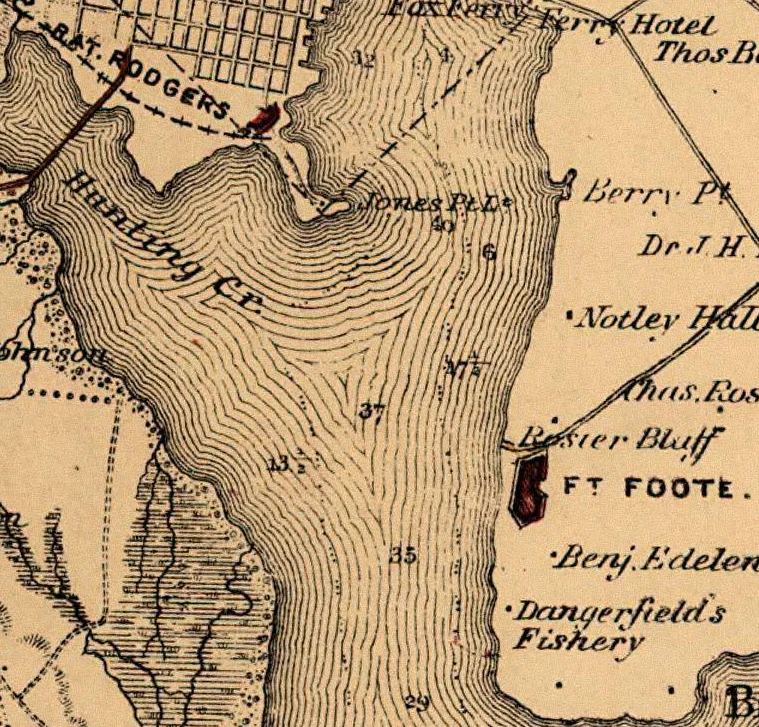

Fort Foote
Gideon Welles, Lincoln's Secretary of the Navy, stood on the parapet of Fort Foote on October 22, 1864 and watched the new 200-pounder Parrott rifles fire their first salute over the Potomac. The big guns roared, the smoke drifted downriver, and Welles wrote that he felt a melancholy come over him. The fort is not wanted, he confided to his diary, and will never fire a hostile gun. No hostile fleet will ever ascend the Potomac. He was correct. Fort Foote was completed three weeks before Appomattox. Its garrison fired the great guns in practice, in salute, and in mourning for Lincoln. They never fired them in anger.
The Ironclad Scare
Until 1862 the only thing standing between Washington and a hostile fleet on the Potomac was Fort Washington, a stone work originally built in the War of 1812. Then on March 8 and 9 of that year, the USS Monitor and the CSS Virginia clashed at Hampton Roads in the first battle of ironclads, and every senior officer in the United States government suddenly understood that wooden ships had become obsolete. If the Confederacy could build an ironclad - or worse, if England or France could be persuaded to send one - then Fort Washington's old smoothbores would not stop it. A commission appointed by Secretary of War Edwin Stanton recommended building a covering battery on the Maryland shore opposite Alexandria, at a place called Rosier's Bluff. The bluff rose 100 feet straight up from the water. The river channel ran close inshore. The site was nearly perfect.
Cedar Posts and Chestnut Logs
Colonel John Gross Barnard, chief engineer of the Washington defenses, broke ground in the winter of 1862-63. Construction was slow until four companies of soldiers arrived in August 1863 to do the heavy work. Because the bluff was a coastal position, iron was used sparingly. The fort was almost entirely wood and earth. Cedar posts framed the magazines and bombproofs. Chestnut logs roofed them. The river-facing wall ran over 500 feet long with earth ramparts 20 feet thick, and a central traverse housed the powder magazines and storage for the planned heavy ordnance. The guns themselves trickled in over two years. The first 15-inch Rodman arrived in late 1863. The fort was not fully armed until April 1865 and not formally complete until June 6. By then it carried two 15-inch Rodmans, four 200-pounder Parrotts, and eight 30-pounder Parrotts - enough firepower to obliterate any ironclad afloat. Secretary of State William Seward attended the naming ceremony, honoring Admiral Andrew Hull Foote, who had commanded Union gunboats on the Mississippi and died in June 1863.
Malaria and Mosquitoes
Garrison life at Fort Foote followed the same rhythm as any other Civil War-era post - reveille before sunrise, drill and gunnery practice through the day, taps at nine in the evening. But the bluff sat above a large swamp, and the swamp produced clouds of mosquitoes every summer. Malaria put as much as half the garrison on the sick list during the warm months. Typhoid struck regularly because the water supply was contaminated. The 10-by-40-foot post hospital was perpetually full. The fort was only six miles from Washington as the crow flies, but the nearest land route, Piscataway Road, was over a mile away through swamp and only usable when the river froze. Everything else - mail, supplies, visitors - came in by boat to the wharf at the bottom of the bluff, completed in 1864. Ordinary enlisted men were rarely furloughed to Alexandria or Washington. Officers and visiting dignitaries came and went freely. The garrison stayed put and itched.
A Park That Almost Was
The Army held Fort Foote until 1878, then abandoned it. The bluff was briefly used during both world wars - the U.S. Army installed antiaircraft batteries during the Second World War - but the earthworks themselves slowly returned to forest. In the 1960s the Smithsonian and the National Park Service proposed turning the fort site into Bicentennial Park, a combination outdoor museum and Revolutionary War encampment to celebrate the country's 200th anniversary in 1976. Plans included a recreated patriot camp, a parade ground, and a Naval Ordnance Park along the river. Local residents opposed the development. The National Bicentennial Commission concluded that Fort Foote had limited relevance and significance to the Revolution it was supposed to commemorate. By 1973 the plan had collapsed. The site became Fort Foote Park, run by the National Park Service as part of National Capital Parks-East, and it remains mostly forested. Two of the original bastions are preserved. Two 15-inch Rodman guns sit on reproduction carriages overlooking the Potomac. Only one of those guns ever served at the fort. The other came from Battery Rodgers, which stood on the Alexandria side of the river during the war and was demolished long ago. The bluff is quiet. The river still flows past it. The hostile fleet Welles predicted would never come never did.
From the Air
Fort Foote occupies the top of Rosier's Bluff on the Maryland shore of the Potomac at roughly 38.77 degrees N, 77.03 degrees W, six river miles south of the U.S. Capitol. The bluff rises about 100 feet above the water. From 2,000 to 3,500 feet AGL the bluff, the Potomac bend, and Alexandria opposite are easily visible. This is Class B airspace, deep inside the Washington Tri-Area SFRA - flight planning, ADS-B, and Potomac TRACON clearance are mandatory. P-56 over the Capitol is just north. Reagan National (KDCA) is six miles north. Andrews JBA (KADW) is five miles east. Plan very carefully.
Nearby Stories
- Crownsville Hospital Center 3.5 km away
- Battle of Thoroughfare Gap 7.4 km away
- Battle of Unison 8.6 km away
- Mallows Bay-Potomac River National Marine Sanctuary 9.1 km away
- Murders of Katherine and Sheila Lyon 9.9 km away
- Germanna 15 km away
- Capital Gazette Shooting 27 km away
- St. Mary's City, Maryland 39 km away