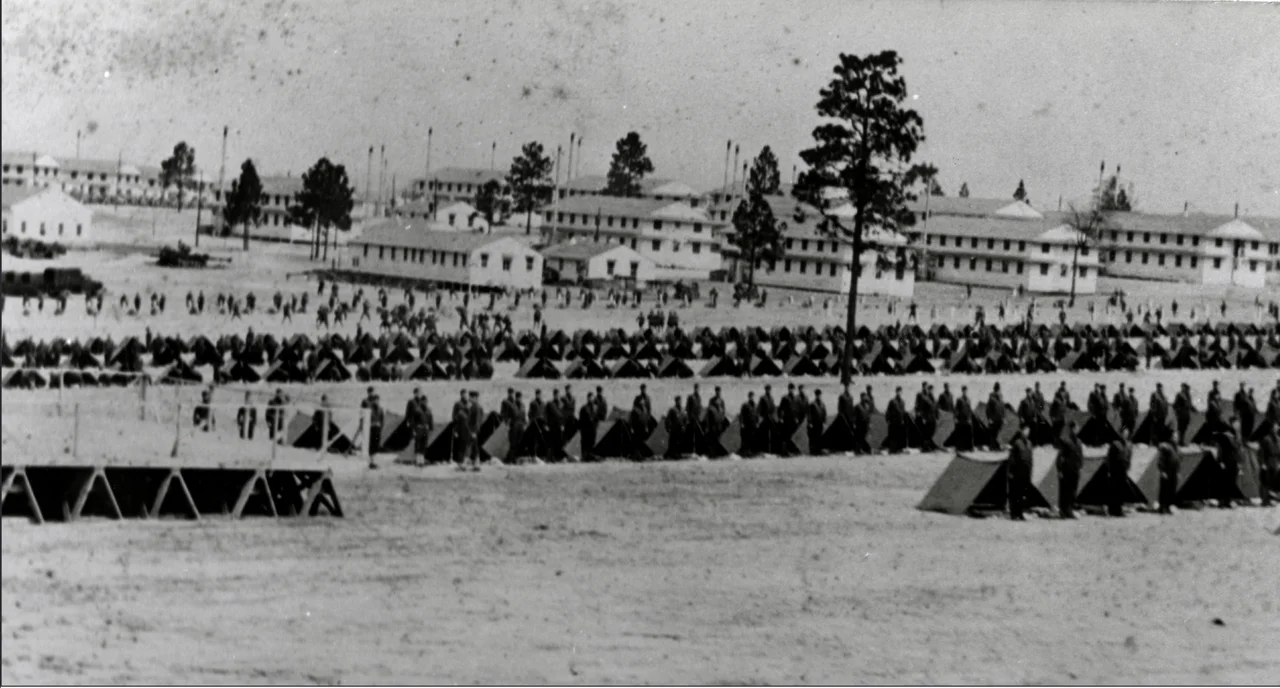

Fort Jackson
Half of everyone who joins the United States Army comes through here. Fifty percent. Walk the post on any given Monday and you will see eighteen-year-olds from every state stepping off a bus into ten weeks that will rebuild how they walk, talk, and think of themselves. Fort Jackson trains about 35,000 new soldiers a year in basic combat training and another 8,000 in advanced individual training, run nonstop by the 165th and 193rd Infantry Brigades. The post sprawls across more than 52,000 acres of Carolina pine and sand, holding 100 ranges and over a thousand buildings. It is the working heart of how the Army makes Americans into soldiers, and it has been doing it, on and off, since 1917.
From Camp to Fort
It began as Camp Jackson in 1917, hastily stood up as the United States entered the First World War. Like most of the rushed wartime camps, it shut down when the shooting stopped - General Orders 33 closed it on April 25, 1922. It might have stayed closed forever, a footnote in upstate South Carolina. Instead, the world went to war again. Reactivated for the Second World War, the post drew the highest visitors. Franklin Roosevelt and George Marshall brought Winston Churchill and Alan Brooke to Camp Jackson to watch the combat readiness of several divisions, preparing for the cross-Channel invasion that became Operation Roundup before it became something else. After 1945, the post was scheduled for shutdown by 1950. The Korean War arrived first, and Fort Jackson has not closed since.
The Trainee's Ten Weeks
What makes Fort Jackson the Army's largest initial entry training center is not size alone but volume. Training runs Monday through Sunday, ten weeks at a time, an industrial rhythm of formation, fundamentals, marksmanship, and field exercises. Since 1995, while other installations contracted, Fort Jackson has added new schools: the U.S. Army Soldier Support Institute, the Department of Defense Chaplain Center and School, and the National Center for Credibility Assessment - the polygraph school - within the Defense Intelligence Agency. In 2007, the Army consolidated all of its drill sergeant training here, making Fort Jackson the sole drill sergeant school in the Army. In 2009, Command Sergeant Major Teresa King became the first woman to lead it. Roughly 3,500 civilians work on post. More than 46,000 retirees and their families draw services through it. Annual expenditures exceed $716 million.
Who Comes Through
The names of Fort Jackson alumni read like a cross section of twentieth-century American life. Leonard Nimoy trained here. So did Jim Croce, before the music. Oliver Stone went through basic and advanced individual training at Jackson before he shipped to Vietnam, before he became the filmmaker who would put that war on screen. Ken Berry did artillery and Special Services in 1953 to 1955, near the close of Korea. Desmond Doss, the conscientious-objector medic whose Okinawa rescues earned the Medal of Honor, came through Fort Jackson. So did Freddie Stowers in 1917 - among the first recruits to enter training there, and one of only two African Americans to receive the Medal of Honor for the First World War. James C. Dozier, born 1885, served in the Pancho Villa expedition, the Great War (Medal of Honor), and the Second World War. Jason Crow, Army Ranger turned member of Congress, trained here too. Every name represents a single soldier; multiply by the millions who passed through over a century, and the math gives some sense of the place.
A Post Inside a City
Fort Jackson is not separate from Columbia; in October 1968 the city annexed it. The post sits in the Midlands of South Carolina, midway between New York and Miami, with direct access to interstates 20, 26, and 77. Average July highs push past 90 degrees Fahrenheit, January lows around 34. About 48 inches of rain falls each year. Soldiers who survive ten weeks in that climate have already learned something about endurance. Every spring and through the long summer, more than 100,000 family members come to Columbia for basic training graduation - parents and siblings and partners watching the formation pass, looking for the one face they came to find. The post and the city absorb them all: hotels, restaurants, churches, photo studios. It is one of the small American rituals that runs continuously, year after year, mostly out of national view, in a part of South Carolina most travelers never visit.
From the Air
Located at 34.04N, 80.82W in the Midlands of South Carolina, fully inside the city limits of Columbia. The post covers more than 52,000 acres of pine forest, ranges, and cantonment area. Nearest airports: Columbia Metropolitan (KCAE) 13 nm west, Owens Field/Jim Hamilton (KCUB) 6 nm west of post, Shaw AFB (KSSC) 28 nm east. The post lies between I-77 to the west and US 378 to the south. From altitude, look for the distinctive grid of training ranges in the pine flats northeast of downtown Columbia.
Nearby Stories
- Lexington, South Carolina 4.1 km away
- Battle of Camden 12 km away
- Hartsville, South Carolina 12 km away
- Battle of Mobley's Meeting House 20 km away
- Orangeburg Massacre 33 km away
- Graniteville Train Crash: The Night Invisible Death Came to a Mill Town 59 km away
- Francis Marion National Forest 79 km away