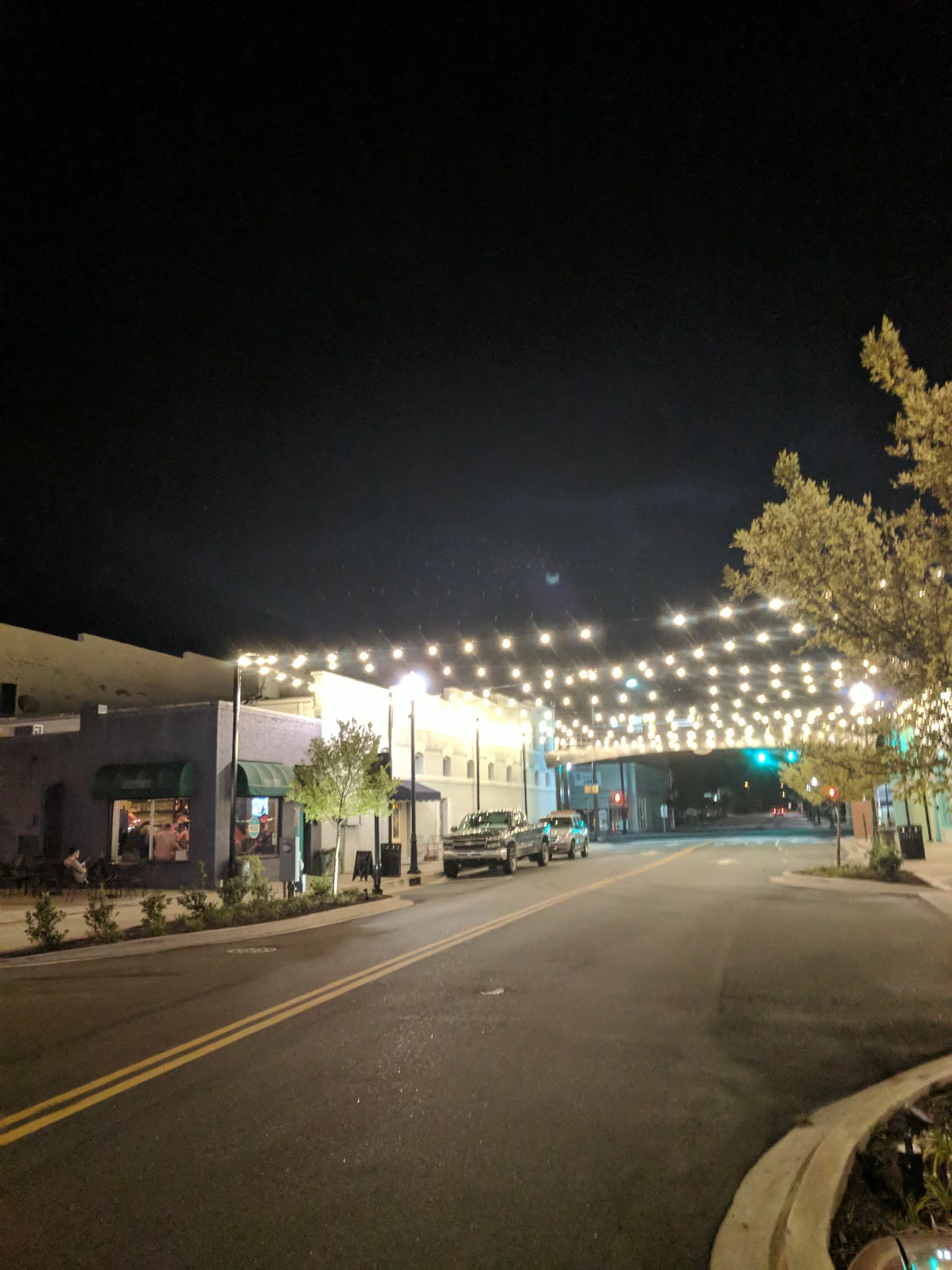

Hartsville, South Carolina
James Lide Coker had returned from the Civil War a wounded man with a broken plantation. He had gone north to Harvard before the war to study agriculture; he had served as a major for the Confederacy; he had been hit at Lookout Mountain and walked with the injury the rest of his life. By 1865, the new farming methods he had planned to introduce to the South Carolina sandhills lay buried under defeat. So Major Coker did something his neighbors did not expect. He started a school, a seed company, an oil mill, a bank, a general store, and a paper-tube factory. Within a generation, his town had a railroad and a name.
Before the Major
The country around Hartsville was Pee Dee people's country first, then home to the Catawba, Chicora, Edisto, Sane, and Chicora-Waccamaw before European settlement. The first colonial settlement in the area began around 1760. The town is named for Captain Thomas E. Hart, who eventually owned most of the land - until he lost his business and his property in the economic depression of 1837-1838. His son John Lide Hart bought 495 acres of what is now downtown Hartsville in 1845 from a Colonel Law and started building. Carriage factory, sawmill, grist mill, general store, the Hartsville Baptist Church. In 1855, Caleb Coker bought the carriage factory for his son. The Cokers would never let go.
The Coker Empire
James Lide Coker arrived in 1857. The war interrupted his plans, but after coming home injured, he set about doing what he had always meant to: dragging this stretch of coastal-plain pine country into the new century. He founded Welsh Neck High School, which became Coker University. He set up a seed company that made the family name famous among Southern cotton farmers for decades. He built an oil mill, a fertilizer plant, the Coker and Company General Store, and a bank. When local merchants refused to back a railroad spur, the Cokers built their own; the Hartsville Railroad was completed in 1889. Two years later, on December 11, 1891, the town was officially chartered. Coker's last and most consequential venture was the Southern Novelty Company, founded in 1899 to make paper tubes for the new yarn-spinning mills - it would eventually become Sonoco Products Company, a Fortune 500 packaging giant still headquartered in Hartsville.
Schools on the Sandhills
For a town of about seventy-five hundred people, Hartsville carries an outsized educational footprint. Coker University, the liberal arts school built out of the Welsh Neck High School Coker founded, sits in the center of town. The South Carolina Governor's School for Science and Mathematics, a public boarding high school that draws the state's most talented science students, also makes its home here. A satellite campus of Florence-Darlington Technical College serves working students. Walk Coker Avenue on a weekday and you pass college students, high schoolers in lab coats, retirees on benches, and Sonoco engineers on their lunch breaks - an unlikely mix for a Pee Dee mill town.
Kalmia and Burry Park
Kalmia Gardens, the thirty-acre garden created by Coker's son David Coker's wife, May Roper Coker, in 1932, sits on a sixty-foot bluff above Black Creek - high, by Pee Dee standards. It is named for the mountain laurel, Kalmia latifolia, that blooms there in spring. In the city center, Burry Park holds the Hartsville Veterans Memorial and hosts the summer Screen on the Green movie nights. Lawton Park preserves the 1938 Lawton Park Pavilion, a Works Progress Administration building beside Prestwood Lake; the New Deal still touches Hartsville here. Pride Park stands on the site of the Hartsville Graded School, the first public school for Black children in Hartsville, which operated from about 1900 to 1921, and the later Butler School named for Reverend Henry H. Butler. The Reverend T.J. James started a Sunday school on the site in 1922 that grew into Mt. Pisgah Presbyterian Church. James's family donated the land for the park in 1986.
An All-America City
Hartsville was chosen as an All-America City in 1996 and again in 2016, an unusually high recognition rate for a town this size; it has been an Arbor Day Foundation Tree City since 1986. The aviation legacy is quieter: Hartsville Regional Airport sits south of town. The economic mix is heavy-industrial - Sonoco, Nucor, Duke Energy's H.B. Robinson Nuclear Generating Station that has been producing power since 1971, Novolex, Stingray Boats. The town's notable people list reads like a small-town wonder: comedian Aziz Ansari grew up in the Bennettsville area but spent time here; baseball pitcher Bobo Newsom, born in Hartsville in 1907, gave his name to SC 151 through town; ballet dancer Gillian Murphy began her career here; Leeza Gibbons became a national television personality. A wounded Confederate major's town keeps turning out unexpected lives.
From the Air
Located at 34.37N, 80.08W in northwestern Darlington County, South Carolina, in the Pee Dee region. Cruise at 3,000-5,000 feet AGL. The H.B. Robinson nuclear plant's distinctive cooling tower is the most recognizable landmark from altitude. Black Creek snakes east of downtown; Prestwood Lake is the obvious water body. Nearest airports: Hartsville Regional (KHVS) immediately southwest of town, Darlington County Jetport (KUDG) 18 miles east, Florence Regional (KFLO) 25 miles southeast. Columbia (KCAE) is 70 miles southwest. Coastal plain agricultural patterns extend in every direction; this is one of the few towns with any topographic relief, sitting on the sandhills edge.
Nearby Stories
- Battle of Camden 9.7 km away
- Cheraw, South Carolina 11 km away
- Battle of Hayes Pond 13 km away
- High Hills of Santee 14 km away
- Lancaster County, South Carolina 19 km away
- Florence County, South Carolina 27 km away
- 1950 Myrtle Beach USAF C-46D Crash 39 km away
- Lumbee Tribe of North Carolina 41 km away