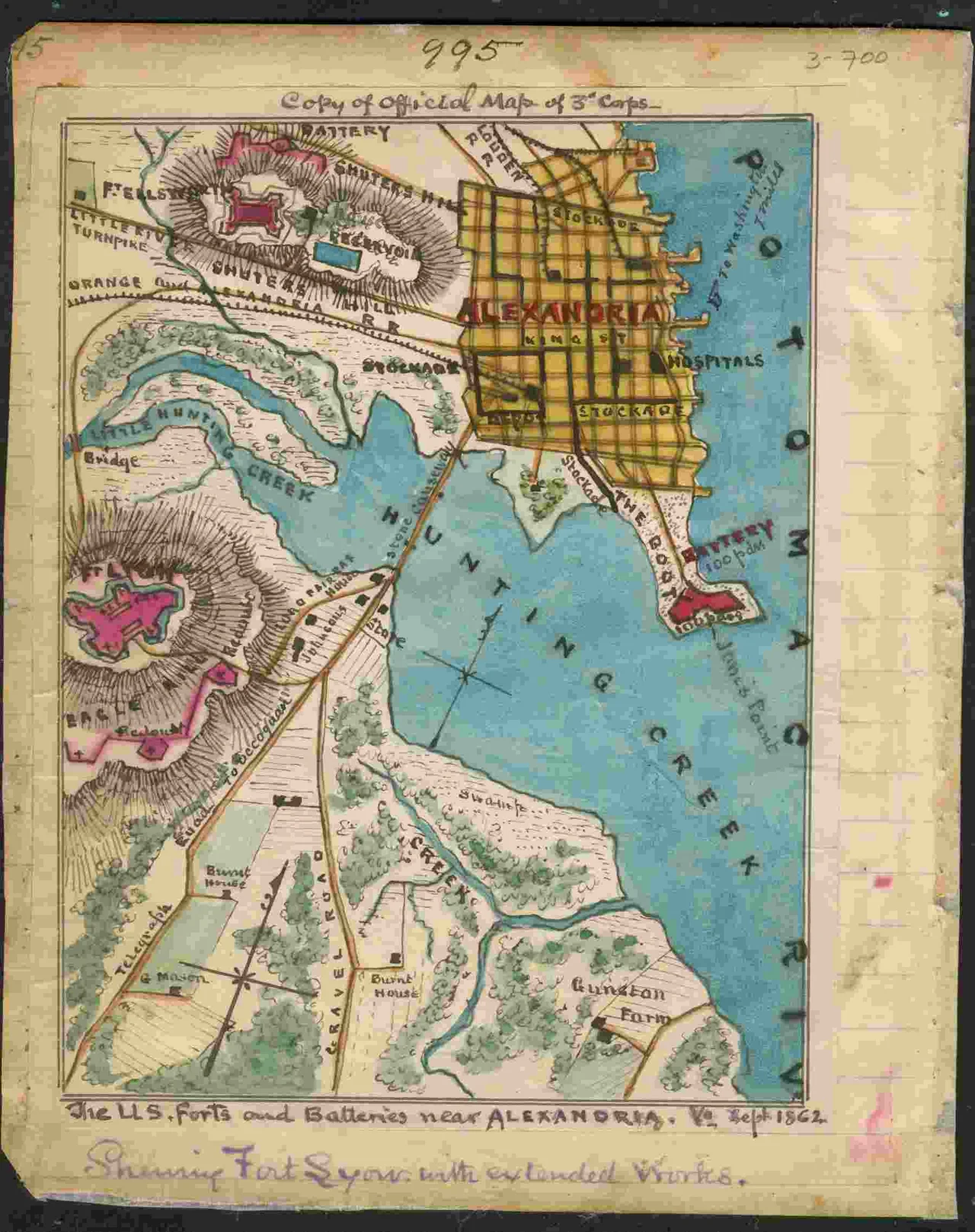

Fort Lyon (Virginia)
Around two o'clock on the afternoon of June 9, 1863, Anne Frobel was sitting in her house south of Alexandria when the windows rattled. A second blast followed almost immediately. She looked up toward Fort Lyon, the Union earthwork on the hill above her, just as the magazine went up. Everything flew up from the center and seemed to stand still for a moment, she wrote that night in her diary - then pieces of steel, stones, and dirt came rattling and thundering down. She compared the scene to engravings of Mount Vesuvius in eruption. Twenty-five soldiers died in the explosion. Eight tons of black powder and several thousand rounds of ammunition went with them. President Lincoln himself came down from Washington a few days later to inspect the damage. Today the hill where Fort Lyon stood is a Metro station parking lot.
Crossing the River
On the night of May 23, 1861 - the same day Virginia voted three to one to leave the Union - United States Army regiments began marching across the Potomac bridges into northern Virginia. Eight thousand infantry crossed at the Long Bridge alone. The plan, which Brigadier General Joseph K. Mansfield had been pushing for weeks, was to deny the Confederacy the ridges of Arlington from which artillery could shell the Capitol. The occupation was peaceful except in Alexandria, where Colonel Elmer E. Ellsworth - a Lincoln family friend and the commander of the 11th New York Fire Zouaves - climbed to the roof of the Marshall House hotel to remove a Confederate flag and was shot dead by the proprietor James W. Jackson on his way back down. Ellsworth became one of the first Union officers killed in the war. Alexandria stayed under Union occupation for the next four years. The town leaned Confederate. The garrison did not leave.
Building on Ballenger's Hill
After the disastrous Union defeat at the First Battle of Bull Run on July 21, 1861, George McClellan took command of what would become the Army of the Potomac and ordered a great expansion of the Washington defenses. Alexandria, which held a major port and the southern terminus of the Chesapeake and Ohio Canal, became an object of particular study. Generals Horatio Wright and John Newton supervised construction of a new ring of forts south of the city. The most important of these went up on Ballenger's Hill, one of the highest points south of Alexandria, where the Telegraph Road, the Columbia Turnpike, the Little River Turnpike, and the Orange and Alexandria Railroad all converged. The 27th New York Volunteer Infantry built the fort in September 1861. Its perimeter ran 937 yards. It covered nine acres. Its armament included thirty-one guns - among them four 200-pounder Parrott rifles and sixteen mortars. The work was named for Brigadier General Nathaniel Lyon, killed at the Battle of Wilson's Creek in Missouri on August 10, 1861. Lyon had been the first Union general to die in combat in the war.
The Vesuvius Comparison
Major General Samuel P. Heintzelman commanded the defenses of Washington from his headquarters at Fort Lyon between October 1862 and October 1863. On his staff was a young topographical engineer named Robert Knox Sneden, whose remarkable wartime diary and watercolors would be rediscovered in the 1990s and become a Civil War best-seller. Sneden left Fort Lyon in March 1862 for the Peninsula Campaign; he was later captured by Mosby's Rangers near Brandy Station in November 1863 and survived Andersonville prison. The fort he left behind was filling with powder. By June 1863 the magazines held eight tons of black powder and thousands of rounds of fixed ammunition. On the afternoon of June 9, something - the cause was never determined, but suspicions ran to a careless cigar - ignited a charge. The chain reaction was instantaneous. Twenty-five soldiers were killed outright. Anne Frobel watched the column of smoke and debris rise above the ridge from her house below. The blast was heard miles away in Alexandria. In the days that followed, Secretary of War Edwin Stanton and President Abraham Lincoln rode out to inspect the damage. Reinforcements rebuilt the magazines. The garrison kept working.
A Metro Station Now
Companies from a series of New York and Ohio regiments rotated through Fort Lyon over the course of the war. Four companies of the 1st Wisconsin Heavy Artillery took over in October 1864 and were mustered out at war's end on June 26, 1865. After Appomattox the fort was abandoned and the earthworks gradually weathered. By the twentieth century the hill belonged to suburban development. The Huntington station of the Washington Metro Yellow Line opened on the north flank of the old fort site in 1983. The earthworks themselves were obliterated by parking lots, road cuts, and townhouse construction. A historical marker erected by the Virginia Department of Historic Resources in 1998 stands at the north end of the Metro station parking area off North Kings Highway. A second marker at Mount Eagle Park, just south, points to a remnant of earthwork that has survived erosion in a wooded fold of the hill. A short trail leads back to it. The trees there are old. The soil where the magazines blew is quiet. The hill is still high enough to see Alexandria, and even, on a clear day, the Capitol dome across the river.
From the Air
Fort Lyon stood on Ballenger's Hill at roughly 38.79 degrees N, 77.08 degrees W, immediately south of Alexandria, Virginia, at an elevation around 230 feet. The Huntington Metro station now marks the site. The Potomac River runs two miles east. This is inside Class B airspace, with Reagan National (KDCA) four miles north and Andrews JBA (KADW) five miles east. The Washington Special Flight Rules Area applies - flight planning, ADS-B, and Potomac TRACON clearance are required for any low operations. P-56 is just north.
Nearby Stories
- Crownsville Hospital Center 3.5 km away
- Battle of Thoroughfare Gap 7.4 km away
- Battle of Unison 8.6 km away
- Mallows Bay-Potomac River National Marine Sanctuary 9.1 km away
- Murders of Katherine and Sheila Lyon 9.9 km away
- Germanna 15 km away
- Capital Gazette Shooting 27 km away
- St. Mary's City, Maryland 39 km away