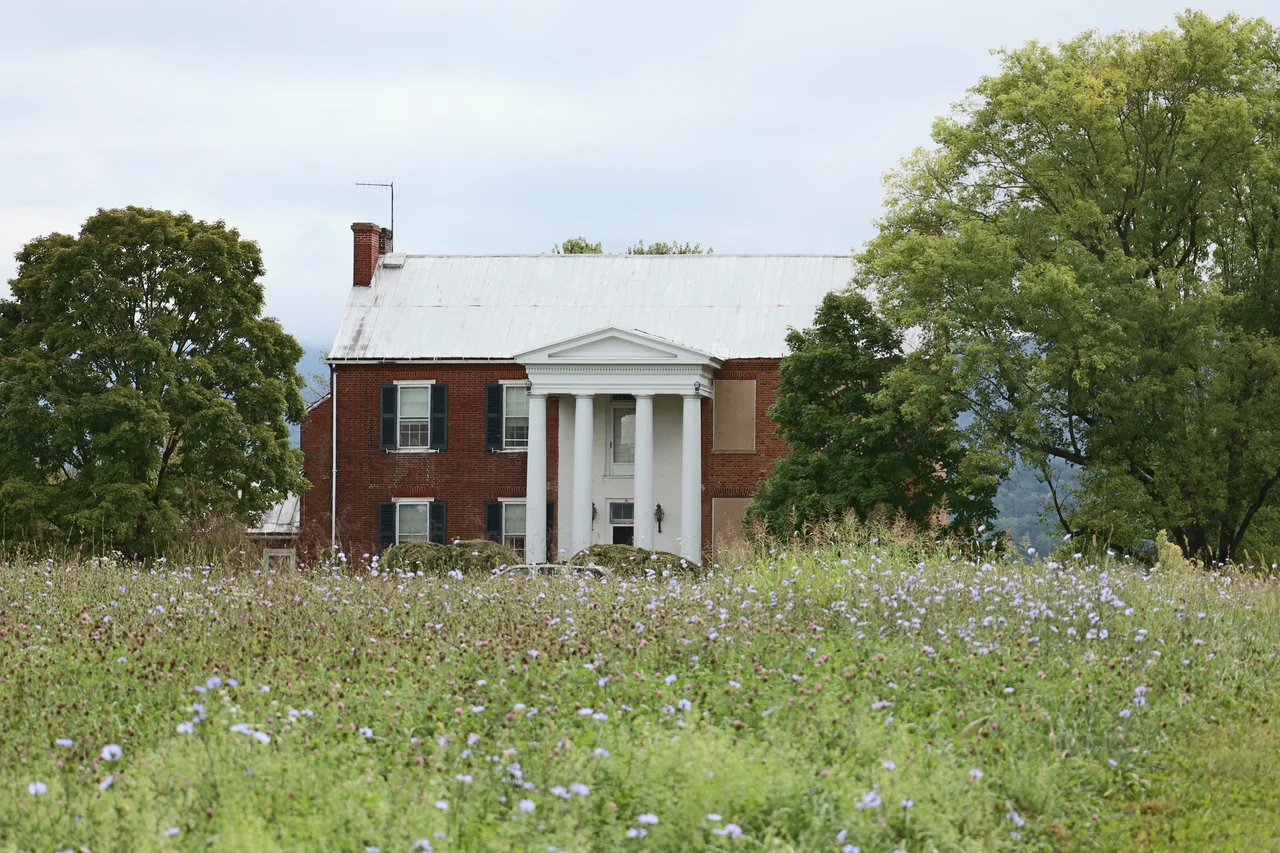

Fort Pleasant
Colonel George Washington was twenty-four years old in 1756 when he ordered a fort built on Isaac Van Meter's land along the South Branch Potomac. The French and Indian War was already underway, the western Virginia frontier was burning, and the place the Van Meters had settled in 1744 - known then as the Indian Old Fields - was suddenly a strategic point on the British colonial map. The cabin that came down for Washington's fort, and the great Federal-style brick house that eventually rose on the same ground, are still threaded through every chapter of this corner of West Virginia history.
Washington's First Visit
George Washington was sixteen when he first saw the Indian Old Fields. He arrived in 1747-48 as a teenage surveyor, mapping the South Branch tract on behalf of Thomas, Lord Fairfax, the 6th Lord Fairfax of Cameron, who claimed the land as part of his Northern Neck Proprietary. The Van Meters disagreed. Isaac Van Meter told the young surveyor - whom Washington recorded in his journal as Mr Vanmetrise - that the family held the tract under Virginia Council grants of 1730 and that Fairfax's claims did not apply. The litigation would continue for decades and was not resolved until well after the American Revolution, when the Van Meter heirs finally prevailed. By the time the question was settled, Washington had become president, and the Van Meter family had built a fort, fought a war, and raised one of the great houses of the South Branch.
Fort Van Meter, Fort Pleasant, Town Fort
In 1756, with French and Indian raiding parties pressing eastward, now-Colonel Washington ordered Captain Thomas Waggener to build a major fortification on Van Meter land. The new fort was substantial - blockhouses at the corners, supporting structures, room for soldiers and civilians during raids. The Battle of the Trough, a fierce skirmish, was fought a mile and a half away the same year. The fort served through the war and after, taking on different names with different eras. After Moorefield was founded in 1777 it became known as Town Fort because of its proximity to the new settlement. Garrett Van Meter (1732-1788), Isaac's son, eventually demolished most of the old fort and the original family cabin, replacing them with a strong brick structure - half above ground and half below, connected by enclosed steps - that he intended for defense. Parts of that unusual half-buried structure still survive.
The Great House
Isaac B. Van Meter (1757-1837) and his wife Elizabeth Inskeep Van Meter completed the large brick mansion on the site before the end of the 18th century. They built it on the same ground as the old fort, and the house and the fort shared the name Fort Pleasant. The mansion was a massive double-chimney Federal-style residence made of clay bricks fired on the Fort Pleasant farm itself. Its giant-order columns - colossal columns spanning two full stories - were among the first such features in the South Branch Valley and gave the house a presence visible from far down the river road. The mansion earned a reputation as one of the great houses of the valley, an Appalachian frontier landscape where two-story columns were a deliberate architectural statement: this is no longer the wilderness.
What Survives
When the historian Samuel Kercheval visited Fort Pleasant in 1830, he found that not all of the old fort had been swept away. One of the blockhouses, with its portholes still cut into the walls and the logs particularly sound, was still standing seventy-four years after the fort had been built. The last vestiges of the original fortification vanished only later in the 19th century. Fort Pleasant was added to the National Register of Historic Places in 1973, recognizing both the colonial fort site and the surviving Federal-style mansion. It is one of five significant Van Meter family dwellings in the Old Fields area, alongside Traveler's Rest, Fort Van Meter proper, the Garrett VanMeter House, and Buena Vista Farms - the architectural footprint of a single Dutch-American family who arrived in the South Branch Valley in the 1740s and never left.
From the Air
Located at 39.13 degrees north, 78.95 degrees west, near Old Fields in Hardy County, West Virginia. From 4,000 to 6,000 feet AGL the broad bottomland of the South Branch Potomac valley reads clearly, with the river meandering through farmed fields. The house itself is hidden among trees from the air, but the surrounding farmland and the river bend are obvious. Nearest airports are Hardy County (W22) at Moorefield and Grant County (W99) at Petersburg.
Nearby Stories
- Davis 2.5 km away
- Orkney Springs Hotel 11 km away
- Belle Grove Plantation 13 km away
- Sinks of Gandy 22 km away
- The Inn at Little Washington 26 km away
- Battle of Fort Necessity 50 km away
- Antietam: The Day America Lost 23,000 Men 57 km away
- Fallingwater 75 km away