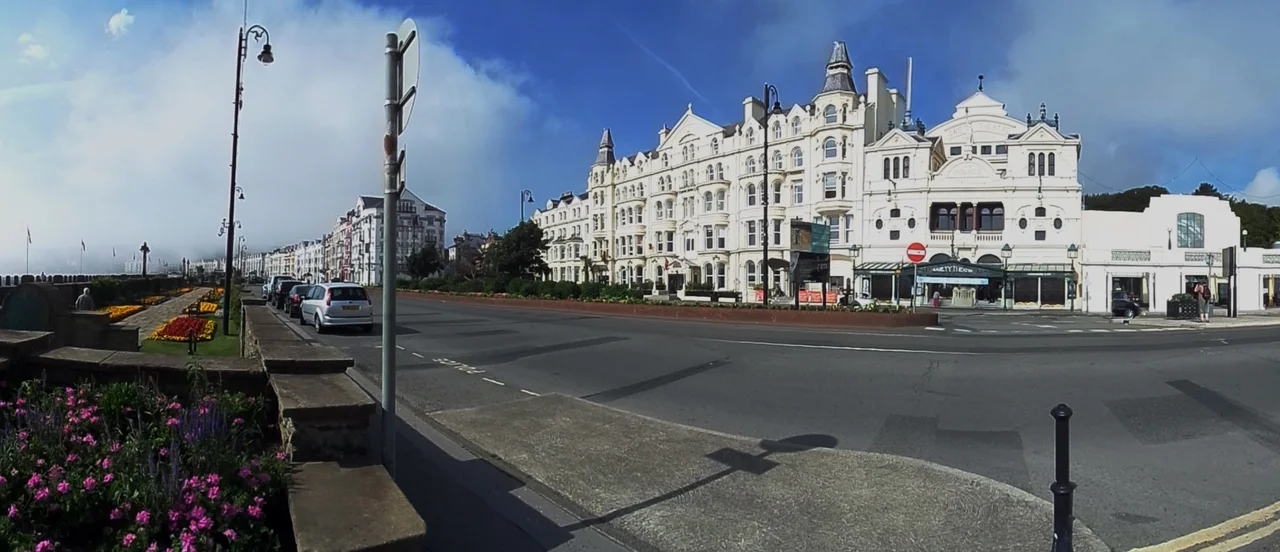

Gaiety Theatre
Frank Matcham designed more than 200 theatres in his career and we have lost most of them. The London Hippodrome, the Glasgow Empire, the Manchester Hippodrome, dozens of provincial palaces of variety, all knocked down or gutted or turned into bingo halls in the long Edwardian-to-postwar slump of British theatre. So when restorers approached the Gaiety in Douglas in the late 20th century, they were working on one of the most complete surviving examples of his work anywhere. Matcham was the master of the cantilever and the proscenium, of plaster cherubs and gold leaf, and the Gaiety carries his fingerprints on every cornice. The remarkable thing is that those fingerprints have been polished back to their original brightness.
Before Matcham
Harris Promenade has hosted entertainment under different names since 1893. In January of that year, adverts appeared in Douglas papers seeking shareholders for a new palace of entertainment called The Marina. To enclose enough space for an audience the builders used a Belfast Roof, a barrel-vaulted ceiling made of iron sections bolted into hoops and faced with laminated wood, a structural trick beloved of late Victorian engineers because it gave huge clear spans cheaply. The Marina opened in April 1893 and closed three months later when the company went bankrupt. A consortium of creditors bought the building at auction in January 1894 and reopened it as The Pavilion in February, hoping the new name would shake off the smell of failure. Richard Maltby Broadbent, the impresario who had turned Groudle Glen into a Victorian pleasure garden and helped build the Groudle Glen Railway, ran the new venue.
Matcham's Hand
In 1899 the Pavilion was demolished and rebuilt to Matcham's design as the Gaiety Theatre and Opera House, opening in 1900. The site itself had a Manx pedigree: it had been occupied earlier in the 19th century by a lodge belonging to George Steuart, the Scottish architect of Castle Mona and a retainer of the Atholl family, and was later bought by the Manx benefactor Henry Bloom Noble and donated for recreational use. Matcham's auditorium delivered everything his audiences expected: a horseshoe of plush seating, plaster ornament thick on every surface, a magnificent painted ceiling, sightlines that worked from every seat. One small but unique feature still survives, the working Victorian Act Drop, a painted curtain depicting a dancing lady that lowers between acts in a piece of in-theatre theatre.
Mervin Stokes and the Long Restoration
By the 1970s the Gaiety, like most surviving Matcham houses, was in danger. The theatre manager Mervin Russell Stokes spent years coordinating a restoration that aimed not just to preserve but to recreate. Stokes arranged funding, supervised the work, did some of it himself, and insisted on a level of authenticity that bordered on the religious: the original paint colours were matched and reapplied, the original wallpaper patterns reprinted, the original carpets rewoven. The Friends of the Gaiety, formed in 1978 to raise money and assist with operations, did the steady fundraising work that made the project possible. Stokes was made an MBE for his contribution. The result is one of the most accurate Victorian theatre interiors in the British Isles, the kind of building where the gilt on the boxes is the same gilt the original audiences saw.
Stamps, Stages, and Welles
Today the Gaiety stages musicals, plays, opera, and ballet, both local productions and touring shows, and forms part of the VillaGaiety complex with the 1,620-seat Villa Marina next door. Manx Post commemorated the theatre on stamps in 1987, 1994, and 2000. In a small irony for a venue defined by its preserved past, the Gaiety has also done film work playing other theatres: it stood in for New York's Mercury Theatre as it appeared in 1937, in the 2008 Richard Linklater film Me and Orson Welles, starring Zac Efron, Christian McKay, and Claire Danes. The illusion worked because the building already looked like a 1937 American playhouse, which it did because Mercury-era theatre architects in New York were copying men like Matcham. The line between original and replica, in this small Manx auditorium, runs back on itself.
From the Air
The Gaiety Theatre stands on Harris Promenade in central Douglas at 54.155 degrees north, 4.478 degrees west, overlooking the bay. From altitude it sits midway along the long promenade arc, with the Villa Marina entertainment complex immediately next door; the theatre's pitched roof and rear stage tower are visible from low oblique angles. The Sea Terminal is just south, the Manx Electric Railway terminus at Derby Castle further north. Nearest airport: Isle of Man Airport at Ronaldsway (ICAO: EGNS), 9 nautical miles southwest. Approaches over Douglas Bay frequently overfly the promenade.
Nearby Stories
- St Bees Lighthouse 15 km away
- Celtic Array 22 km away
- Kirkmaiden 23 km away
- Isle of Whithorn 23 km away
- Seascale Lifeboat Station 31 km away
- German submarine U-1024 36 km away
- SS Georgetown Victory 40 km away
- Blackpool Illuminations 56 km away