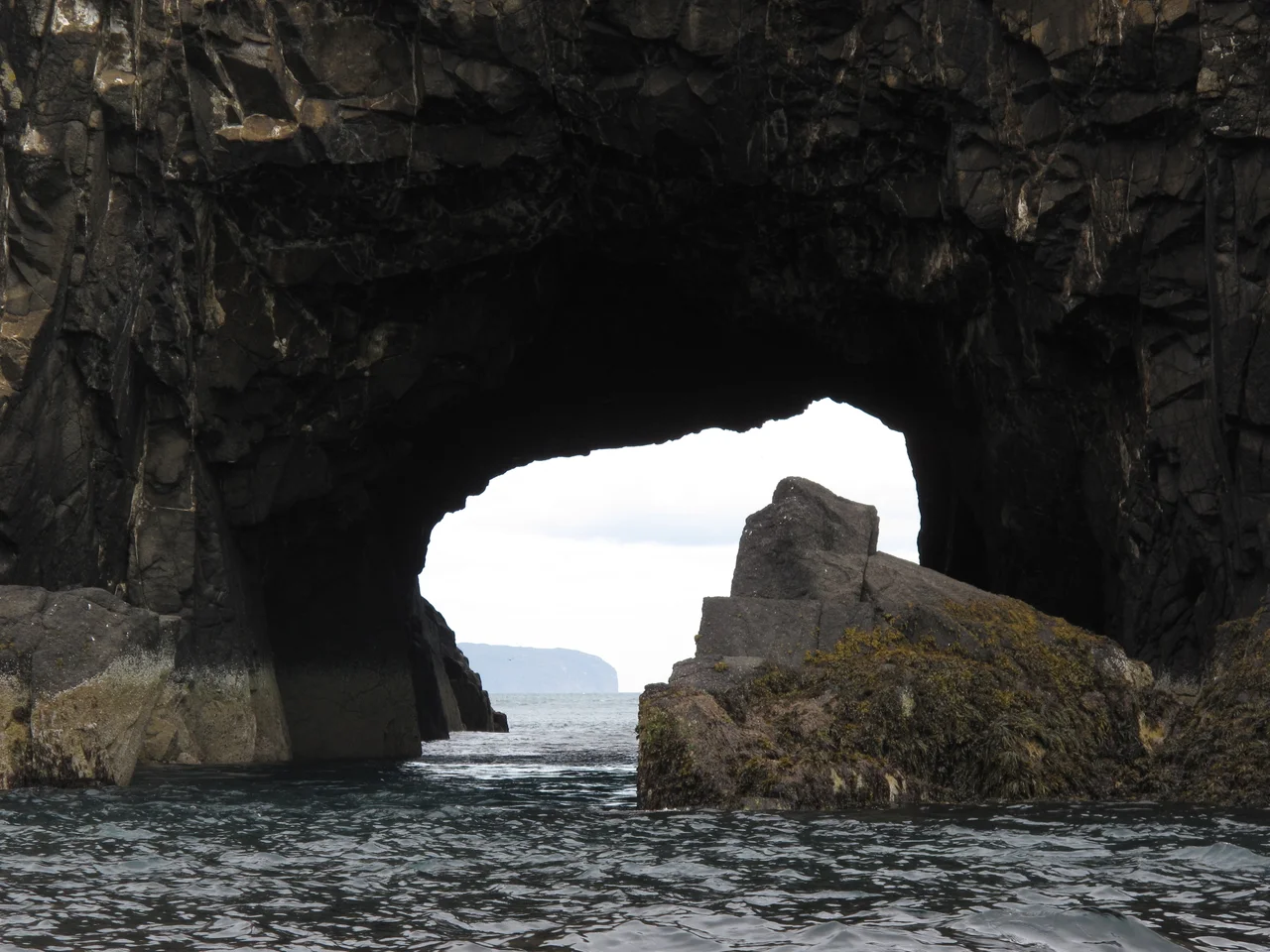

Garbh Eilean, Shiant Islands
Garbh Eilean means 'rough island' in Gaelic, and the name fits. On its northern cliffs, dolerite columns rise more than a hundred metres straight out of the Minch - vertical pipe organs of stone, basalt giants like the columns at Staffa and the Giant's Causeway, only taller. The columns are sixty million years old, which is to say very young for the Hebrides. Below them the sea churns; above them, in summer, the air is thick with puffins. This is one of the loudest, fishiest, most geologically peculiar islands in Scotland, and almost no one is ever on it.
Pillars from a Volcano
Geologically, the Shiants are an extension of the Trotternish peninsula on Skye - volcanic rocks pushed up around sixty million years ago when the North Atlantic was tearing itself open. The dolerite columns on Garbh Eilean's north face are over 100 metres tall and about two metres across, formed when molten rock cooled slowly underground and contracted into hexagonal joints. The intrusive sills show a chemical progression: olivine-rich rocks at the base, almost olivine-free rocks at the top - the signature of crystal settling, where heavier minerals sank as the magma solidified. In places, Jurassic mudstone overlies the basalt, and where it weathers it produces an unusually fertile soil. Almost everywhere else in the Western Isles, the bedrock is Lewisian gneiss and the soil is thin acid peat. Here, briefly, life gets a richer footing.
Lazy Beds and an Old Church
The islands were inhabited until the late 18th century, when changes in land ownership and the disintegration of the old run-rig system made the way of life unsustainable. The previously cultivated zones at Àirighean a' Baigh and Àirighean na h-Annaid sit on the better Jurassic soil, and the long parallel ridges of feannagan - 'lazy beds,' the labour-intensive cultivation strips the Hebridean crofter built to drain peaty ground - are still visible if you know where to look. The name Àirighean na h-Annaid means 'shielings of the old church,' and there may have been a chapel here dedicated to St Columba. Another chapel, this one dedicated to the Virgin, once stood near the present cottage on neighbouring Eilean an Taighe. These are not active sites; they are the soft shapes that human work leaves in the ground.
The Owner Who Wrote the Book
The Shiants are privately owned, and the family who owns them is now best known to readers through Adam Nicolson's 'Sea Room,' published in 2001. Nicolson's father bought the islands in 1937 when he was an Oxford undergraduate; the family has held them ever since. 'Sea Room' is the book Adam Nicolson wrote, as he put it, 'to tell the whole story' - the geology, the human history, the seabirds, the strange privilege and stranger responsibility of holding a small piece of the Atlantic. Until 2016, Garbh Eilean was also home to a population of black rats, descended, possibly, from a shipwreck. They were exterminated as part of a seabird recovery project. The puffins, the guillemots, the razorbills now nest in a place where their eggs will not be eaten before they hatch.
From the Air
57.9°N, 6.367°W in the Minch between Lewis and Skye. Garbh Eilean is the larger northern island of the Shiant group. Approach altitude 1,500-3,500 ft to see the dramatic dolerite cliffs on the north face. Stornoway (EGPO) lies about 22 nm north-northwest; the Scalpay coast is about 5 nm to the west. The Shiants make a useful waypoint when crossing the Minch from Skye to Lewis. Expect strong tidal streams below and lively turbulence in the lee of the cliffs.
Nearby Stories
- Lewis 5.9 km away
- Lochmaddy 9.7 km away
- Uig 11 km away
- Rua Reidh Lighthouse 12 km away
- Loch Torridon 15 km away
- Stoer Head Lighthouse 34 km away
- The Flannan Isles Mystery: The Lighthouse Keepers Who Vanished 35 km away
- Sollas 36 km away