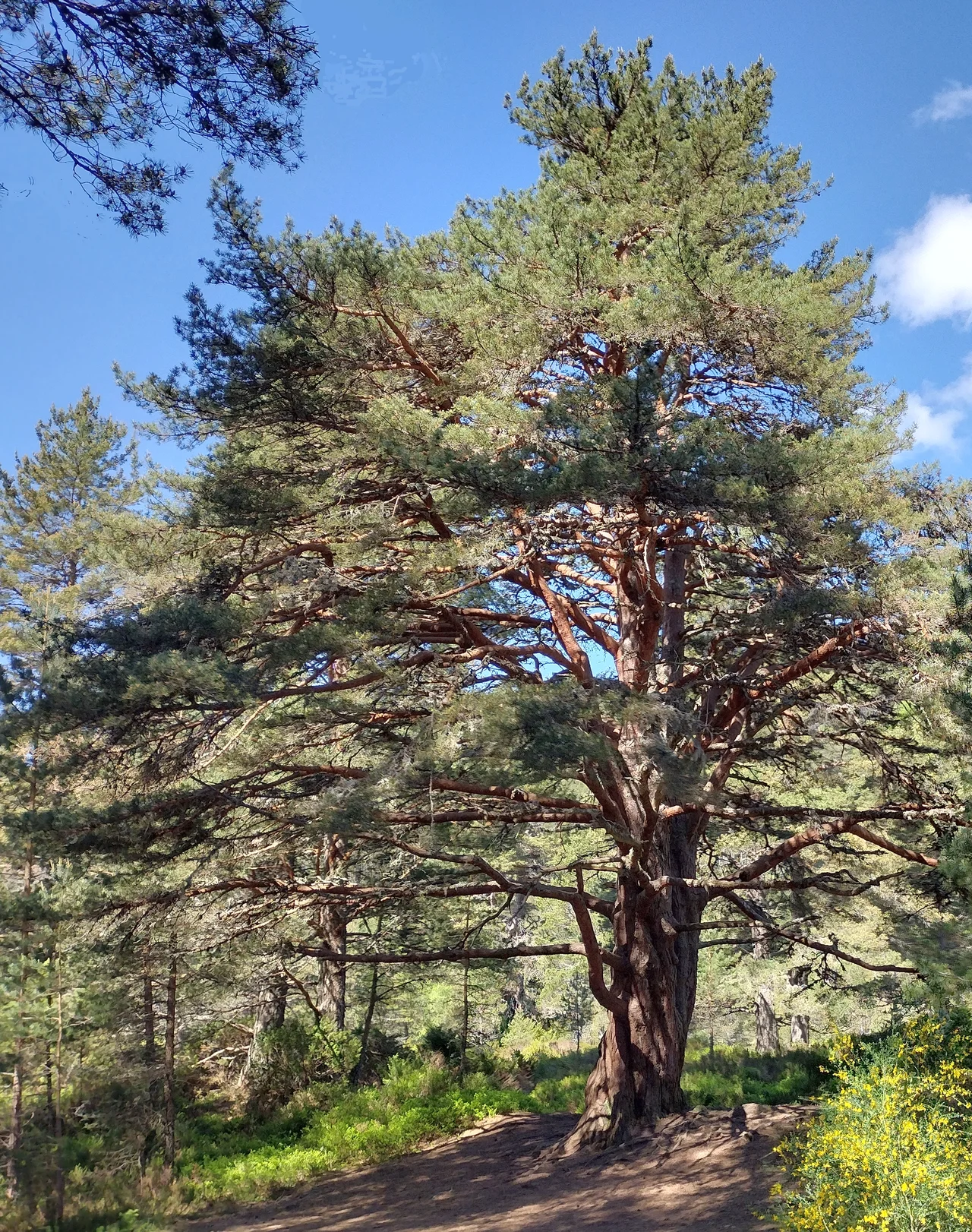

Glenmore Forest Park
The water of An Lochan Uaine glows an impossible shade of green, and the locals have an explanation that has nothing to do with mineral content or algae. The fairies do their washing here, the story goes, and their bright green clothes have stained the pool over centuries. It is the kind of explanation that survives in places where the trees are old enough to remember things. Glenmore Forest Park, sprawled across 35.7 square kilometres of the Cairngorms, is one of those places: a remnant of the great Caledonian Forest that once covered much of Scotland, now reduced to scattered pockets of which this is one of the finest. Scots pine, some grown from seed gathered nearby, lean over moss the colour of wet emerald. Capercaillie - the great wood grouse that once nearly vanished from Britain - still hold their dawn leks in the deeper groves. The forest survives, and so do its ghosts.
What Survived the Axe
After the last ice age, pine forest spread across Scotland from coast to coast. Centuries of clearance reduced it to fragments, and Glenmore is one of the largest. Around half the trees here regenerated naturally; the rest were planted from local seed, a careful effort to keep the genetics of this particular forest intact. The result is something rare: a working woodland that still functions as a Caledonian forest, with all its associated species. Scottish crossbills - found nowhere else on Earth, prying open pine cones with their crossed mandibles - work the canopy. Crested tits flick through lower branches. Capercaillie, the turkey-sized grouse whose males perform an elaborate spring courtship, breed here in numbers that, in 2006, made Glenmore the most productive monitored site in Scotland. The forest park, established in 1948, is also a national nature reserve and a Site of Special Scientific Interest. The designations are the modern equivalent of fencing off something sacred.
Norwegians in the Pines
During the Second World War, this forest became a training ground for Norwegian resistance fighters. Selected men of Kompani Linge and other special units trained in the pines and on the surrounding moors, learning to ski cross-country, survive in cold weather, and conduct sabotage operations they would later carry out behind German lines in occupied Norway. The terrain was the closest thing in Britain to the country they had left behind. A memorial near the visitor centre commemorates them. Some did not survive the operations they trained for. The most famous of those operations - the destruction of the heavy water plant at Vemork - struck a critical blow against the German atomic programme, and several of the men who carried it out had trained in these woods. The pines that shelter capercaillie today sheltered men preparing to do something that mattered very much.
Hunters and Hunted
Above the canopy, the sky belongs to predators. Ospreys hunt the loch of Morlich, plunging feet-first for trout. Golden eagles ride the thermals above the higher ground, occasionally crossing the forest in long, deliberate glides. Peregrine falcons and merlins hunt smaller prey, and both occasionally breed in the area. On the open plateau above the tree line, dotterel - small wading birds that migrate from Africa - sometimes show themselves. Down in the rivers and lochs, otters fish, and Atlantic salmon return each year to spawn in the gravel beds. Red squirrels, almost extinct elsewhere in Britain thanks to the introduced grey, still flourish in the pines. Red deer drift through at dawn. The narrow-headed ant - one of Britain's rarest insects - builds its mounds among the heather. It is a working ecosystem of the kind that has become exceedingly hard to find.
The Lochan and the Fairy
Folklore clings to Glenmore the way moss clings to its trees. The Ly Erg - a small soldierly figure said to appear in the forest with a single bloody hand - is a portent of death; meet him on the path, the legend goes, and someone close to you will not see the year out. An Lochan Uaine, the small green lake, is the more cheerful story: the fairies wash their green clothes here, and the dye has tinted the water permanently. The real cause is more mundane - light scattering through suspended particles and the dark peat-stained bed - but the fairy version is the one that gets told. The lochan sits at the head of the Ryvoan Pass, reached by a short walk from the visitor centre, and on a still day the green is genuinely startling. The forest has been telling stories about itself for as long as there have been people in it to listen.
From the Air
Glenmore Forest Park sits at 57.17°N, 3.72°W in the heart of the Cairngorms National Park, about 8 nautical miles east-southeast of Inverness Airport (EGPE). Aviemore lies 3 nm to the west; the forest wraps around the northern shores of Loch Morlich and runs up toward the Cairngorm plateau (1,245 m / 4,084 ft at Cairn Gorm summit). Recommended viewing altitude is 4,000-6,000 ft AGL to take in both the forest canopy and the granite scarps above. Look for the dark mass of pinewood spreading from the loch's edge up to the natural tree line around 600 m. Weather changes fast in the Cairngorms; orographic cloud can build rapidly against the plateau. EGPE provides full instrument approaches; Aviemore has no airfield. The Spey valley to the north-east makes a useful visual reference line.
Nearby Stories
- Dalwhinnie distillery 1.9 km away
- Battle of Mons Graupius 11 km away
- Black Isle 12 km away
- Battle of Auldearn 13 km away
- Keith, Moray 14 km away
- Kildrummy Castle 16 km away
- Boleskine House 16 km away
- Siege of Blair Castle 22 km away