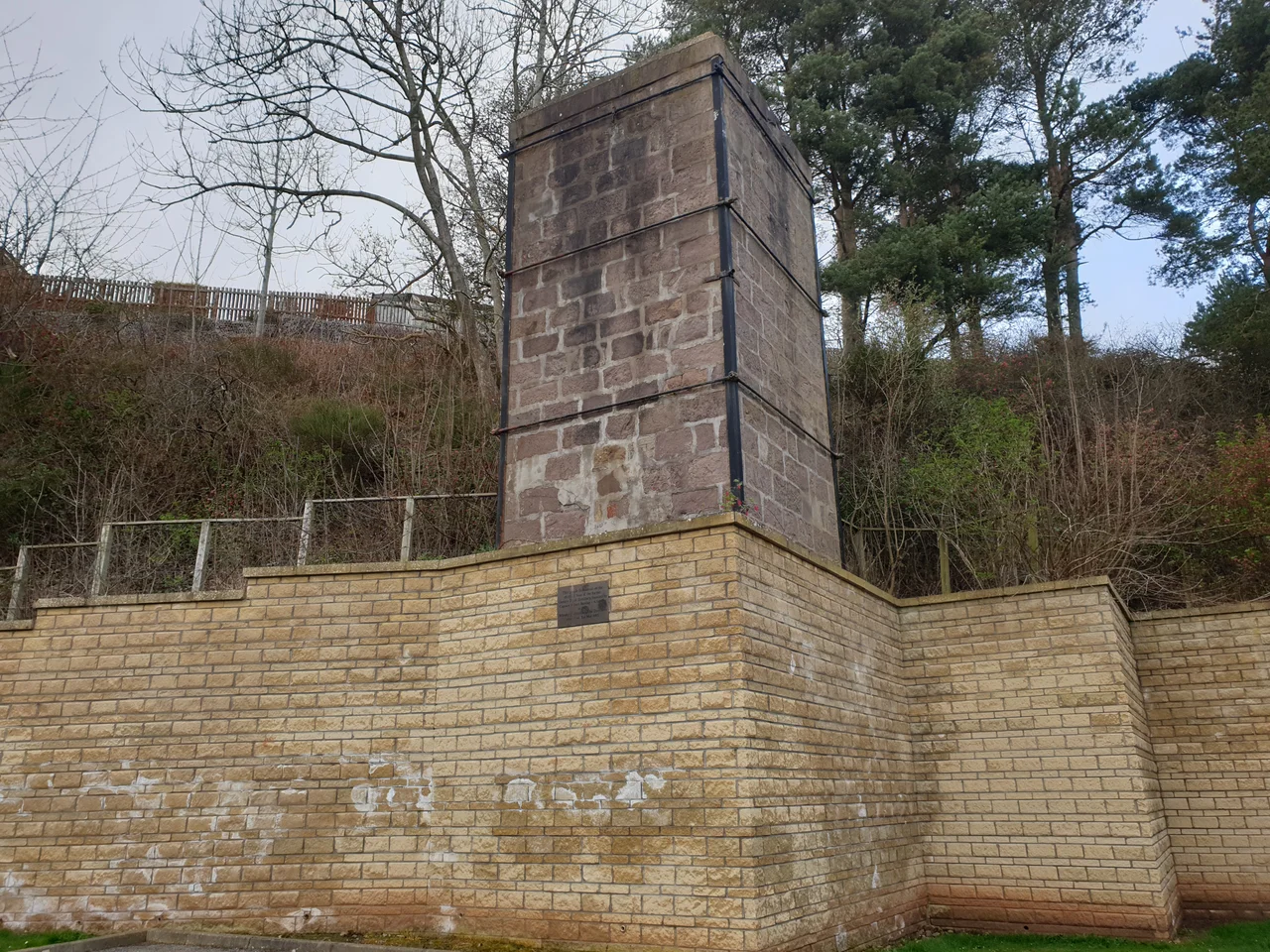

Glenury Distillery
Weeks after Robert Barclay opened his new distillery on the banks of the Cowie Water at Stonehaven in 1825, a fire tore through the buildings. It destroyed the stocks of barley, the kiln, and parts of the malting floor — every essential at the start of a whisky-making operation. Two weeks later, a worker named James Clark died in an accident with the boiler. The distillery had barely poured its first cask of new-make spirit, and it had already cost lives and stock. This was not an auspicious beginning. And yet Glenury kept going, in one form or another, for the next 160 years.
The Founder Who Walked to London
Robert Barclay of Ury — the man who founded Glenury — was not your typical distillery owner. He was the Member of Parliament for Kincardineshire, a champion pedestrian who in 1809 had walked one thousand miles in one thousand consecutive hours for a wager of one thousand guineas at Newmarket. He owned the Ury estate just inland of Stonehaven, and the glen that ran through his land gave the distillery its name. According to local tradition, Barclay used his connections to obtain a royal warrant to call the whisky 'Glenury Royal' — the 'Royal' came from his friendship with King William IV. Whether or not that part is strictly true, the brand wore the royal name for most of its life. Barclay died in 1854, and three years later the distillery was auctioned to William Richie.
A Century of Quiet Production
Through the late nineteenth and twentieth centuries, Glenury operated under a succession of owners, producing a Highland single malt that was used mostly in blends — the workhorse function of most Scottish distilleries of the era. It was never one of the famous names like Glenfiddich or Macallan. It produced steadily, employed Stonehaven men, and contributed to the town's industrial life alongside the herring fishery and the railway. The maltings — where barley was germinated and dried over peat smoke — closed in 1968, after which malted barley was bought in from central maltings, a common consolidation of the era. Production of whisky continued for another seventeen years.
The Last Cask
In May 1985, The Distillers Company mothballed Glenury Royal. The Scottish whisky industry was in the middle of a brutal contraction — too many distilleries, too much stock, demand that had not kept up with the optimism of the 1970s. Glenury was one of dozens shut in that period. The hope was always that some future buyer might fire up the stills again. That hope, at Glenury, did not survive. In 1992 the owners decided to end malt whisky production for good. The buildings were sold in 1993 to a property company, which converted part of them into apartments. The stillhouse, the warehouses, the maltings — most of the working distillery is gone now, replaced by housing on the edge of Stonehaven. What remained, and what still remains, is the whisky itself. Casks laid down before 1985 continued to mature in warehouses around Scotland. Bottles of 30-, 40-, and 50-year-old Glenury Royal occasionally surface at auction. They are rare. They are expensive. They are, for collectors, a small mournful taste of a town's industrial past.
What the Ghost Distillery Means
Industry calls them ghost distilleries — places where the spirit still exists but the stills no longer run. Brora, Port Ellen, Rosebank, Dallas Dhu. Glenury Royal belongs to that list. The interesting thing about a ghost distillery is that its character is now fixed. There will never be another bottling of new-make Glenury, never another variant, never another experiment. Every drop that exists already exists. Each year, the casks get older, scarcer, more expensive — and the supply approaches zero. The glen that gave the distillery its name still runs through Stonehaven, and the Cowie Water still slides down past the apartments that used to be a malting floor. The smell of warm wort and peat smoke is gone. The whisky lingers, in vanishing quantities, somewhere out in the warehouses of Scotland.
From the Air
Glenury Distillery sits at approximately 56.972°N, 2.215°W, on the northern edge of Stonehaven where the Cowie Water meets the town. Recommended viewing altitude is 2,000–4,000 feet AGL. The site is on the inland side of the railway viaduct (Glenury Viaduct) which carries the Dundee–Aberdeen line — itself a useful navigation landmark. EGPD (Aberdeen International) lies about 15 nm north; Dundee (EGPN) is roughly 50 nm south along the coast. The North Sea is just east. Weather is typically grey and damp on this coast — the same conditions that made it ideal whisky country.
Nearby Stories
- Battle of Inverurie (1308) 3.9 km away
- Tomnaverie Stone Circle 9 km away
- Montrose Air Station Museum 12 km away
- Restenneth Priory 14 km away
- Auchindoun Castle 21 km away
- German submarine U-58 (1938) 104 km away
- Longstone Lighthouse 126 km away
- Farne Islands 158 km away