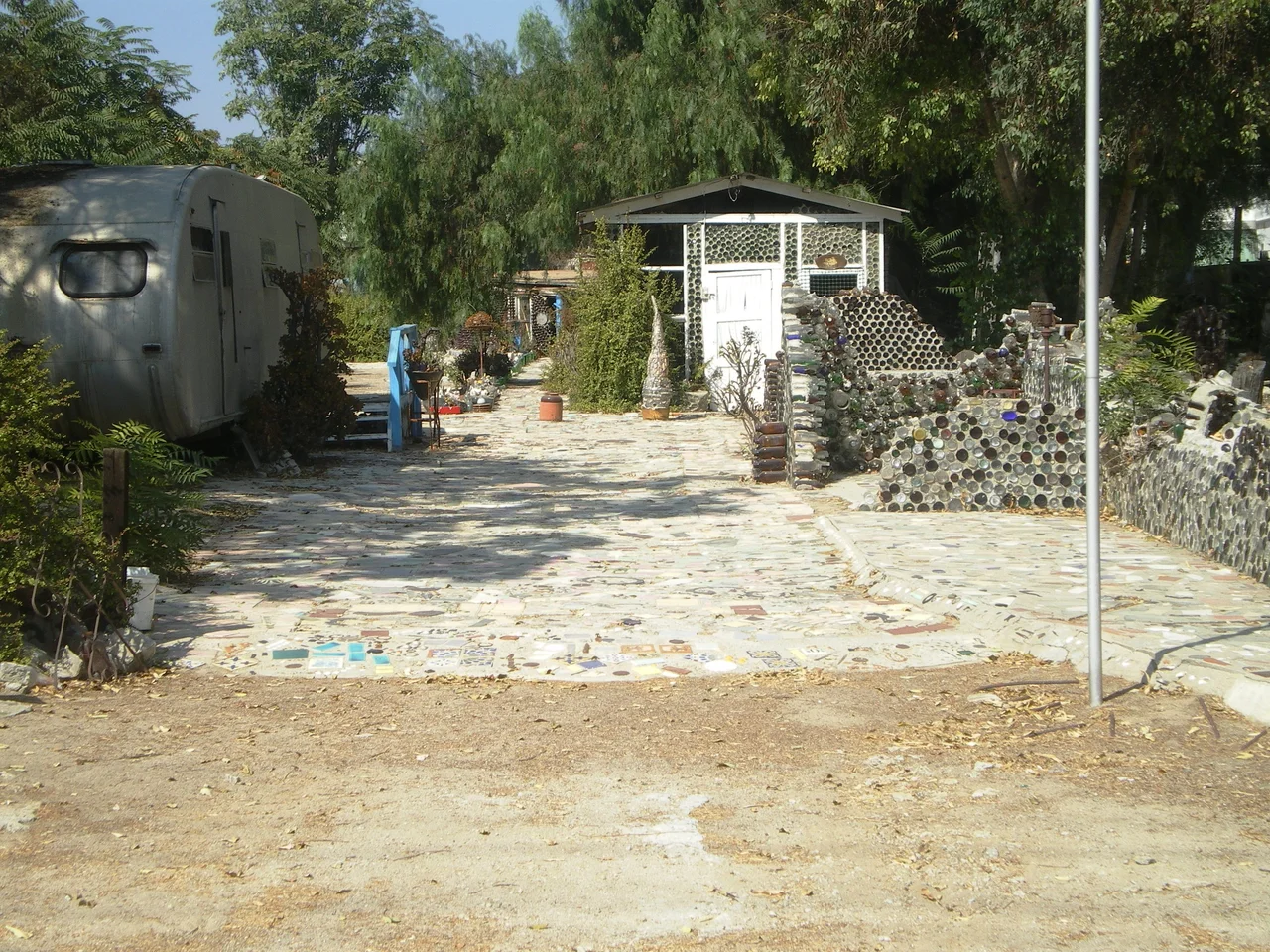

Grandma Prisbrey's Bottle Village
"Anyone can do something with a million dollars. Look at Disney," Tressa Prisbrey once said. "But it takes more than money to make something out of nothing, and look at the fun I have doing it." She was talking about her village—16 buildings, a mosaic sidewalk, a leaning tower, a doll head shrine, a rose garden made of headlights—all built by hand from bottles and objects she pulled from the local dump. The Los Angeles Times called it an "eccentric folk-art wonderland." Art historians called it one of the most significant vernacular art environments in the United States. Prisbrey called it home.
A Life That Made Art Necessary
Tressa Luella Schaefer was born in Easton, Minnesota in 1896 and left school at twelve. At fifteen she married a man thirty-seven years her senior—the ex-husband of her own sister. That marriage lasted fourteen years and produced seven children. She would outlive six of them. Over the course of a life that included two more marriages, a move to Seattle, and eventually a resettlement in what is now Simi Valley, Prisbrey accumulated losses that would have defeated most people. Instead, she accumulated things. When she arrived in Santa Susana in 1946, she had a collection of 17,000 pencils and no place to put them. At sixty, with no money for cinder blocks, she started picking up colored bottles at the dump and making cement by hand at her sister's house. She built a house for her pencils. Then she kept going.
The Village Takes Shape
By 1961, Bottle Village was largely established on a one-third-acre lot on Cochran Street in Simi Valley. Prisbrey never stopped adding to it. Sixteen structures rose from the ground, each with its own theme: a Round House, a shell house, a doll house for her collection of 600 dolls, which she dressed each day. The Headlight Garden was built for a daughter who had been diagnosed with cancer—a rose garden made from automobile headlights and recycled materials, where her daughter would sit in the mornings before she died. There were stepping stones in the shapes of a heart, diamond, and spade from a trip to Las Vegas, filled with scissors and other salvaged objects. Wishing wells. A leaning tower of bottles. The Doll Head Shrine, which eventually appeared on the cover of Wall of Voodoo's 1982 single "Mexican Radio" and developed its own cult following.
Recognition and Damage
Art institutions began to notice Bottle Village in the 1970s. Exhibitions sponsored by the National Endowment for the Arts and the Walker Art Center brought Prisbrey's work to national attention. The village was designated a California Historical Landmark (No. 939) and was listed on the National Register of Historic Places in 1996. Prisbrey charged 75 cents a visit when she was alive, though visitors often gave her more. She would end each tour in her meditation room and sing songs for her guests. In 1984 she moved away permanently; she died in 1988. Then, in January 1994, the Northridge earthquake struck eight miles away and badly damaged what decades of weather and time had not. A $455,000 FEMA grant that might have funded restoration was blocked by local politicians who called it a waste of taxpayers' money.
What Survives
Preserve Bottle Village, a nonprofit group, has been working for decades to stabilize and restore the site. Progress has been slow, funding scarce. Private foundations have contributed tens of thousands of dollars; the state and county have contributed more, focused on specific structures. The village today is damaged but not destroyed. Some buildings have been stabilized; others remain fragile. Every year at Halloween, Prisbrey is commemorated at Simi Valley's Strathearn Historical Park Ghost Tour. The children's book Bottle Houses introduces her story to new generations. What Tressa Prisbrey built from the castoffs of other people's lives—out of grief and persistence and a genuine joy in making something from nothing—has proven harder to erase than anyone anticipated.
From the Air
Located at 34.28°N, 118.70°W on Cochran Street in Simi Valley, California. Visible as a residential neighborhood from the air at 2,000–3,000 feet MSL; the site itself is too small to distinguish from altitude. Nearest airport: KSZP (Santa Paula, ~20 miles west). Simi Valley is clearly visible as the broad, flat valley northwest of the Santa Monica Mountains when viewed from the air.
Nearby Stories
- Topanga 4.6 km away
- Mission San Buenaventura 14 km away
- Mount Lowe Railway 17 km away
- Channel Islands: The California That Cars Never Reached 23 km away
- Antelope Valley California Poppy Reserve 26 km away
- Disneyland Railroad 38 km away
- Edwards Air Force Base 38 km away
- The San Andreas Fault at Carrizo Plain 66 km away