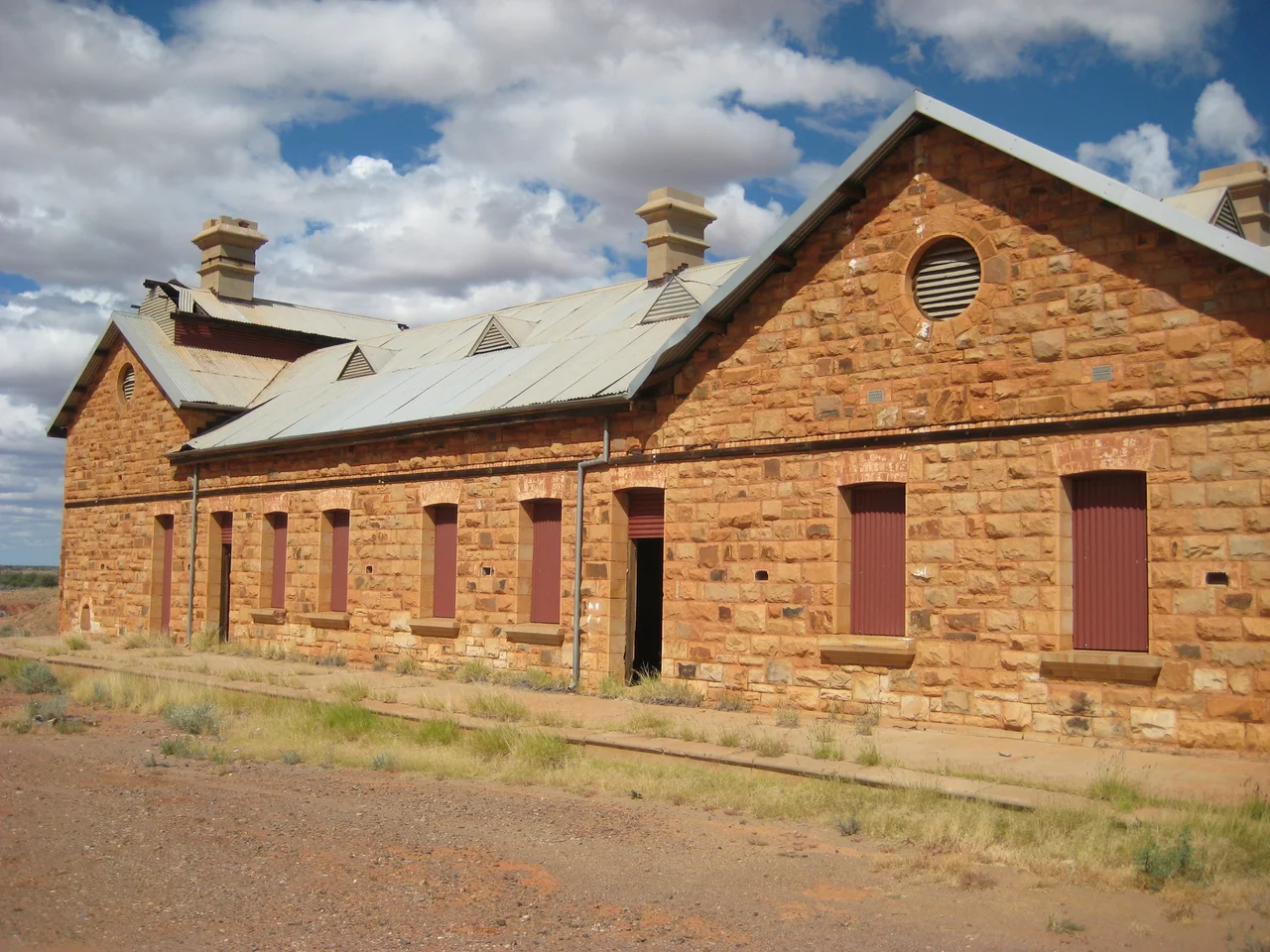

Great Fingall Mine office
It is a strange thing to find in the middle of nowhere: a handsome single-storey building in stone, with the proportions and dignity of a small Italian villa, set down in the red dust of the Murchison. The Great Fingall Mine office was never meant to be remarkable. It was the place where ore was assayed and accounts were kept for one of Western Australia's richest gold mines. But the mine closed, the town of Day Dawn around it disappeared, and the office simply stayed - outliving everything it was built to serve.
Built to Run an Empire of Gold
The office went up around 1902, in the Federation Italianate style favoured for buildings meant to project permanence and authority. It was constructed of local stone - and the masons were probably Italian, believed to have been brought in specifically for the work, though no surviving record nails the detail down for certain. Under one roof it combined two functions that were usually kept apart: the administrative offices, where the Great Fingall Consolidated Gold Mining Company managed its operations, and the assay offices, where ore samples were tested to measure exactly how much gold the rock held. That co-location is part of what makes the building rare today. From these rooms a company ran one of the most profitable mines in the colony.
The Last One Standing
When the Great Fingall mine closed in 1918 and the men left for the war and for other fields, Day Dawn unravelled around the office. House by house, hotel by hotel, the town came down or fell apart, until by the 1930s it was gone. The office endured. Today it is the only substantial building left of an entire municipality - a single point of stone where a town of three thousand once stood. Decades of disuse have taken a toll, but the structure remains generally sound; the main losses are its verandahs, removed long ago, along with the slow damage of weather and the faster damage of vandalism. To stand inside is to occupy the last interior of a vanished place.
The Work Inside the Walls
It helps to picture what these rooms were for. The assay office was a small laboratory in the desert, where workers fired ore samples in furnaces, weighed the gold that separated out on delicate balances, and turned raw rock into the hard numbers a mining company lived or died by. The administrative side handled wages, contracts and the relentless paperwork of a large operation - the same company whose wage policies and use of imported labour sparked a bitter nine-week strike at Day Dawn in 1899. To combine both functions under one elegant Italianate roof was unusual then and rare now, which is precisely why heritage authorities have fought for it. The building carries listings from the National Trust and the Heritage Council of Western Australia, and appears on registers of the state's most endangered places.
On the Edge of the Pit
The office faced a fresh danger when mining returned. In the mid-1990s a new open-cut operation reopened the ground, and the pit was dug startlingly close - the building now perches near the very edge of an open-cut mine, a heritage monument balanced against an active excavation. The Shire of Cue has long wanted to stabilise and restore the office and open it to the public, but the figure quoted runs to around three million dollars, far beyond what a tiny outback shire can find on its own. Officials have looked for help from the state government and from the mine's owners. For now the office holds its ground, elegant and exposed, on borrowed time at the rim of the hole.
From the Air
The Great Fingall Mine office sits at roughly 27.46 degrees south, 117.86 degrees east, at the former Day Dawn townsite about 8 km south of Cue, on ground near 1,400 ft MSL. From the air it is the standout feature of the site - a pale rectangular building immediately beside the dark geometry of an open-cut pit and its waste dumps. Cue Airport (ICAO: YCUE) lies a short hop north; Mount Magnet (YMOG) is about 74 km south and Meekatharra (YMEK) about 112 km north. A slow orbit at 3,000 to 4,000 ft MSL frames the building against the pit. Visibility in this arid country is usually superb; the best light for picking out the stonework is early or late in the day.
Nearby Stories
- Dalgaranga crater 19 km away
- Yarrabubba 33 km away
- Mount Magnet, Western Australia 33 km away
- Wilgie Mia 43 km away
- Sandstone, Western Australia 84 km away
- Boolardy 93 km away
- Sandstone Gold Mine 100 km away
- Ajana 275 km away