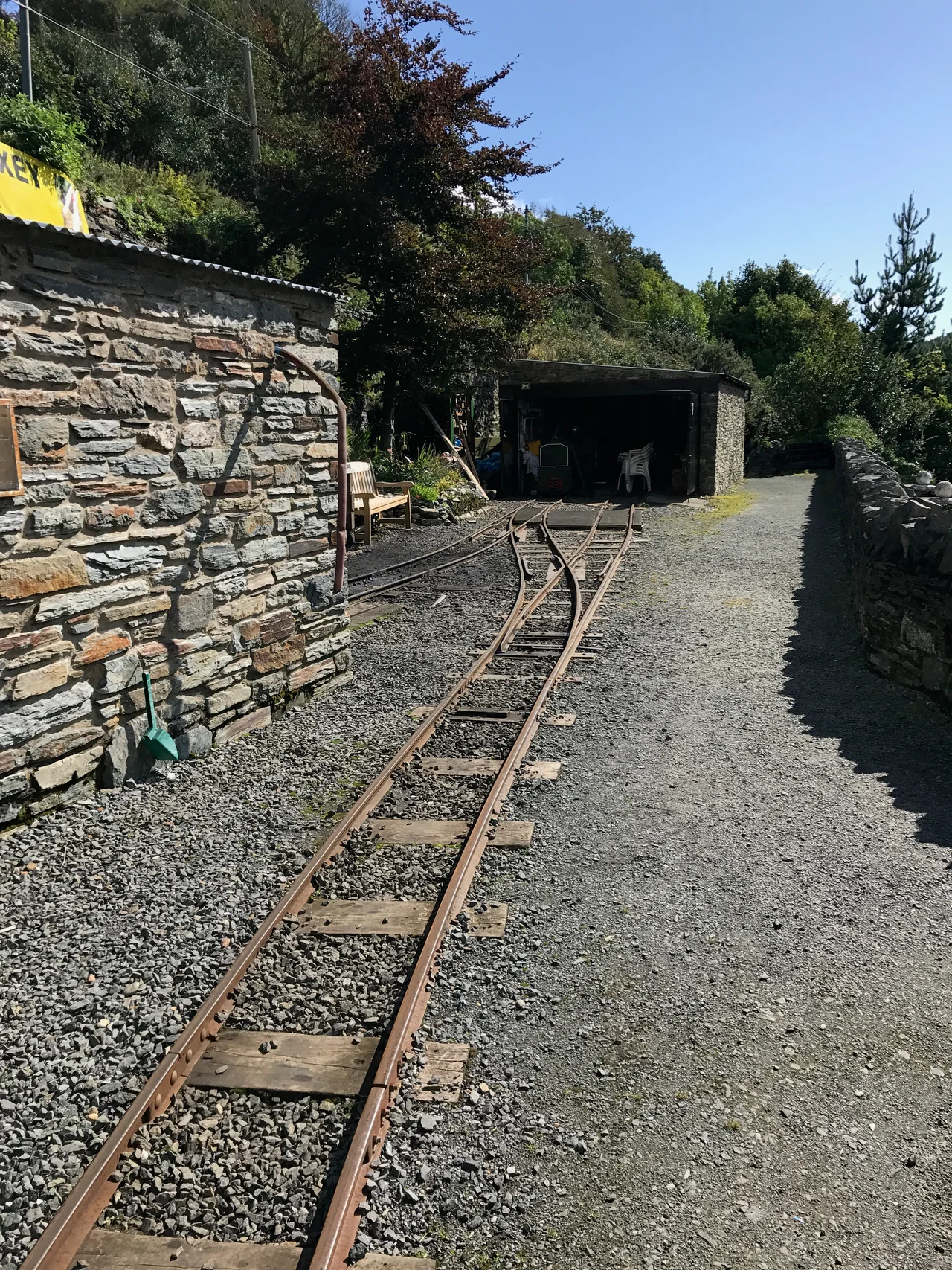

Great Laxey Mine Railway
When restorers crawled into the old adit in the 1970s, they expected blockages and rubble. What they did not expect was an entire train. Six high-sided ore wagons sat in the tunnel exactly where the last miners had left them, abandoned underground in 1929 when the Great Laxey Mine fell silent. The wagons were lifted, restored, and returned to daylight, and within thirty years the railway that had served the deepest mine on the Isle of Man was running again, this time carrying tourists between Valley Gardens and the old mine yard.
Inside the Hill
The Great Laxey Mine descended 2,200 feet into the Manx earth in pursuit of lead, zinc, and copper. Its uppermost level, the adit, was a network of tunnels a mile and a half long, cut horizontally into the hillside at ground level so they could connect the heads of every working shaft. From 1823 a railway ran through this adit so miners could push small wagons of ore from shaft to washing floor. In 1827, the mine bought a pit pony to do the pulling. More ponies followed as the workings grew. By the 1870s the operation had outgrown muscle power, and in 1877 two steam locomotives, named Ant and Bee, arrived from Stephen Lewin of Poole.
Built to Fit
Ant and Bee were 0-4-0 tank engines, made specifically for a tunnel that would not tolerate normal proportions. They stood 4 feet high and only 3 feet wide. Their water tanks sat ahead of the smokebox to keep their flanks narrow. Their two inside cylinders ran Bagnall-Price valve gear with a geared drive to the rear axle, but with conventional coupling rods between the axles. They used launch-type boilers, common to small engines that lacked room between the frames for a normal firebox. Around 1905 the W. G. Bagnall firm in Stafford rebuilt both locomotives to a more conventional saddle-tank design, giving them new boilers and a revised profile that extended their working lives. They survived the closure of the mine in 1929 only to be scrapped six years later when the surface railway was dismantled.
Asleep Underground
What disappeared from sight did not entirely disappear. When volunteers reopened the adit in the 1970s, parts of the underground railway were intact and the abandoned ore train was still in its tunnel, locked in by the silence of a closed mine. The wagons came back into the daylight and were restored. In the late 1990s, momentum built to bring the surface railway back too. Restoration work began in 2000. The locomotive shed was rebuilt on the exact footprint of the original. Blockages in the only remaining working railway tunnel on the island were cleared. By 2004, the line was operating again. A year later, the track had been relaid all the way into the old mine yard, although the spur into the mine itself remains unrestored.
Replicas in Service
The originals are gone, but Ant and Bee live on as replicas built specifically for the railway's reopening. They share duty with Wasp, a battery-electric locomotive that previously worked in a Cornish mine and now wears engineering black with yellow wasp stripes. Two narrow passenger carriages, built by Alan Keef Ltd in 2004 and 2007, run on the line. Because the gauge is tiny and the clearances tighter still, passengers sit on longitudinal benches and effectively ride sideways. Six of the original ore wagons recovered from the adit have been preserved in island museums; six replica wagons, hammered together at the Laxey Blacksmith in 2000, do the working duty.
Tighter Than Anyone Else's
The route is short and unusual. Trains depart Valley Gardens station, restored in 2006 to its original two-platform layout, and pass through the surviving tunnel under the gauge of the Victorian Manx Electric Railway and the A2 coast road that links Douglas to Ramsey. The line includes one of the tightest radius bends on any working heritage railway in the British Isles. At the upper end the line reaches Mines Yard near the old entrance. Once, the Laxey Browside Tramway climbed from here toward the great Laxey Wheel a few minutes away; now it is a car park. The mine railway is a small, peculiar thing, but it runs every operating day on a track that knew silence for almost seventy years.
From the Air
The Great Laxey Mine Railway runs at 54.2338°N, 4.4049°W on the east coast of the Isle of Man, in the valley above Laxey village. Best viewed from 2,000–3,000 feet AGL; look for the green Laxey valley descending to the sea, with the giant red Laxey Wheel as the obvious nearby landmark. Nearest airport is Isle of Man / Ronaldsway (EGNS), about 14 nm south. The Snaefell massif rises just inland, so expect orographic cloud and turbulence in westerly winds.
Nearby Stories
- St Bees Lighthouse 15 km away
- Celtic Array 22 km away
- Kirkmaiden 23 km away
- Isle of Whithorn 23 km away
- Seascale Lifeboat Station 31 km away
- German submarine U-1024 36 km away
- SS Georgetown Victory 40 km away
- Blackpool Illuminations 56 km away