.png)
Great Red Spot
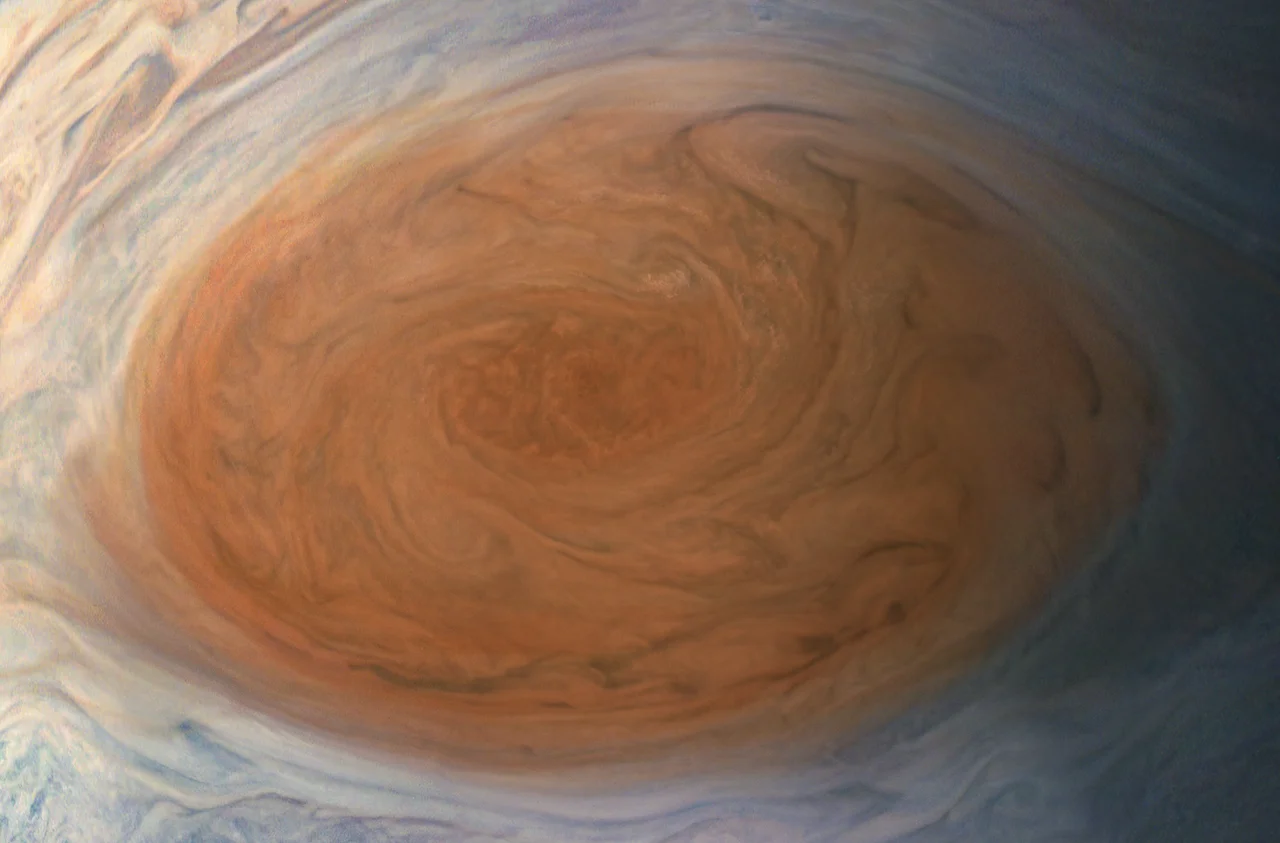
On September 5, 1831, an astronomer pointed a telescope at Jupiter and saw a red oval south of the equator. He was not the first to see it. Robert Hooke described a Jovian spot in 1664, and Giovanni Cassini calculated its rotation period in the following year. But those earlier spots may or may not be the same storm. A 2024 analysis suggests they were not. What the 1831 observer saw, though, has been watched continuously ever since. Every night the planet is visible, somewhere in the world an astronomer is looking at it, and the Great Red Spot is still there, still turning, still rising eight kilometers above the surrounding cloud deck.
A Storm Bigger Than a Planet
As of April 2017, the Great Red Spot measured 16,350 kilometers across, about 1.3 times the diameter of Earth. It has been shrinking for a century, and as of the most recent measurements, it is now slightly smaller than our planet but still easily the largest storm in the solar system. The winds at its edge move at 432 kilometers per hour, roughly the speed of a bullet train on its fastest stretch. The spot rotates counterclockwise, completing one turn every 4.5 Earth days, or about 11 Jovian days. The cloud-tops of the storm sit eight kilometers higher than the surrounding atmosphere, which means that the infrared signature of the Great Red Spot reads colder than the rest of the planet at that latitude. A cold, elevated, counterclockwise vortex the size of a world, spinning for at least 195 years.
Why It Does Not Stop
On Earth, hurricanes die when they hit land. Friction breaks up the circulation, the storm loses its fuel, and within days the winds dissipate. Jupiter has no land. The planet is a gas giant whose outer atmosphere of hydrogen merges smoothly into a hydrogen mantle below, and there is nothing solid for a storm to scrape against. The Great Red Spot, and storms like it, can persist because nothing acts to dissipate their angular momentum. The atmosphere around them does help shape them, though. A modest eastward jet stream runs along the south edge of the spot, and a powerful westward jet runs along the north. The storm is pinned between them like a ball bearing in a gear assembly, held in place by winds pushing in opposite directions on either side.
Red Spot Hollow and the Color Question
The color varies. Sometimes it is brick red. Sometimes pale salmon. Sometimes it fades so much that the only evidence of the spot is the Red Spot Hollow, a darker indentation in the South Equatorial Belt where the storm resides. When the belt goes bright white, the spot tends to go dark. When the belt darkens, the spot lightens. Why the red color at all? Astronomers suspect tholins, complex organic compounds formed when solar ultraviolet radiation breaks apart ammonia and acetylene in the upper atmosphere. The products rain down into the spot's elevated cloud tops and stain them the color of rust. Nobody has yet synthesized the exact chemistry that matches what the telescopes see, so the explanation remains provisional. The oldest continuously observed storm in the solar system, and we still do not know exactly why it is red.
The Flaking Years
In 2019, amateur astronomers noticed something new. Pieces of the spot were spinning off. Red fragments broke away from the edges and dissipated into the surrounding atmosphere. The shrinking had been going on for a century, but the flaking was new, and some astronomers speculated that the spot might disappear within decades. Others disagreed, pointing out that the visible size reflects cloud coverage, not the actual size of the underlying vortex. The flaking, they argued, comes from collisions with smaller cyclones and anticyclones that the Great Red Spot partially absorbs. The vortex itself may be fine. A smaller storm called Oval BA, formed in 2000 from three merging white ovals, turned red in 2006 and is now nicknamed Red Jr. It passes the Great Red Spot every couple of years. They have never merged, but they keep coming close.
What Juno Saw
On July 11, 2017, NASA's Juno spacecraft flew over the Great Red Spot at a distance of about 5,000 miles above the cloud-tops. The images were the closest ever taken. Gravity measurements during Juno's overflight showed that the spot extends downward into the planet at least 200 kilometers, possibly much deeper. It is not a thin cap on the atmosphere but a massive vertical column of circulating gas. The spacecraft also revealed something unexpected about the upper atmosphere above the storm. Temperatures there run several hundred kelvin warmer than elsewhere on the planet at the same altitude. The current explanation is that acoustic waves from the turbulent storm below propagate upward and break, converting their energy into heat. The Great Red Spot, in other words, is warming the sky above itself.
Note on Location
This article is filed in the catalog at coordinates for central South America, which is an indexing error. The Great Red Spot is on Jupiter. It is an anticyclonic storm at 22 degrees south on the fifth planet from the sun, 778 million kilometers from Earth on average, visible to anyone with binoculars on a clear night. No airport offers direct service. Planning accordingly.
From the Air
The Great Red Spot is a storm on Jupiter, not a location on Earth. To observe it from Earth, point a telescope (at least 4 inches aperture) at Jupiter during a favorable opposition. The storm completes one rotation every 9.9 Earth hours (Jupiter's rotation period), so it is visible from Earth only about 50 percent of the time. Current estimated size: about 1.3 times Earth's diameter, shrinking. Winds peak at 432 km/h. The storm sits 22 degrees south of Jupiter's equator.
Nearby Stories
- Battle of Cerro Cora 61 km away
- Buraco das Araras Private Natural Heritage Reserve 95 km away
- Nova Andradina 120 km away
- 9th Military Region (Brazil) 153 km away
- Serra da Bodoquena National Park 163 km away
- Guaira Falls 196 km away
- Laguna Blanca (Paraguay) 211 km away
- Lagoa São Paulo Reserve 262 km away