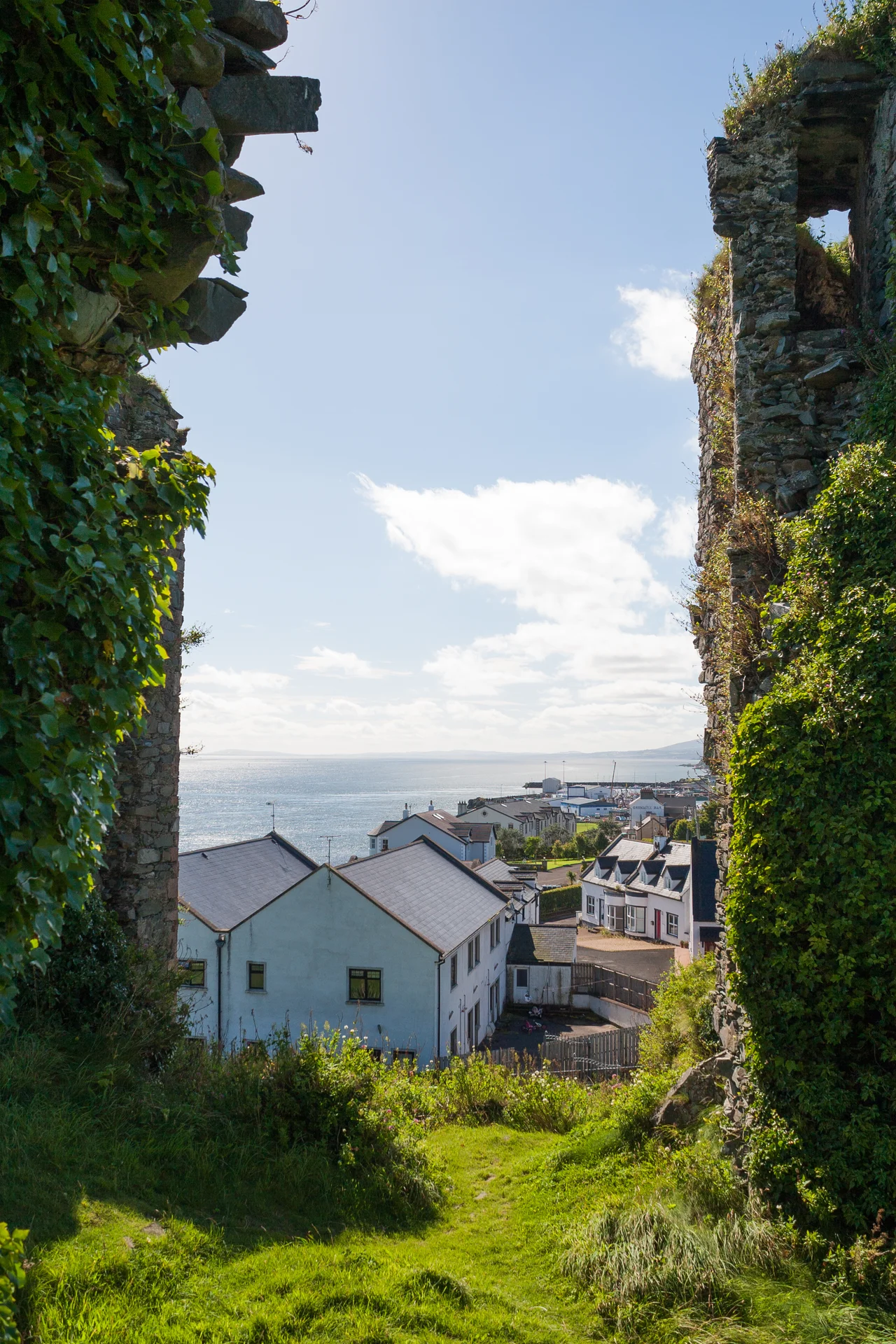

Greencastle, County Donegal
Saoirse-Monica Jackson grew up here. The actress who played Erin Quinn in Channel 4's *Derry Girls* - the show that defined a generation's view of late-90s Northern Ireland - was raised in Greencastle, where her parents ran a pub. From the back garden of that pub you can look across the mouth of Lough Foyle and see the Causeway Coast of County Londonderry on the other side. It is a peculiar geography. Greencastle is in the Republic of Ireland but its nearest big town is Derry in the United Kingdom. The ferry to Magilligan saves you forty-nine miles of road driving and crosses an international border in fifteen minutes. The fishing fleet that ties up here works the same waters as the trawlers out of Portrush. Brian Friel, perhaps the greatest Irish playwright since Beckett, chose Greencastle as his home from 1982 until his death in 2015. Some places sit on borders. Greencastle is one of them.
The Castle That Gave the Name
Northburgh Castle was built in 1305 by Richard de Burgh, the Red Earl of Ulster, as a base for Anglo-Norman power in the north-west. The ruins still stand on the headland above the village - a substantial fragment of curtain wall, the remains of a square keep, the foundations of a once-formidable fortification facing out over Lough Foyle. The castle's name is said to come from the green freestone with which it was built, a local sandstone with a faint greenish cast that gave both the building and eventually the village their name. Northburgh was strategic - it controlled the entrance to Lough Foyle and the sea approach to Derry - and it was contested through the 14th century by competing Gaelic and Anglo-Norman lords. The skeleton-and-castle motif on the present-day Derry City crest is said to commemorate Walter de Burgh, who was starved to death in this fortress by his cousin in 1332. The castle declined after the 14th century, was occupied intermittently in the 16th and 17th centuries, and finally fell into the ruined state in which it stands today.
The Martello and Napoleon
Beside the ruined medieval castle stands a much later fortification: a Martello tower, built by the British around 1800 to defend the entrance to Lough Foyle against a possible French invasion. The Martello at Greencastle is one of a chain of these squat, drum-shaped coastal towers that the British built along vulnerable coasts during the Napoleonic Wars - from Cape Town to Quebec to Sicily. The Napoleonic invasion never came. The tower never fired a shot in anger. But it still stands a few hundred yards from the medieval ruin, a five-hundred-year gap of military architecture sharing the same headland - a quiet visual demonstration of how strategically valuable this particular piece of Inishowen ground has been across the centuries.
Pier, Trawlers and Ferry
The first proper pier at Greencastle was built in 1813. It has been extended several times since. Today the pier hosts the Greencastle Fishermen's Co-Op, the Foyle Fishermen's Co-Op, Fresco Seafoods and a working trawler fleet that supplies markets across Ireland and beyond. The fishing industry has declined from its mid-20th-century peak, and Greencastle today resembles more closely a holiday village than the working port it once was. In 2002 the Magilligan-Greencastle ferry began operating across the mouth of Lough Foyle - a fifteen-minute crossing that saves 78 kilometres of road driving through Derry. The Lough Foyle Ferry Company also operates a seasonal service between Buncrana and Rathmullan across Lough Swilly to the west. Greencastle is also a tender port for cruise ships visiting Derry; the channel up the Foyle Estuary to Lisahally docks is too shallow at low tide, so larger vessels anchor off Greencastle and bring passengers ashore by lifeboat-style tender.
Brian Friel's Last Address
When Brian Friel - playwright of *Translations*, *Dancing at Lughnasa*, *Philadelphia, Here I Come!* - moved to Greencastle in 1982, he was already one of the most important Irish writers of his generation. He chose Greencastle for the same reasons many people chose it: the quiet, the views, the proximity to the sea, the distance from Dublin. He lived here for 33 years until his death in 2015. His later plays - *Molly Sweeney*, *Faith Healer*, *Performances* - were largely written in this small village at the eastern edge of Donegal. Friel's funeral in Glenties drew most of the Irish theatre establishment north for the day, but his daily life had been here, in a fishing port of fewer than a thousand people for most of his time, walking the pier in the morning, watching the trawlers come in. The pub Saoirse-Monica Jackson's family ran is the kind of place Friel might have written into a play set forty miles down the coast in Glenties. The same dramatic ear, the same hard wit, the same border-country sensibility.
The Fastest-Growing Place in Donegal
Between the 2016 and 2022 Republic of Ireland censuses, Greencastle's population grew by 52.6 percent - from 831 to 1,268. That is the fastest growth rate of any urban area in County Donegal. The drivers are a combination of remote working, the ferry connection to Northern Ireland, the appeal of coastal living, and the relatively low house prices compared to Derry or Belfast across the water. The National Fisheries College (NFC), located on the edge of the village, completed a €1.1 million expansion in recent years, funded through the cross-border INTERREG II programme; it now includes a realistic simulator bridge deck for training merchant mariners. The fishing industry that built the village is no longer its principal employer, but the village is finding new reasons to be lived in. The ruined castle still keeps watch from the headland. Brian Friel's house is still there. The ferry runs four times an hour in the summer. And the population, against the national trend of rural decline, keeps climbing.
From the Air
Greencastle sits at 55.20°N, 6.98°W on the eastern tip of the Inishowen peninsula, at the mouth of Lough Foyle. From altitude, the village is unmistakable - a small cluster of harbour buildings at the seaward end of a long pier, with the ruined medieval castle and Martello tower on the headland just to the north. Across Lough Foyle, the long sandy spit of Magilligan Point and the Causeway Coast of County Londonderry are clearly visible. Nearest airports: City of Derry (EGAE) about 11 nm southwest across the lough, Donegal Airport (EIDL) about 50 nm west-southwest. The Atlantic open water lies a few miles north; the seas can be rough, and the pilot service that operates from Greencastle handles cruise ships, freighters and tankers transiting between the Atlantic and Derry.
Nearby Stories
- Ballyliffin 0.7 km away
- Grianan of Aileach 3.2 km away
- HMS Drake (1901) 7.2 km away
- County Londonderry 11 km away
- Port Ellen Distillery 13 km away
- German submarine U-155 (1941) 17 km away
- County Antrim 18 km away
- Bruichladdich Distillery 39 km away