
Groudle Glen
In Manx Gaelic, Lhen Coan means "Lonely Valley." The name was attached to a stretch of canyon in Groudle Glen, the only natural canyon on the Isle of Man. The translation has been bent over the years into prettier things, Lovely Glen, Lovely Valley, but the original word was honest about the place. It was lonely. Until the Victorians arrived, Groudle was a remote hamlet on the outskirts of Onchan with a handful of cottages and a stream running down to the sea. Then someone laid an electric railway through it and the loneliness ended for almost a century.
The Fern Land of Mona
In 1893, the Manx Electric Railway reached the glen and turned it overnight into a tourist destination. The owners began promoting it as 'The Fern Land of Mona,' planting many different kinds of tree so that Victorian visitors could inspect specimens as part of the day out. Where most Manx glens were left to nature, this one was curated. At the beach there were bowling and croquet greens, a mill, crofters' cottages, and a bridge across to the Howstrake Holiday Camp on the next headland. Where the old pack-horse road crossed the railway, there was a lime kiln from which an intermediate station took its name. By the standards of the 1890s, this was a serious attraction. Later writers would describe it as 'the Alton Towers of its day.'
Sea Lions on the Cliff
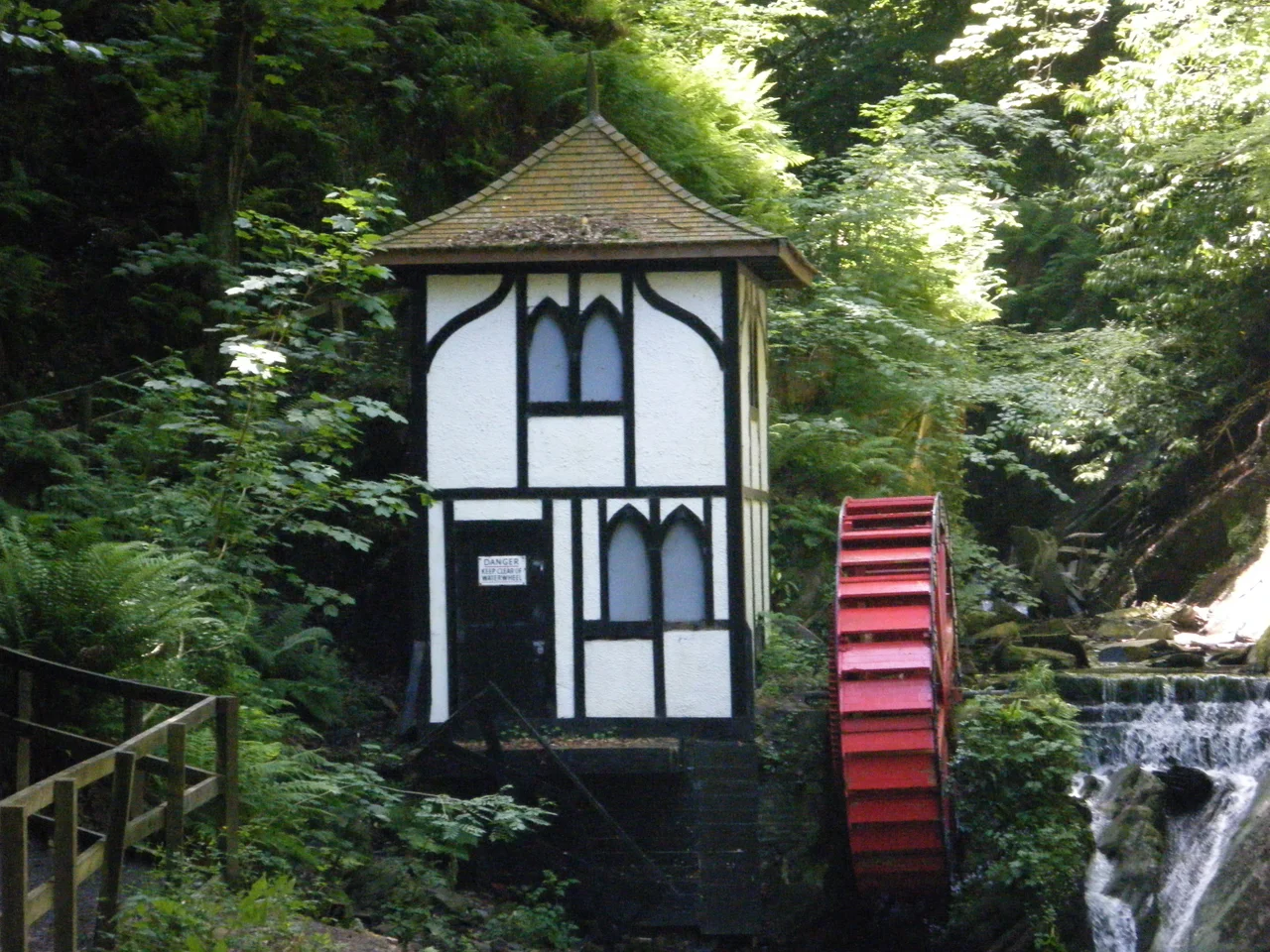
What set Groudle apart was its zoo. In 1893, a small cove at the outer reach of the glen was dammed off and a sea lion enclosure built into the rock. Polar bears were added. The whole apparatus was a remarkable feat of engineering, and the remains of it can still be seen today, weathered concrete and iron in situ on the headland. To carry the crowds out to see the animals, the Groudle Glen Railway opened in 1896, climbing three quarters of a mile from Lhen Coan up onto the cliff. The terminus was named Sea Lion Rocks, a name it still carries even though the sea lions have been gone for more than eighty years. The glen filled out around these anchors with a dance floor, a bandstand, fortune tellers, food stalls, a playground, and a water wheel that everyone called Little Isabella in cheeky reference to the world-famous Laxey Wheel a few miles up the coast.
Mona May at the Kiosk
About sixty yards below the Little Isabella wheel are the foundations of an old refreshment kiosk, just across the stream from where the bandstand used to stand. In the 1920s it was run by a young woman named Mona May Cannell, who travelled in from Laxey each day on the tram from South Cape. She was then Mona May Grose. The details are the kind of thing a guidebook would omit, but they are exactly what make a Victorian pleasure ground feel real: someone arriving on a tram, opening a kiosk in a glen, serving tea and ices to day-trippers from Douglas, then catching the tram home. The kiosk is a ruin now. The bandstand was replaced in 1993 with a smaller version, and the dance floor is gone.
Falling Quiet
The Second World War closed the zoo for good and the glen never really recovered. Of all the attractions, only the railway survived, and even that closed in 1962. For twenty years the glen returned to a quiet footpath, the trackbed swallowed by brambles. Volunteers brought the railway back in stages from 1982 onward, and today the trains run again in summer, with a visitor centre and tea rooms beside the old zoo. The lily ponds in the lower glen, refurbished by the Manx Heritage Trust in 1986, have been allowed to slip again and are not easily accessible from the public path. The glen itself runs from the Whitebridge in Onchan down to Port Groudle, and most of it can still be walked freely.
Little Isabella, Restored
The Little Isabella waterwheel had stood broken for years. Then in 2020, the mining engineering firm MMD put it right, restoring both the wheel and its wheelhouse to working order in memory of their founders. It now turns again in the lower glen, a small but exact echo of the world-famous Laxey Wheel that inspired its nickname. Most of the Victorian flourishes of the glen are ghosts, traces in the undergrowth and corners of old postcards: the bandstand, the croquet green, the fortune tellers' tent. But the railway runs in summer, the wheel turns, and the Lonely Valley is much less lonely than its name suggests.
From the Air
Groudle Glen sits at 54.1786°N, 4.4301°W on the east coast of the Isle of Man, just north of Onchan and a few minutes by tram from Douglas. Best viewed from 1,500–2,500 feet AGL; from the air the wooded ravine cuts east through grazing land to the Irish Sea, with the headland and Sea Lion Rocks marking its mouth. Nearest airport is Isle of Man / Ronaldsway (EGNS), about 10 nm south. Sea fog can roll in suddenly off the Irish Sea.
Nearby Stories
- St Bees Lighthouse 15 km away
- Celtic Array 22 km away
- Kirkmaiden 23 km away
- Isle of Whithorn 23 km away
- Seascale Lifeboat Station 31 km away
- German submarine U-1024 36 km away
- SS Georgetown Victory 40 km away
- Blackpool Illuminations 56 km away