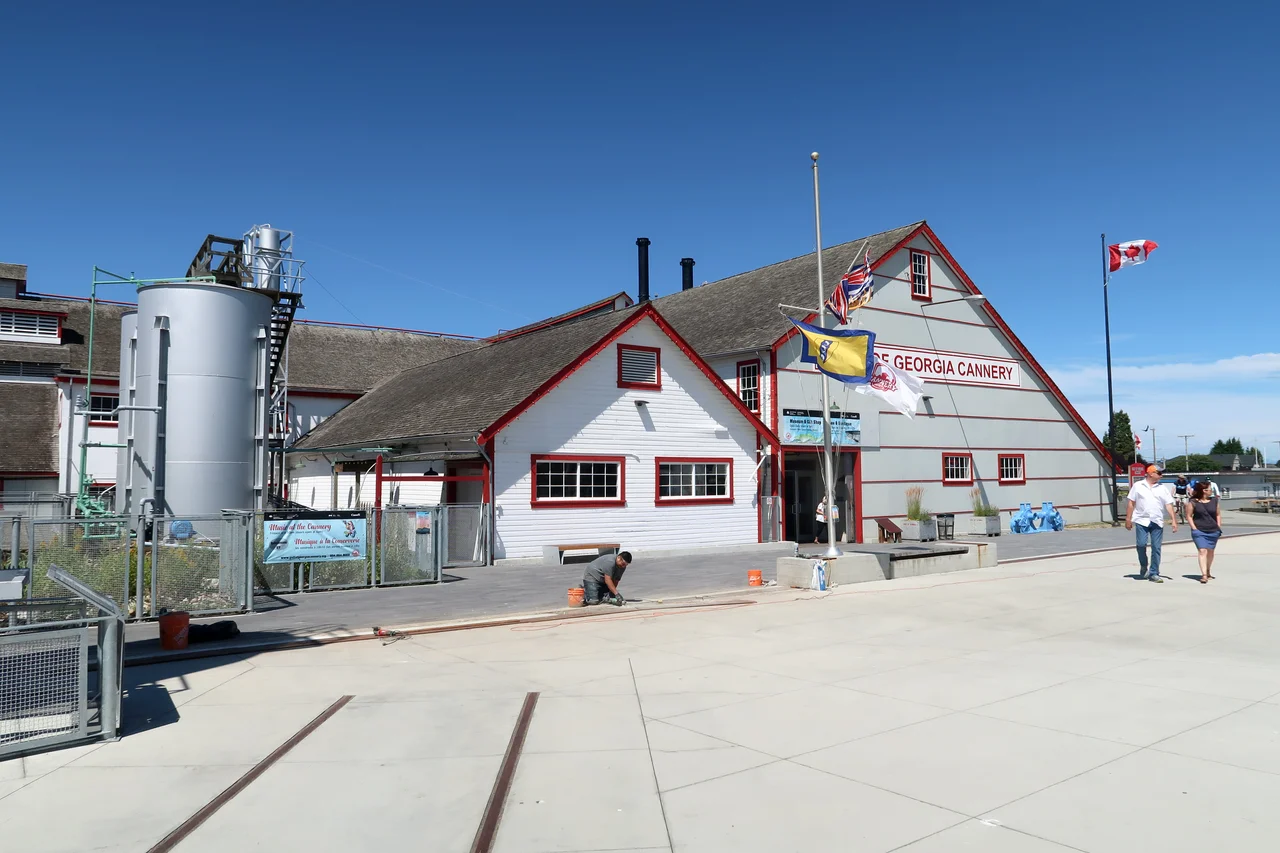

Gulf of Georgia Cannery
In 1897, the Gulf of Georgia Cannery packed more than two and a half million cans of salmon. The building had opened three years earlier on the lower Fraser River at Steveston, then a boomtown of canneries standing shoulder to shoulder along the water, and it was the largest in British Columbia until 1902. People called it the Monster Cannery, which was less a compliment than a description. A sockeye run arriving all at once gives a cannery a few frantic weeks to process a year's income, and in those weeks the place ran on hundreds of pairs of hands moving very fast in a building that smelled of fish, steam, and hot solder.
Who Filled the Cans
The workforce each season was First Nations, Chinese, Japanese, and European, sorted by job and by pay in ways nobody at the time pretended were accidental. Indigenous women, many of them from communities up the coast who travelled down for the season, did much of the cleaning and filling. Chinese crews handled the butchering under labour contracts. Japanese fishers supplied a large share of the catch. Canning was among British Columbia's biggest employers and its canned salmon among the province's principal exports, an industry built almost entirely on people who could not vote in it. In 1906 a mechanical butchering machine arrived, and the West wing that had been the butchering shed became a net loft. The machine was sold across the industry under a name that was a racial slur aimed at the Chinese butchers it was designed to replace, which is as clear a statement of intent as any invoice.
April 1942
By 1941, Japanese Canadians owned 46 of Steveston's 62 businesses, and their families made up much of the fishing fleet and the cannery workforce. Women processed the catch with babies on their backs. Within hours of Canada declaring war on Japan in December 1941, the government began seizing their fishing boats, gathering them on the Fraser to be sold off to canneries and to non-Japanese fishermen, generally without their owners' consent. Then the people went. Roughly 2,600 Japanese and Japanese Canadian residents of Steveston were removed from their homes and sent to camps in the British Columbia interior or east to farm and road labour, and by April 1942 the village held no one of Japanese descent at all. Their houses, boats, and businesses were auctioned, and the proceeds were applied to the cost of interning them. Some families came back after the war. Many had nothing to come back to.
Herring in Tomato Sauce
The last can of sockeye came off the Gulf of Georgia line in 1930, after which the salmon work consolidated into British Columbia Packers Limited and the building went quiet through the Depression. War brought it back. Capital and machinery poured in for a new product, canned herring in tomato sauce, which turned out to be an efficient way to move protein to soldiers and civilians in Britain and Europe. The cannery raised its roofline in 1940 for a bigger boiler and built an ice house in 1943. Alongside the canning grew herring reduction, the process of cooking and pressing whole fish into oil and meal for animal feed, and when the war ended and the tomato-sauce market vanished, reduction was what remained. By the late 1940s it was the main business, and the complex expanded in three successive waves of sheds, evaporators, separators, and grinding rooms to keep up.
Fishing a Population to the Floor
Herring reduction ended the way those industries usually do. Catches that had run into the hundreds of thousands of tonnes collapsed under their own weight, and in the late 1960s the government closed the fishery outright. A reprieve came in the 1970s, when a Japanese market for British Columbia herring roe reopened the boats, but the roe fishery is a different animal: tightly regulated, with catches capped in the low tens of thousands of tonnes, and it left only a trickle of raw material for reduction. The Gulf of Georgia's reduction equipment was by then decades old and expensive to run. In 1979 the plant shut for good, and the building was demoted to a net loft and winter storage for the Canadian Fishing Company's boats.
The Building That Refused to Go
Steveston did not let it be demolished. Through the 1970s and early 1980s residents lobbied every level of government they could reach, and in 1979 the federal government bought the property, transferring it to Parks Canada in 1984. Locals formed the Gulf of Georgia Cannery Society in 1986 to help develop the site, and the doors opened to the public in 1994, exactly a century after the first can was sealed. The arrangement that resulted is unusual: a federally owned National Historic Site run day to day by a community non-profit, one of very few in the country. Inside, the machinery still stands where it was bolted down, heritage interpreters walk visitors through the lines, and a film runs on request. The smell is gone. Almost everything else is where it was left.
From the Air
The Gulf of Georgia Cannery stands at 49.125N, 123.187W, on the waterfront of Steveston village in Richmond, British Columbia, at the south edge of Lulu Island where the main arm of the Fraser River meets the Strait of Georgia. From the air, find the Fraser delta's broad brown sediment plume and the long straight training jetty running west from Steveston into the strait; the cannery is on the north bank at the head of the fishing harbour, a large weathered wooden complex among the marina docks. Vancouver International Airport (CYVR) sits about 4nm north on Sea Island, so this area lies directly under its approach and departure paths and inside its control zone — coordinate before any transit. Boundary Bay Airport (CZBB) is roughly 8nm southeast and Vancouver Harbour Water Aerodrome (CYHC) about 12nm northeast. Overflight should be planned around CYVR traffic; the delta is often clear when the North Shore mountains are in cloud, but fog forms readily over the river mouth in autumn.
Nearby Stories
- Mudge Island 3 km away
- Mayne Island 4.9 km away
- Canadian Museum of Flight 6.1 km away
- Hovander Homestead Park 8.5 km away
- St. Augustine's Indian Residential School 8.8 km away
- Paldi, British Columbia 11 km away
- Golden Ears Provincial Park 20 km away
- Britannia Mine and the Mountain That Bleeds 25 km away