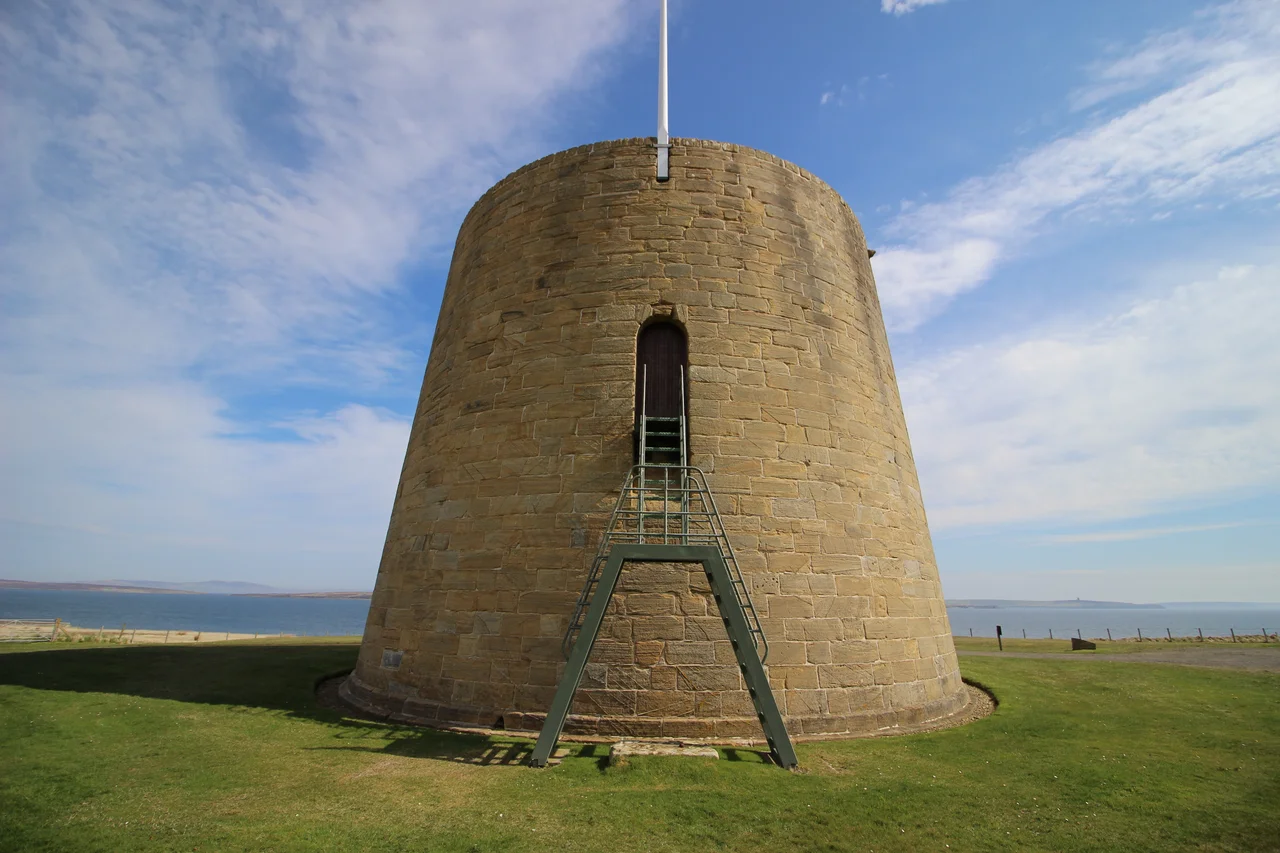

Hackness Martello Tower and Battery
On the island of South Walls at the southern tip of Hoy, two squat stone towers stand half a mile apart facing each other across the bay of Longhope. Their walls taper inward from a thick base, their roofs are flat with a single 24-pounder gun position on top, and their shape - vaguely conical, undeniably defensive - belongs to a small family of fortifications that ringed the empire two centuries ago. They are Martello towers. The southern one, Hackness, sits beside a small artillery battery and a row of barracks. Together they form the most northerly Martello complex in the British Isles, built not to fight Napoleon's navy directly but to guard a convoy anchorage from a more nimble menace: privateers.
Privateers and the Baltic Run
By 1813 the Napoleonic Wars had been grinding for over a decade, and Britain was simultaneously at war with the United States. The English Channel was a working battleground; the Baltic timber trade, vital for Royal Navy masts and shipbuilding, depended on convoys that took the long way around the north of Scotland. The bay of Longhope, sheltered behind South Walls, was a natural rendezvous point where merchantmen could gather and wait for a Royal Navy escort. It was also exposed to a particular kind of attack. French and American privateers - privately owned ships licensed to take enemy commerce - operated independently, struck fast, and made no attempt to engage warships. A handful of armed sloops could devastate a waiting convoy. The Admiralty wanted Longhope defended. In 1815 two Martello towers and a battery went up: Hackness on the south side of the bay and a twin at Crockness on the north.
The Martello Idea
The design came from a tower at Mortella Point in Corsica, where in 1794 a Royal Navy squadron had taken heavy damage trying to subdue a small Genoese gun position before eventually capturing it. The British were impressed enough to copy the form - the spelling shifted, the basic idea did not. Thick, sloping walls of solid masonry could absorb cannon fire from ships at sea. A single heavy gun mounted on a turntable on the flat roof could fire in any direction. A small garrison - typically a dozen soldiers - could hold the building against a much larger landing force. Between 1804 and 1815 the British built more than a hundred Martello towers from the south coast of England to Ireland, Canada, the Caribbean, South Africa, and now finally to Orkney - the northernmost of the lot. By the time Hackness was finished, Waterloo had been fought. The wars were over.
Built Late, Upgraded Anyway
Defenses built at the end of a war are usually obsolete on completion. Hackness was no exception - it never saw an enemy in the Napoleonic context it was built for. But the Royal Navy kept finding reasons to maintain it. In 1866, responding to the perceived threat from the American Fenian Brotherhood, the towers and battery were upgraded with new guns and additional structures. The barracks beside Hackness Battery, where a small garrison lived in conditions that would have struck a Caribbean Martello soldier as Arctic, were periodically refurbished. Even in the twentieth century, Scapa Flow's importance as a fleet anchorage kept the wider Hoy defences active through two world wars, though by then the Martello towers themselves had become curiosities rather than working fortifications.
The Museum on South Walls
Hackness Martello Tower and Battery is now in the care of Historic Environment Scotland and open as a museum. Visitors climb the narrow internal stair to the gun deck on top, where the original turntable mounting is still visible and the view sweeps across Longhope, Aith Hope, and the dark hills of Hoy. The Crockness twin across the bay is also extant, though less restored - a private property, visible from the road. Together they remain among the cleanest surviving examples of the form: thick walls, narrow embrasures, single heavy gun, designed for one job and built when it was almost too late to do it. The Martello tower is one of those forms - like the lighthouse or the windmill - that survives because its geometry is what its function looks like. Hackness is the northernmost surviving example. There are none beyond it.
From the Air
Hackness Martello Tower and Battery sits at 58.81°N, 3.15°W on the north shore of South Walls, the small peninsula at the south end of Hoy. From the air look for the small round tower and rectangular barracks on the south side of the bay of Longhope, with the Crockness twin just visible across the water. Kirkwall Airport (EGPA) is fifteen miles northeast. Wick (EGPC) is sixty miles south across the Pentland Firth. Recommended viewing altitude 1,500-3,500 feet. The towers throw distinctive shadows in low side-light - best photographed mid-morning or late afternoon when the long northern shadows make the cylindrical shape pop against the green sward.
Nearby Stories
- Battle of Harpsdale 5.8 km away
- Noss Head Lighthouse 7.2 km away
- Broch of Gurness 8.7 km away
- Thurso 23 km away
- HMS Daring (H16) 45 km away
- German submarine U-58 (1938) 60 km away
- Fair Isle 70 km away
- The Laki Eruption: The Volcano That Changed World History 954 km away