
Hằng Nga Guesthouse
Đặng Việt Nga had run up roughly 30 million Vietnamese dong in debt building her dream, and the most practical solution she could find was to open it to strangers. That decision, taken in late 1990, turned a private obsession into one of Vietnam's most visited buildings. The Hằng Nga Guesthouse — named for the Chinese moon goddess, designed to look like a living giant tree, its surfaces writhing with sculpted caves, spider webs, mushrooms, and animal forms — had already been dubbed the "Crazy House" by early visitors. Nga adopted the name herself. Whatever she had set out to build, the world had decided what it was, and she was practical enough to agree.
The Architect and Her Influences
Đặng Việt Nga is the daughter of Trường Chinh, a leading figure in Vietnamese Communist politics. She earned a PhD in architecture from the University of Moscow. The combination sounds like preparation for a career in rationalist state architecture; instead, she came home to Da Lat and built something that defies categorization. Her stated inspirations were the natural environment surrounding Da Lat — the pine forests, the hills, the organic forms of the highland landscape — and the work of Catalan architect Antoni Gaudí, whose Church of the Sagrada Família in Barcelona similarly treats architecture as something that grows rather than something that is assembled. Visitors have drawn comparisons to Salvador Dalí and Walt Disney as well. The building's expressionist architecture — complex, organic, non-rectilinear shapes that resist every straight line — was not what Soviet architecture schools typically produced. Nga built it anyway.
What the Building Is
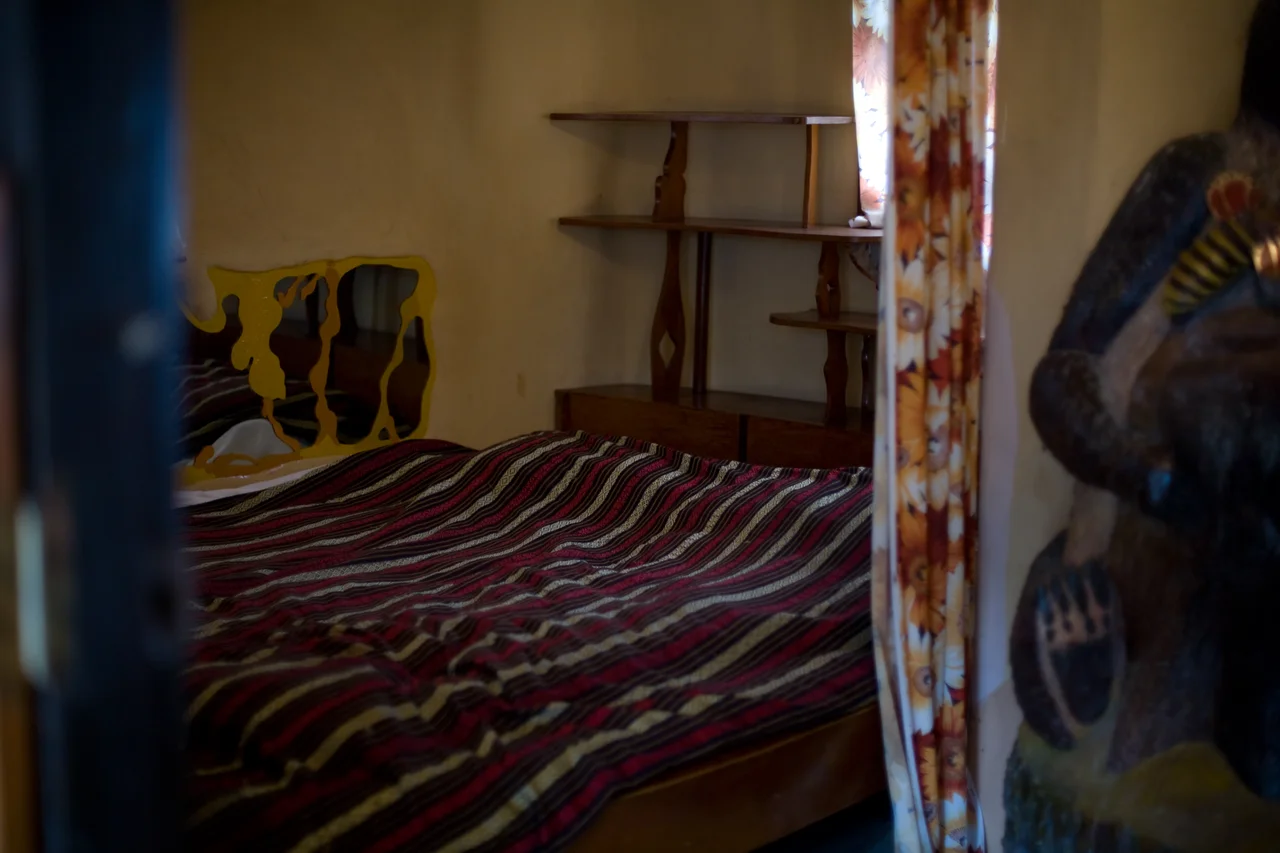
From the street, the Hằng Nga Guesthouse presents itself as an improbability. The five storeys do not rise in any conventional sense; they erupt. The exterior is a sculptural accumulation — cave-shaped stairways, tree-trunk columns, rooms that open like grottoes, surfaces that look cast rather than built. The overall form suggests a giant tree, though the analogy breaks down quickly because no tree has ever incorporated quite this arrangement of animal sculptures, webbed ceilings, and tunneling corridors. Inside, themed guest rooms continue the organic logic: the Eagle Room, the Kangaroo Room, each with its own carved ambiance. The building is a working guesthouse — guests do actually stay here — which adds a layer of surrealism that static art installations cannot achieve. You can sleep inside the Crazy House. Some people do.
Recognition and Controversy
The reception since 1990 has been consistently divided and consistently loud. Early visitors gave the building its nickname; Nga kept it. Guidebooks highlighted it as one of Da Lat's essential stops. In 2009, China's People's Daily listed the Hằng Nga Guesthouse among the world's ten most "bizarre" buildings — an honor that neither praises nor condemns architecture so much as acknowledges that it refuses to be ignored. Critics have found it excessive, even grotesque. Admirers find it liberating, even joyful. What most observers agree on is that it is singular: there is no other building quite like it in Vietnam, or possibly anywhere. That singularity was not accidental. Nga set out to build something unprecedented, ran up considerable debt doing so, and then charged admission to tourists to keep the project alive. The market validated what the critics could not quite categorize.
Da Lat's Other Architecture
The Crazy House is unusual in Da Lat, but Da Lat is itself an unusual city. The French colonial hill station is full of European villas, Gothic churches, and Baroque facades — buildings that were themselves transplanted incongruously into the Vietnamese highlands. Into this landscape of deliberate architectural strangeness, Nga introduced a building that rejected both the colonial and the modernist vocabularies entirely and went back to organic forms: to caves, to trees, to the shapes that exist before architecture imposes its geometry. Whether that reads as rebellion or as continuation depends on your framing. What is certain is that the Hằng Nga Guesthouse has become, in its own way, as much a piece of Da Lat's identity as the French villas that preceded it.
From the Air
The Hằng Nga Guesthouse sits at 11.9347°N, 108.4306°E in the Trại Hầm neighborhood of Da Lat, at an elevation of approximately 1,475 meters. Its distinctive tree-form exterior is visible from low-altitude overflights of the city's residential areas. The nearest airport is Lien Khuong Airport (VVDL), approximately 28 kilometers south. Da Lat's valley sits in the Langbiang Plateau; the city's dense pine-tree canopy covers much of the residential area, making individual buildings difficult to distinguish except during low approaches. The Xuân Hương Lake and the Dalat Palace Hotel lie roughly 800 meters to the northeast, providing orientation landmarks.
Nearby Stories
- Tà Đùng National Park 3.1 km away
- Phan Rang–Tháp Chàm 4.2 km away
- Cam Ranh 18 km away
- Bao Loc 18 km away
- Operation Byrd 23 km away
- Nha Trang Air Base 25 km away
- Bidoup Núi Bà National Park 34 km away
- Duc Lap Camp 43 km away