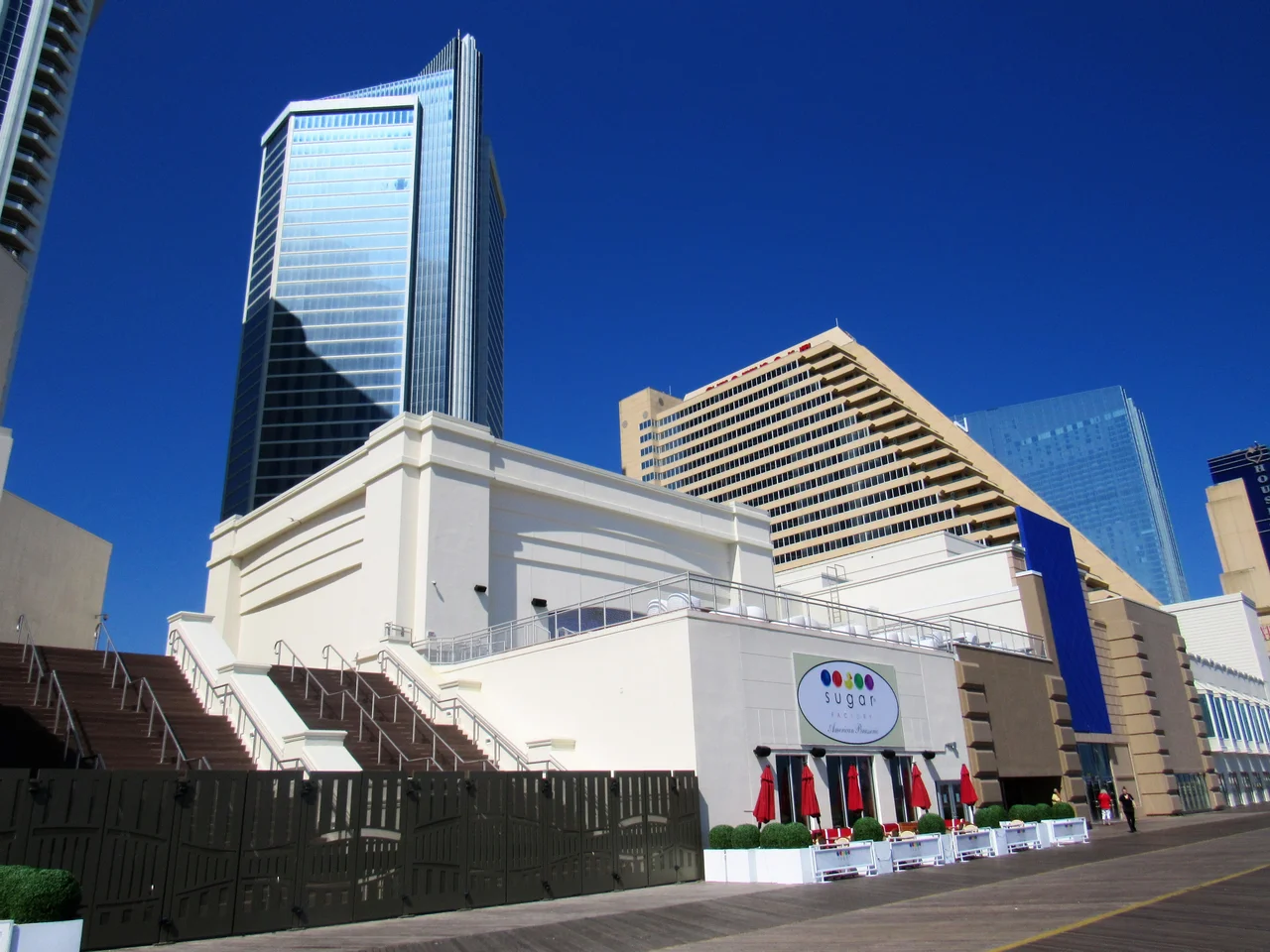

Hard Rock Hotel & Casino Atlantic City
It billed itself, with the unembarrassed bravado that defined the late 1980s, as the eighth wonder of the world. When the Trump Taj Mahal threw open its doors on April 2, 1990, its onion domes and minarets rose above the Atlantic City Boardwalk like a Vegas fever dream transplanted to the Jersey Shore. The chandeliers reportedly weighed nine tons. The opening-day crowds spilled out onto the planks of weathered wood. And the casino - all 120,000 square feet of it - was, at least by its own accounting, the largest in the world. Three decades later, the domes are still there. The name has changed twice. The story keeps getting stranger.
A Billion-Dollar Mirage
Construction began in 1983 under Resorts International, the company that built the boardwalk's first modern casino next door. The original budget was $250 million. By the time Donald Trump wrestled control of the unfinished property away from Resorts in November 1988 - after a bruising takeover battle with television producer Merv Griffin that ended in mutual lawsuits and a settlement - the price tag had ballooned to $930 million. Trump financed the rest with $675 million in junk bonds at 14 percent interest, a financial structure that economists at the time called untenable and that Trump called genius. The casino opened with an elaborate grand ceremony three days after its first roll of the dice. Within eighteen months, it was in bankruptcy. Trump surrendered half the business to bondholders in a 1991 prepackaged restructuring, the first of many corporate reorganizations the property would endure.
The Etess Memorial
Look at the arena tucked into the resort's east side and you find a piece of Atlantic City's saddest aviation history written into the architecture. Mark Grossinger Etess was a Trump Organization executive responsible for bringing championship boxing back to the boardwalk - the marquee fights that made Atlantic City the prizefighting capital of the East Coast in the late 1980s. He was 38 years old when his helicopter went down over New Jersey's Pine Barrens in October 1989, killing him, two other Trump executives, and two crew members. The Taj Mahal was still six months from opening. When it finally did, the main performance venue was named the Mark Grossinger Etess Arena. The name remains today, even though the casino does not. It is a small dignity, an acknowledgment that even the gaudiest empires are built by people, and that some of them never lived to see what they made.
The Long Decline
For a decade after opening, the Taj Mahal was Atlantic City's highest-grossing casino - a distinction it surrendered in 2003 when the Borgata opened in the Marina District and quietly redirected the city's fortunes inland. The Taj responded the way struggling Boardwalk casinos always responded: more rooms, more amenities, more spectacle. The Chairman Tower opened in 2008, pushing the complex past 2,000 rooms. In 2013, the property added the nation's first in-casino strip club. None of it worked. In September 2014 the parent company filed for bankruptcy and announced the casino would close by November unless its unions accepted deep concessions. About a thousand employees marched to Mayor Don Guardian's office that fall to plead for help. The closure was delayed, then delayed again. Billionaire Carl Icahn pledged $20 million in financing at the eleventh hour. The Taj limped on for two more years before shutting down on October 10, 2016, amid a workers' strike. Donald Trump, by then a presidential candidate, said there was no reason for it to close at all.
Rock and Roll Resurrection
On March 1, 2017, the Seminole Tribe of Florida announced through its Hard Rock International brand - along with the Morris and Jingoli families - that it would buy the dormant property and spend $300 million reinventing it. Out came the gold-leaf domes and Mughal kitsch. In came guitars on the walls, a Hard Rock Live concert venue inside the Etess Arena shell, and a sound system tuned to a different decade. The casino reopened on June 27, 2018, a day ahead of schedule. Atlantic City had a strange new resident: a casino dressed up like a music museum, occupying a building still shaped like an emperor's tomb. The Hard Rock launched New Jersey's tenth sportsbook app in January 2019. Scores, the strip club Trump had installed in 2013, closed in January 2020. Robert's Steakhouse followed a month later. The boardwalk kept turning over.
What the Domes Remember
From the Boardwalk, the building still reads as the Taj Mahal - the silhouette is unmistakable, the minarets are still there, the basic geometry remains an emperor's dream rendered in 1980s glass and steel. But step inside and the music is different, the brand is different, the ownership lineage runs through Seminole tribal enterprise rather than Manhattan real estate. The casino's history is a compressed lesson in how Atlantic City has actually worked: spectacular construction financed by spectacular debt, a brief decade of dominance, a long slide, multiple bankruptcies, a closure that felt final, and then someone else buying the carcass for a fraction of its construction cost and starting over. The Mark Grossinger Etess Arena hosts concerts now instead of boxing. The cards are still being dealt. The Atlantic still pounds the beach a hundred yards east. The eighth wonder of the world is on its third name and counting.
From the Air
Hard Rock Hotel & Casino Atlantic City stands at 39.3587°N, 74.4198°W on the northern end of the Atlantic City Boardwalk. From altitude, the resort is unmistakable - the gold-tinted glass towers and the cluster of onion-dome roofs read clearly against the long ribbon of the boardwalk and the sand of Absecon Beach. The complex is north of the main casino strip, sitting between Virginia Avenue and Pacific Avenue. Atlantic City International Airport (ACY) lies about 12 nautical miles west-northwest; the FAA Tech Center is co-located. Recommended viewing altitude: 1,500-3,000 feet AGL. The Absecon Lighthouse is a useful pinpoint just to the north. Watch for the inland marshlands of the Pine Barrens to the west and the broad sweep of the Atlantic to the east.
Nearby Stories
- Cape May 8.1 km away
- A. J. Meerwald 14 km away
- The Pine Barrens: Home of America's Oldest Monster 25 km away
- Hereford Inlet Lighthouse 38 km away
- Constitutional Convention (United States) 50 km away
- PS General Slocum 143 km away
- Wardenclyffe Tower 201 km away
- USS Atik 493 km away