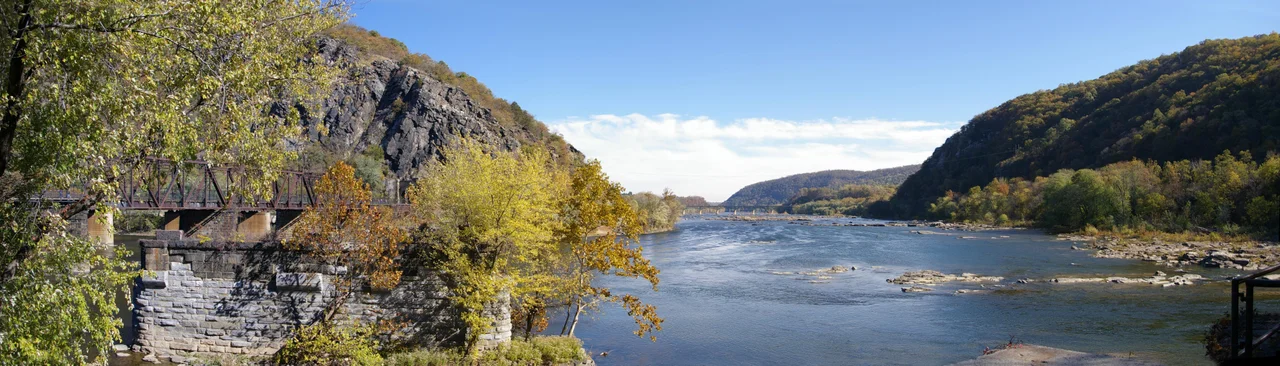

Harpers Ferry National Historical Park
John Brown's prediction was the last thing he wrote. On the morning of December 2, 1859, on his way to the gallows in Charlestown, Virginia, he handed a slip of paper to a guard. I am now quite certain, it read, that the crimes of this guilty land will never be purged away but with blood. He had been captured in a firehouse in Harpers Ferry six weeks earlier by a detachment of United States Marines under a colonel named Robert E. Lee. The firehouse still stands. It is now called John Brown's Fort, and it is the most visited historic site in West Virginia. Sixteen months after Brown was hanged, the country he had warned was at war with itself. Harpers Ferry would change hands eight times before it was over.
The Stupendous Scene
Thomas Jefferson came here in 1783 and wrote that the passage of the Potomac through the Blue Ridge was perhaps one of the most stupendous scenes in Nature. He was looking at a triangle of water and stone: the Potomac flowing east from the Appalachians, the Shenandoah flowing north from the valley that bears its name, and the Blue Ridge opening like a gate to let them meet. The town that grew up at the confluence took its name from Robert Harper, who had operated a ferry there since 1763. George Washington saw something different. He saw waterpower. In 1794 he authorized a federal armory on the spot, and for the next sixty-six years Harpers Ferry produced more than 600,000 muskets and rifles. Meriwether Lewis bought most of the weapons for his expedition west here in 1803, along with a collapsible iron boat frame the blacksmiths built him. John H. Hall pioneered interchangeable parts at the armory between 1820 and 1840. James Burton developed the modern conical bullet here, adopted by the U.S. Army in 1855.
John Brown's Raid
On the night of October 16, 1859, John Brown and twenty-one followers - five of them Black - seized the armory. Brown's plan was to arm enslaved people in the surrounding countryside and lead them in an insurrection. The plan failed almost immediately. No general uprising came. By the morning of October 18, Brown and his surviving men were trapped in the armory firehouse. Robert E. Lee, then a colonel in the United States Army on leave at his Arlington home, was summoned to take command of a detachment of Marines. They battered down the firehouse doors and captured Brown alive. Ten of Brown's men died in the raid, including two of his sons. Brown himself was tried in nearby Charlestown for treason against Virginia and hanged on December 2. The first person killed in the raid was Heyward Shepherd, a free Black baggage handler at the Baltimore and Ohio Railroad station - an irony that historians have wrestled with ever since. Brown's body went home to North Elba, New York. His prediction went everywhere.
Eight Times Over
When Virginia seceded in April 1861, the Federal garrison at Harpers Ferry burned the armory rather than surrender it and pulled out, but they did not destroy everything. Confederate Colonel Thomas J. Jackson - not yet Stonewall - arrived a week later and shipped most of the gun-making machinery south to Richmond. The Confederacy's wartime small-arms industry was built on those crates. Jackson returned in September 1862 to capture the Federal garrison left behind, taking 12,419 prisoners in the Battle of Harpers Ferry - the largest American surrender until Bataan in 1942. Then he marched to Sharpsburg in time for Antietam two days later. By the war's end the town had changed hands eight times. Most of the manufacturing that had made Harpers Ferry a strategic prize was rubble. Virginius Island, the working-class water-powered manufacturing district immediately upstream, never recovered. Successive floods finished what the war started. After the great flood of 1936 not a single structure remained standing on the island.
Storer College and the Niagara Movement
Five years after Lee surrendered, a small school opened on Camp Hill above the ruined town. Storer College was one of the first integrated colleges in the United States - admitting students regardless of race, religion, or sex. Frederick Douglass served as a trustee and delivered a long oration on John Brown there in 1881, calling Brown a man whose zeal in the cause of my race was greater than mine. In August 1906, W.E.B. Du Bois convened the second meeting of the Niagara Movement at Storer - the immediate predecessor of the NAACP. The conference deliberately met in Harpers Ferry to claim John Brown's ground. Du Bois led participants in a barefoot pilgrimage to John Brown's Fort at sunrise. Storer College closed in 1955, one year after Brown v. Board of Education ended legal school segregation. Today the Stephen T. Mather Training Center, where the National Park Service trains its rangers, occupies the old Storer campus. The park, established as a National Monument in 1944 and elevated to a National Historical Park in 1963, now covers nearly 4,000 acres across West Virginia, Maryland, and Virginia. About half a million people visit each year - to walk Shenandoah Street, to stand on the Point where the two rivers meet, to climb to Jefferson Rock for the view he called stupendous, and to look at a small brick firehouse where a man with a long beard waited for the country to catch up with him.
From the Air
The park spans the confluence of the Potomac and Shenandoah rivers at approximately 39.32 degrees N, 77.73 degrees W, where West Virginia, Maryland, and Virginia meet. The town sits in a bowl flanked by Maryland Heights to the north, Loudoun Heights to the south, and Bolivar Heights to the west. From 3,500 to 6,000 feet AGL the three peaks frame the river junction in dramatic relief. The Appalachian Trail crosses the park. Nearby airports include Frederick Municipal (KFDK) 20 miles east, Hagerstown Regional (KHGR) 25 miles north, Winchester Regional (KOKV) 25 miles southwest, and Leesburg Executive (KJYO) 30 miles east-southeast. Watch for restricted P-40 airspace over Camp David to the north.
Nearby Stories
- Great Falls, Virginia 4.6 km away
- Battle of Middleburg 11 km away
- Gettysburg: The Three Days That Decided America 31 km away
- Literary Hall 31 km away
- Great Falls Park 33 km away
- Camp David: Where Presidents Escape and History Gets Made 36 km away
- Bryce Resort 39 km away
- Gravity Hill 54 km away