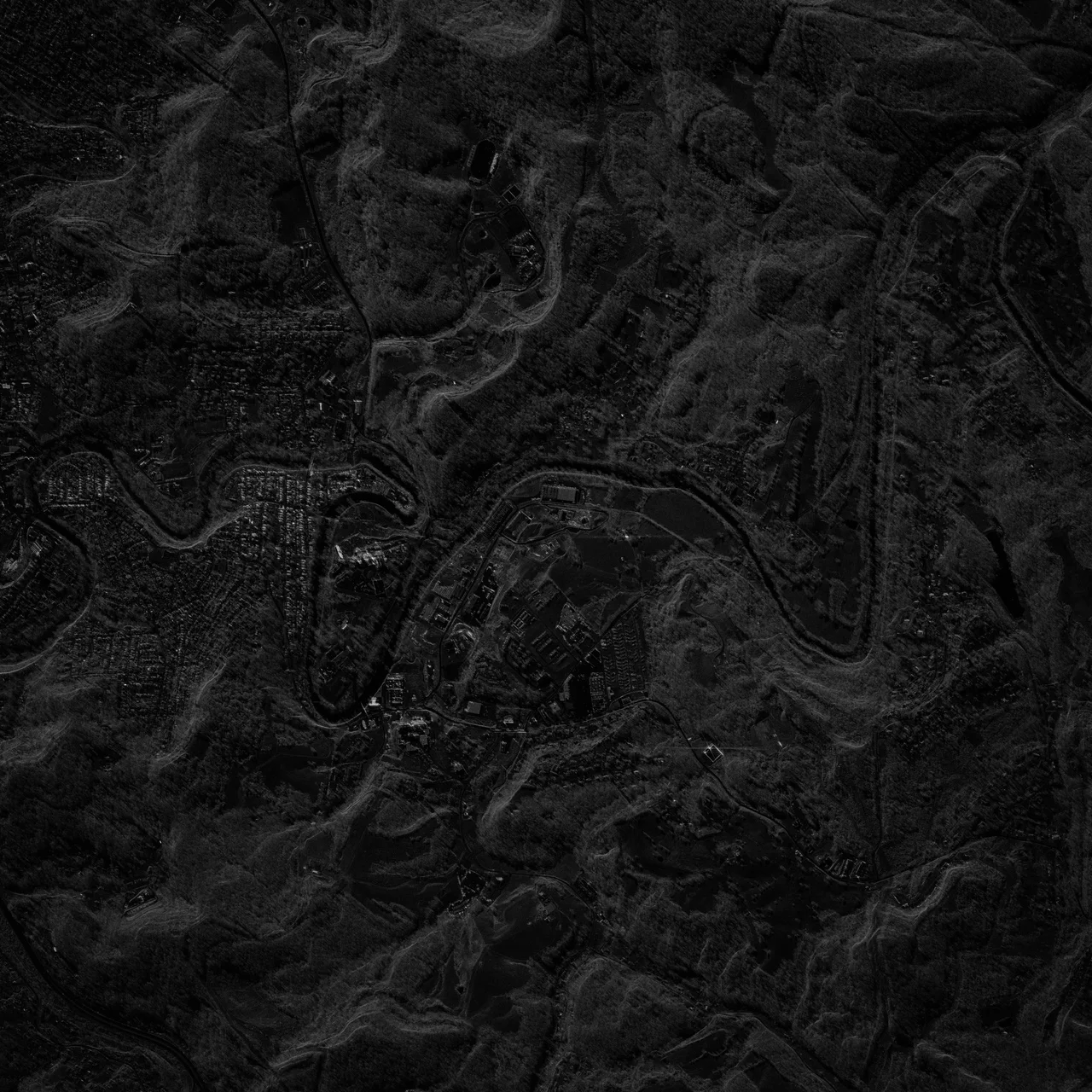

Harrison County, West Virginia
John Simpson built the first cabin at the mouth of Elk Creek in 1763 or 1764. He owed a man named Cottrial one quart of salt, a substantial debt in a country with no currency and no nearby supply. When Simpson returned from Winchester with goods to settle the debt, an argument broke out. Cottrial grabbed Daniel Davisson's rifle, which was leaning against the cabin, and aimed at Simpson through the gap between the logs. Simpson moved faster, sprang outside, grabbed the gun from Cottrial's hands, and killed him. It was the first homicide recorded in what is now Harrison County, West Virginia. The settlement that grew from those early cabins became Clarksburg, the county seat - and the county itself, organized in 1784, was named for Benjamin Harrison V, the Virginia governor who would father William Henry Harrison and great-grandfather Benjamin Harrison, two future U.S. presidents.
Before the Settlers
Indigenous peoples lived in the area now called Harrison County for thousands of years. The most visible surviving evidence is the Oak Mounds, a complex of Hopewell-culture earthen mounds outside Clarksburg, built in the first millennium CE by a sophisticated mound-building society whose trade networks extended across much of eastern North America. The Hopewell people farmed, hunted, fished, and constructed ceremonial earthworks of remarkable engineering. They eventually disappeared from the historical record around 500 CE, replaced by later Indigenous cultures who continued to live in and use the country through the contact period. By the time English-speaking trappers arrived in the 1760s, the area was lightly populated but actively used by various Native nations, particularly the Mingo, Shawnee, and Lenape, who hunted there seasonally.
Carved Out of Virginia
Harrison County was organized in 1784, three years after the British surrender at Yorktown. The territory was partitioned from Monongalia County - itself only eight years old at that point - which had been carved from Augusta County, the enormous original Virginia jurisdiction that nominally stretched from the Shenandoah to the Mississippi. The new county was named for Benjamin Harrison V, who had just retired as governor of Virginia and was a signer of the Declaration of Independence. The first meeting of the Harrison County court was held on July 20, 1784, at the home of George Jackson. The court designated Clarksburg, named for the Revolutionary War general George Rogers Clark, as the county seat. The town was chartered by the Virginia General Assembly in October 1785 and incorporated in 1795. Over the next 72 years, eight present-day West Virginia counties and parts of ten others would be carved out of this original Harrison County.
Railroads and the Italian Wave
The Northwestern Turnpike connecting Winchester and Parkersburg reached Clarksburg in 1836, opening the town to eastern markets. The Baltimore and Ohio Railroad arrived in 1856, and Harrison County's economic trajectory shifted decisively upward. The railroad made commercial coal mining and timber production possible by giving the operators a way to move bulk product to markets in Baltimore, Pittsburgh, and the Great Lakes industrial cities. The discovery of natural gas and oil in the 1890s added a second economic wave on top of the first. Italian immigrants arrived in numbers between 1890 and 1924 to work the mines, glass factories, and construction projects; their descendants now constitute one of the largest Italian-American populations of any small-city region in the eastern United States, and the West Virginia Italian Heritage Festival in Clarksburg every Labor Day draws crowds of more than a hundred thousand.
The People Harrison County Produced
For a small north-central West Virginia county, Harrison has produced a striking number of nationally consequential figures. Stonewall Jackson, the Confederate general, was born here in Clarksburg in 1824. Joseph Johnson, the only governor of Virginia ever from the trans-Allegheny region, was a Harrison County farmer, businessman, and U.S. Representative. John W. Davis, born in Clarksburg in 1873, was the Democratic Party's presidential nominee in 1924 (he lost decisively to Calvin Coolidge) and went on to argue more than 140 cases before the U.S. Supreme Court, including the segregationist side of Brown v. Board of Education. Jennings Randolph, born in Salem in 1902, served in the U.S. House from 1933 to 1947 and in the Senate from 1958 to 1985. Cyrus Vance, born in Clarksburg in 1917, served as U.S. Secretary of State under Jimmy Carter and resigned in 1980 over the failed Iran hostage rescue. Guy Goff and John S. Carlile both served in the U.S. Senate. The county's contribution to American national life is disproportionate to its modest population.
Harry Powers and The Night of the Hunter
The county also produced Harry Powers, one of the more infamous serial killers in early-twentieth-century American crime. Powers operated through lonely-hearts personal ads in the 1920s, corresponding with women who were widowed, divorced, or otherwise vulnerable; he convinced several to come visit him at his farm in Quiet Dell, just south of Clarksburg. He murdered them and buried them on the property. He was arrested in 1931 after one of the women's families became suspicious; investigators found multiple bodies in a hidden cellar under his garage. He was tried, convicted, and hanged at the Moundsville Penitentiary in 1932. The case became one of the most-reported crime stories of the year. Davis Grubb, a West Virginia novelist who had been a child in nearby Moundsville during the trial, drew on the Powers case for his 1953 novel The Night of the Hunter, which Charles Laughton adapted in 1955 into the dark, lyrical film classic starring Robert Mitchum as the murderous Preacher Harry Powell. The film's Preacher Powell is a fictionalized composite, but Harry Powers of Quiet Dell is at the dark heart of the source material.
The Modern Corridor
Modern Harrison County has a population of about 65,921, the seventh-most-populous county in West Virginia. Its economic center of gravity has shifted east from Clarksburg to Bridgeport along the I-79 corridor. The North Central West Virginia Airport at Bridgeport offers commercial flights; the FBI's CJIS (Criminal Justice Information Services) complex at Clarksburg, opened in 1995, employs more than 2,500 people and handles fingerprint and criminal background checks for the entire United States; the United Hospital Center is a $278 million regional medical facility; the Charles Pointe master-planned community spreads across 1,700 acres of mixed commercial, residential, and recreational development. The I-79 corridor through Harrison County is sometimes called the I-79 Technology Corridor or Mountaineer Country. It is the largest concentration of high-skill, high-wage employment in north-central West Virginia, and one of the few parts of the state that has experienced genuine economic growth in the past quarter century.
From the Air
Harrison County centers around 39.29 N, 80.38 W in north-central West Virginia. Best viewed at 3,500-5,000 feet AGL; the West Fork River traces the county's central spine, with Clarksburg at the confluence of Elk Creek and the river. Nearest airport: North Central West Virginia Airport (KCKB) about 5 nm east of Clarksburg at Bridgeport. I-79 traces a clear north-south line through the county; US-50 runs east-west through Clarksburg. The terrain consists of rolling, wooded hills, with the highest point at 1,736 feet in the southern corner. Look for the dense suburban grid of Bridgeport along Emily Drive, contrasting with the older urban core of Clarksburg to the west.
Nearby Stories
- Buckhannon 9.3 km away
- North Bend Rail Trail 9.6 km away
- State of Kanawha 12 km away
- West Virginia Maneuver Area 13 km away
- Cathedral State Park 23 km away
- Battle of Fort Necessity 35 km away
- West Virginia Penitentiary 54 km away
- Gnadenhutten Massacre 102 km away