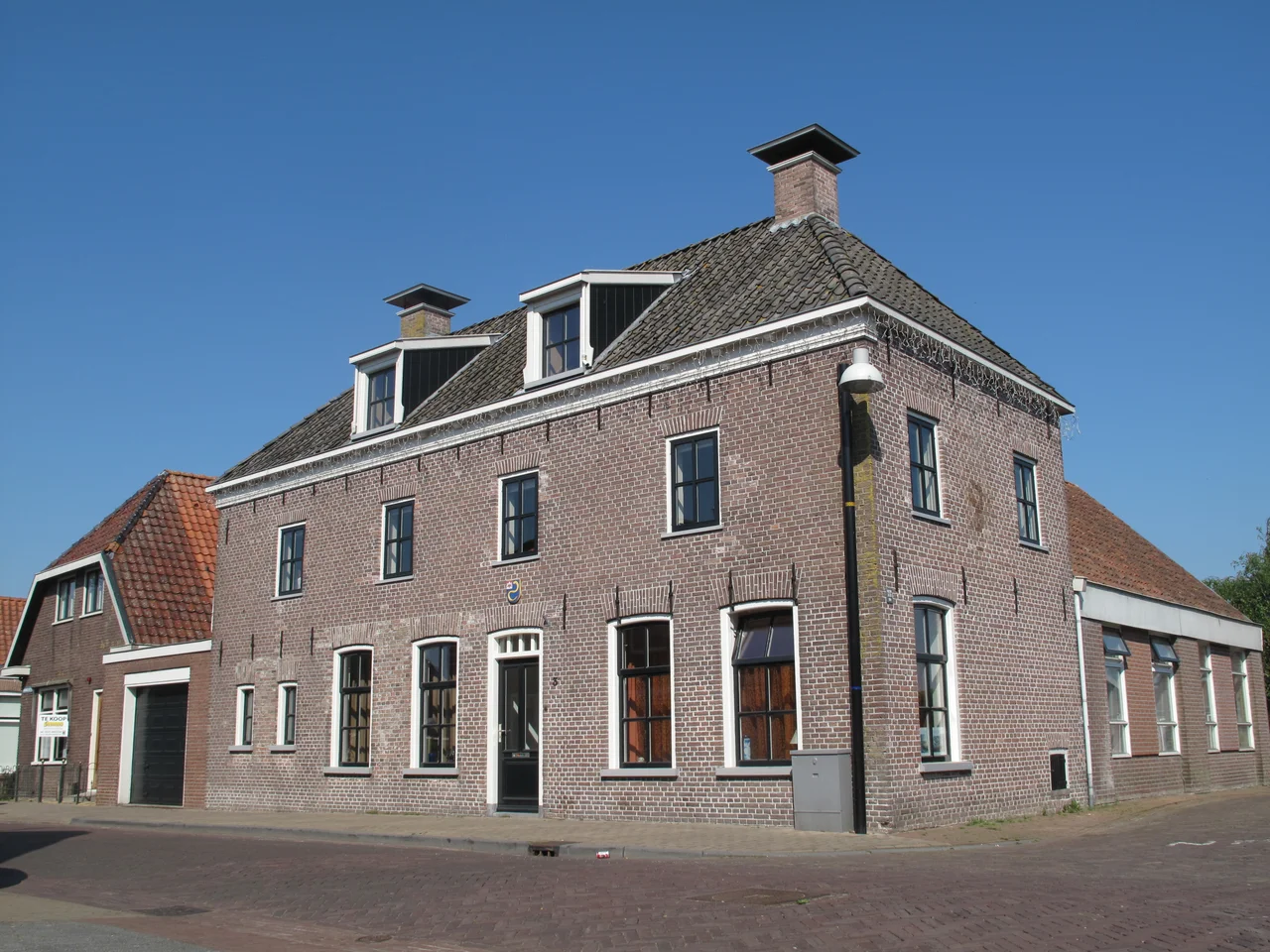

Heeg
For most of three centuries, the children of Heeg learned English at primary school. Not French, not German, English - because Heeg was an eel town, and Heeg's eels went to London. From the seventeenth century until 1938, flat-bottomed Frisian barges called palingaken left the harbour on the Heegermeer with live cargo, sailed across the Zuiderzee, threaded the English Channel, and tied up at a wharf on the Thames just downriver of the Tower of London. The Dutch had their own dedicated mooring there, the Dutch Landing, granted by long-standing treaty. A village of fewer than two thousand people, deep inside Friesland, taught its children English because their fathers and uncles spent half the year unloading slithering wooden tanks of eel for London fishmongers. The trade did not survive the twentieth century. The English lessons did, for a while.
A Lake Full of Eels
Heeg sits on the western shore of the Heegermeer, one of the chain of shallow lakes that stitches together the south-west of Friesland. The water is dark, weedy, and historically full of European eel - a creature with one of the strangest life cycles in the natural world, hatching in the Sargasso Sea, drifting on Atlantic currents to European rivers, growing into adults in lakes like the Heegermeer, then swimming back to the Sargasso to spawn and die. For Frisian fishermen the eels were a reliable harvest, smoked and sold locally for centuries. The breakthrough came in the seventeenth century, when Heeg's shipwrights figured out how to keep the catch alive on a long sea voyage. They built the palingaak, a sturdy single-masted boat with a flooded compartment in the hold - essentially a wooden aquarium with sail and rudder. Fresh seawater flushed through the well as the boat moved. The eels stayed alive all the way to London.
The Dutch Landing on the Thames
By 1830 the Dutch eel boats had a permanent berth on the Thames in the Pool of London, just below Tower Bridge - the Dutch Landing, where palingaken from Heeg, Workum, and a handful of other Frisian villages took their turn at the wharf and sold their cargo directly to English buyers. A reproduction of one of these vessels, the Korneliske Ykes II, was launched at the Piersma shipyard in Heeg in 2009. She is still flat-bottomed, still single-masted, still has a flooded well at her heart - a working museum that occasionally sails Frisian regattas. The original trade ended in 1938. Stricter sanitary regulations, refrigeration, the slow collapse of London's wholesale fish trade, and the rising suspicion that European eel stocks were no longer infinite all played their part. The Second World War sealed it. The last live cargo from Heeg never made the return trip.
A Hedge, a Hill, or a Church
The name of the village has its own small mystery. The oldest documentary trace is Hagekerke, recorded in a forged charter dated 1132. Later spellings include Haghekercke and Hagakerke. Then, in 1389, the kerk - church - drops out of the name. By 1505 the village is Heech, and 74 years after that it has settled into Heeg. Linguists offer two theories. One holds that haga means hedge, and the church was simply the one surrounded by a hedge. The other proposes an older Frisian word hag, meaning a small height - the church on the hill, in a country where any rise above sea level qualifies. The village has lived too long with both possibilities to commit to either. The current St Jozefkerk and the Ichtuskerk stand a few hundred metres apart, neither of them surrounded by hedges, neither of them on a meaningful hill.
Three Hundred Years of Boats
Piersma shipyard, established more than three hundred years ago, is still the best-known yard in Heeg and still specialises in flat-bottomed Frisian craft - skutsjes for the regional racing fleet, traditional yachts in oak and pine, the occasional commissioned palingaak. The yard is the kind of family business that has outlived empires. Around it, modern Heeg has reorganised itself as a watersports village. Marinas line the harbour. Sailing schools run summer programmes for children from all over the Netherlands. The WSHeeg sailing club is one of the older clubs in Friesland, and the village supports football, volleyball, tennis, gymnastics, and an ice-skating club for whatever weeks of winter the climate still delivers. About 2,175 people lived here in January 2017. The number drifts up in summer, when the marinas fill and the harbour becomes briefly Mediterranean.
What the Dutch Reformed Church Watches
In the centre of Heeg, a handful of 18th-century buildings survive - including the Dutch Reformed Church, dated 1745, plain and brick and high-windowed like every other Frisian village church. The view from its small bell tower is essentially the view that Heeg's eel skippers came home to: low green farmland, the broad polished surface of the Heegermeer, the masts of yachts in the harbour, and beyond all of it the flat horizon that the people of this part of the world have spent a thousand years rearranging. Until 2011, Heeg was part of the Wymbritseradiel municipality. It is now part of Sudwest Fryslan, a larger administrative consolidation. The villagers, by long custom, refer to themselves by neither name. They are simply Hegemers - the people of Heeg, who once spoke English to London fishmongers and still know how to handle a flat-bottomed boat in a stiff breeze.
From the Air
Heeg sits on the Heegermeer in southwest Friesland at 52.97N, 5.61E. EHLW (Leeuwarden) is 28km north; EHGG (Groningen-Eelde) 55km northeast; EHLE (Lelystad) 40km southwest across the IJsselmeer. Best approach is low along the chain of southwest Frisian lakes - Heegermeer, Slotermeer, Tjeukemeer - which thread together east of Sneek. Look for the marinas crowded along the village's eastern waterfront and the Piersma shipyard at the harbour. Skutsje sailing races on the Heegermeer are visible from the air on summer weekends; classic flat-bottomed Frisian boats in tan and ochre sail against the green polder backdrop.
Nearby Stories
- Broeksterwâld 1.8 km away
- Rede van Texel 3.6 km away
- Heerenveen 6.1 km away
- North Holland 9.6 km away
- Zuiderzee Museum 11 km away
- Het Bildt 14 km away
- Meppel 15 km away
- Antiope 80 km away