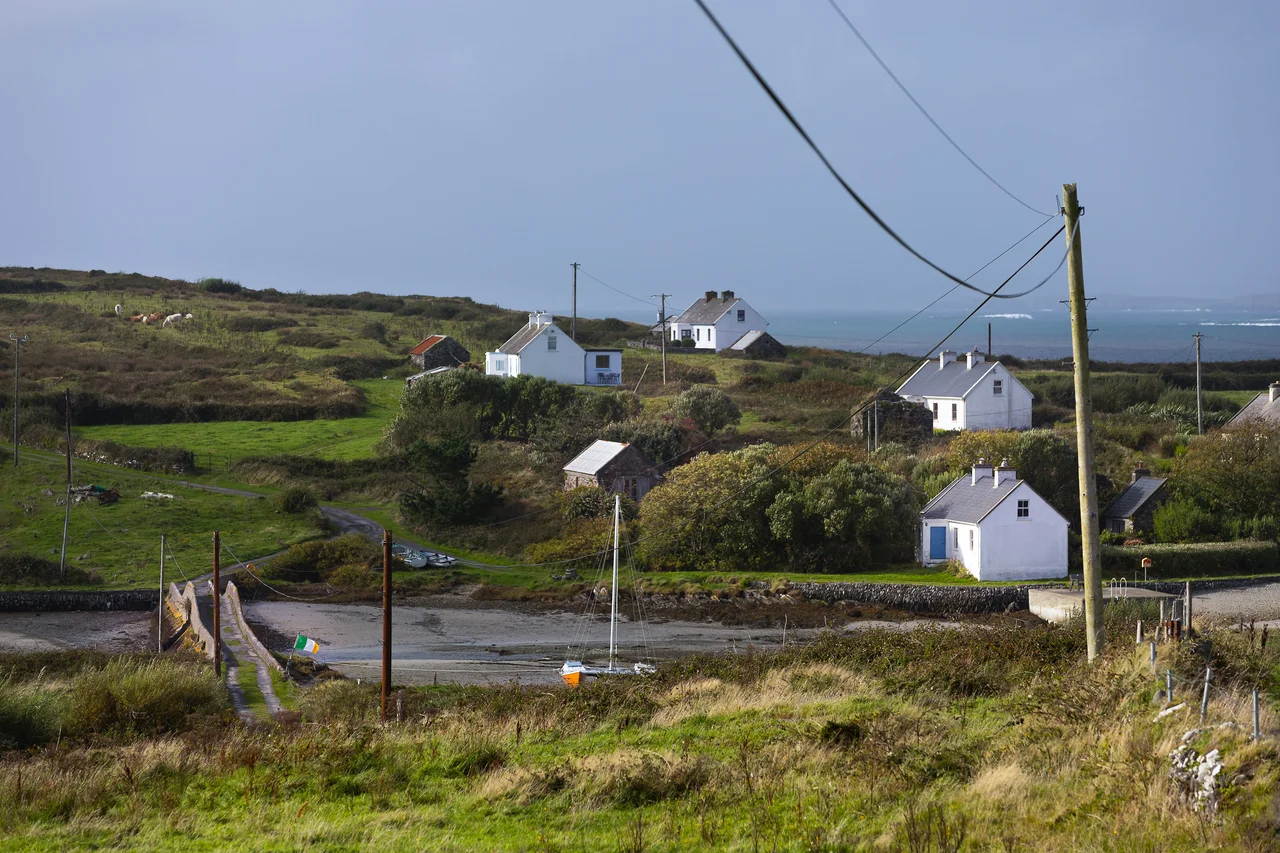

Heir Island
The hamlet on Heir Island is called Paris. This is not a joke. It is the main residential area on a 2.5-kilometre island that had four hundred people on it in the 19th century and has somewhere between twenty-five and thirty now, and it was once the centre of the island's fishing trade -- the place where the day's catch came in, where the pilchards were pickled and barrelled, and where the lobster boats made up their nets. The name's origin is forgotten. The fishing is gone. But Paris is still on the map.
Towelsail Yawls
Before motorboats, lobsters around Heir Island were caught from a craft called the towelsail yawl -- a two-masted, gaff-rigged boat about thirty feet long, carrying a crew of three and a train of thirty or so willow lobster pots. The boats worked in convoys, multiple vessels roped together in trains, sometimes for three weeks at a stretch between May and August. The crew's only shelter from the weather was a canvas teabhal sail spread tent-fashion at the bow of the boat -- the name anglicised over time into towelsail. They cooked on coal and turf and wood. Fish caught in the north, up as far as Dursey Island, was sold into Baltimore; the eastern catch, from down towards Ardmore, went to Cobh or Kinsale. In summer the yawl fishermen would race their boats at the Baltimore and Schull regattas, which were the social events of the West Cork year. The boats are gone. The tradition is mostly remembered now as belonging to Heir.
Four Hundred to Thirty
At its peak Heir Island carried about four hundred people. The McCarthys and the O'Neills are the surnames that everyone remembers; the O'Neills ran the post office. Life was fishing or farming, neither of which on a small Atlantic island made much of a living, and by the 19th century the young people had begun the long Irish drain to England, the United States, Australia. The houses they left behind sat empty until the 1960s, when most of them were sold off and bought up as holiday homes. Many were restored carefully, retaining their original character. The result is an island where the old place names still mean something -- where you can walk past the schoolhouse and the schoolmaster's house on the main road, where the ruined cottages and the still-lived-in ones share the same hedgerows -- but where the permanent winter population could fit comfortably into one of the larger cottages.
Two Hundred Wildflowers
Heir is one of the seven inhabited West Cork islands. It has twenty-three beaches for an island measuring two and a half kilometres by one and a half, which is to say it is mostly beach. The largest, Trá Bán -- the Sandy Beach, on the eastern side facing Baltimore across the channel -- is the landing point for small craft in summer. There are cliffs on the south-western tip, at a point called The Dún. The island is small enough to walk in an afternoon and varied enough to support coastal, forest, marsh, and heathland ecosystems, with over two hundred species of wildflower recorded. Bird-watchers come for the variety; over the water, Mount Gabriel rises behind Schull on the opposite shore. There is no pub on Heir, but there is a sailing school, an art gallery, a holistic therapy centre, holiday rentals, a couple of restaurants and the ruined ones, and as of 2023 a scattering of picnic tables installed deliberately to invite people to stay for the afternoon.
The MV Thresher
The link to the mainland is the MV Thresher, a small ferry running from Cunnamore Pier on the mainland six times a day in summer, every two hours from 8am to 6pm. The service has been subsidised by the relevant Irish government department since 2003 and crossed its hundred-thousandth passenger in 2013, which is a lot of people for a fifteen-minute crossing. A second boat, the MV Boy Colm, runs additional services from Baltimore and Cunnamore in July and August. A third, the MV Norvic, runs angling and eco-tours around Roaringwater Bay. After 8pm there is one evening sailing by booking. The mainland electricity arrives by submarine cable, the only direct link other than the boats. In summer the holiday homes fill and the population swells to about a hundred and fifty -- a real island in winter, a particular kind of West Cork retreat in summer.
From the Air
Heir Island is located at approximately 51.50N, 9.43W in Roaringwater Bay, southwest County Cork, between Baltimore and Schull. Cork Airport (EICK) is roughly 95 km east-northeast; Kerry Airport (EIKY) about 95 km north-northwest. From the air, look for an elongated low green island lying east-west, about 2.5 km long, surrounded by the smaller islets of Carbery's Hundred Isles. The Sandy Beach on the eastern shore (facing Baltimore) is a distinctive light-coloured strip. Mount Gabriel rises 407 metres immediately to the north behind Schull on the mainland. Best in clear westerly conditions; Atlantic fronts can close the area down quickly.
Nearby Stories
- Bear (barony) 2.5 km away
- Castle Donovan 2.7 km away
- Bandon, County Cork 8.1 km away
- HMHS Llandovery Castle 14 km away
- The Sinking of the Lusitania: The Torpedo That Changed the War 17 km away
- Wolfpack Prien 61 km away
- SM U-27 111 km away
- 1356 Lisbon Earthquake 1629 km away