
Hell-Bourg
The name sounds like a warning, but it honors a man. Hell-Bourg takes its title from Anne Chrétien Louis de Hell, a French admiral who governed the island of Bourbon - Réunion's old name - from 1838 to 1841. The village he lent his name to is anything but hellish. It sits deep inside the Cirque de Salazie, one of the three colossal valleys that collapsed out of Réunion's central volcano, its painted wooden houses ringed by sheer green walls down which dozens of waterfalls pour after rain.
A Spring Everyone Already Knew
The village began with hot water. Europeans recorded the discovery of a thermal spring near the future Hell-Bourg around 1830 and set about building a spa around it. But the spring was no secret. It had long been known to the local people and to enslaved Africans and Malagasy on the island, who used its waters to ease their ailments. One colonial administrator fretted, in the cold language of the era, that it would be hard to turn the place into a respectable spa while enslaved people suffering from leprosy and ulcers were bathing in it - a remark that reveals, in passing, both the casual cruelty of the time and the simple human fact that the sick and the enslaved had found relief here first. The official version of Hell-Bourg's history begins with its European 'discovery,' but the water had been healing people long before anyone thought to build a casino beside it.
The Spa of the Indian Ocean
Once the colonial authorities committed, the village rose quickly. A hotel was ordered in 1839, a military hospital tied to the spring was finished in 1857, and in 1852 a company was formed to build the thermal establishment proper, complete with a casino and a director's house. A carriage road finally reached the remote village in 1890. By then Hell-Bourg's baths were famous across the southern hemisphere. Wealthy vanilla planters from Réunion's east came to take the waters, and so did travelers from South Africa, Kenya, and Mozambique, drawn by spas marketed as a cure for the fevers that plagued Europeans in the tropics.
When the Mountain Closed the Tap
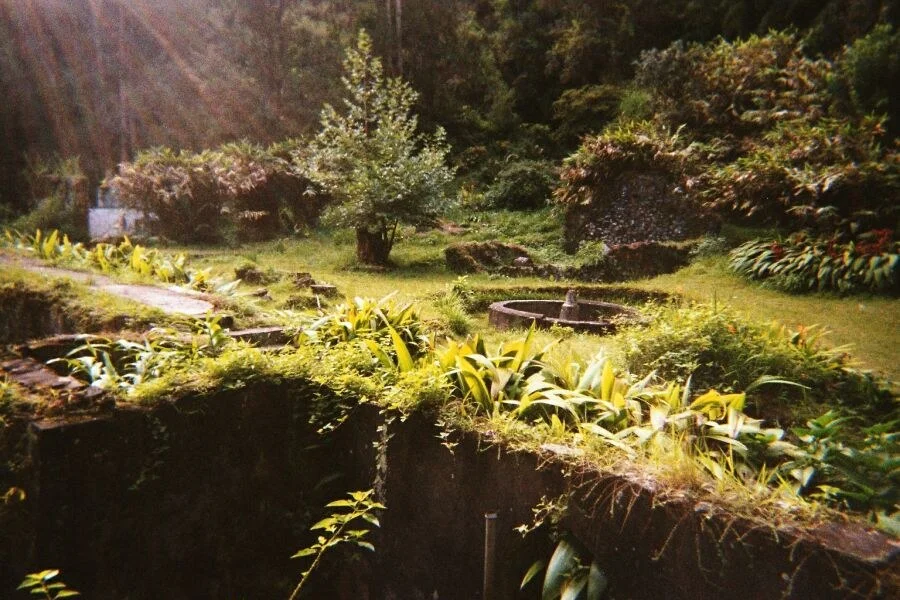
The good times did not last. In 1948, a cyclone-driven landslide buried the spring for good, and without its waters the village lost the very thing that had built it. The grand thermal establishment fell silent, and the jungle began to reclaim the old spa - whose overgrown ruins still stand at the edge of the village, slowly dissolving into the green. Hell-Bourg might have faded entirely. Instead, cut off and left behind, it simply stopped changing - and that accidental preservation became its salvation.
The Most Beautiful Village
In 1999, Hell-Bourg was admitted to Les Plus Beaux Villages de France, the association of France's most striking small communities - and it remains the only village in Réunion, and the only one in all of overseas France, to hold the label. To keep it, the village hides its modern fittings: there are almost no visible telephone or power poles among the brightly painted nineteenth-century Creole houses. Today it lives on hiking and heritage. Trails climb from here to the Piton d'Anchaing in the heart of the cirque and onward to Piton des Neiges, and visitors wander a famously colorful cemetery and small museum. The chou chou vine - the chayote squash - climbs over fences and gardens, a quiet green emblem of a village that turned being forgotten into being treasured.
From the Air
Hell-Bourg lies within the Cirque de Salazie at approximately 21.07°S, 55.52°E, about 930 m (3,051 ft) above sea level, hemmed in by near-vertical cirque walls - demanding terrain with limited escape routes. The Piton des Neiges massif (3,069 m) rises immediately to the south. Cloud floods the cirques from late morning and waterfalls thread the walls after rain, so clear views are a dawn affair. Nearest airport is Roland Garros / Saint-Denis (ICAO FMEE) on the north coast; Pierrefonds / Saint-Pierre (ICAO FMEP) lies to the south. The lush, waterfall-streaked amphitheater of Salazie is the standout visual landmark.
Nearby Stories
- Tromelin Island: The Forgotten Enslaved People of the Isle of Sand 540 km away
- Battle of Tamatave 644 km away
- Toamasina 688 km away
- Canal des Pangalanes 742 km away
- Fianarantsoa 858 km away
- Siege of Galle (1640) 3989 km away
- Galle Fort 4010 km away
- French Western Australia 5783 km away